A stomping good time, all for a good cause

No toes were harmed in Alzheimers fundraiser

Advertisement

Advertise with us

When I became a crusading newspaper columnist more than a decade ago, I didn’t realize the job would involve so much grape-stomping.

Read this article for free:

or

Already have an account? Log in here »

To continue reading, please subscribe:

Subscribe and receive a limited-edition Free Press branded hat or tote.

Digital Subscription

One year of digital access for only $205*

  • Enjoy unlimited reading on winnipegfreepress.com
  • Read the E-Edition, our digital replica newspaper
  • Access News Break, our award-winning app
  • Play interactive puzzles

*First annual payment billed as $205.00 + GST for one year. This annual subscription will automatically renew at $233.00 + GST every 52 weeks (10% off the regular annual price of $259.35). Offer available to new and qualified returning subscribers only. Cancel any time.

To continue reading, please subscribe:

Add Free Press access to your Brandon Sun subscription for only an additional

$1 for the first 4 weeks*

  • Enjoy unlimited reading on winnipegfreepress.com
  • Read the E-Edition, our digital replica newspaper
  • Access News Break, our award-winning app
  • Play interactive puzzles
Start now

*Your next Brandon Sun subscription payment will increase by $1.00 and you will be charged $17.95 plus GST for four weeks. After four weeks, your payment will increase to $24.95 plus GST every four weeks.

Opinion

Hey there, time traveller!
This article was published 29/09/2018 (2848 days ago), so information in it may no longer be current.

When I became a crusading newspaper columnist more than a decade ago, I didn’t realize the job would involve so much grape-stomping.

The unvarnished truth is I am starting to lose count of the number of times I have been invited to climb into a barrel and make wine with my feet in support of worthy causes.

For the uninitiated, thrashing around in a sea of ice-cold grapes is easily 100 pounds of fun in a 50-pound barrel, but it is also an activity fraught with peril.
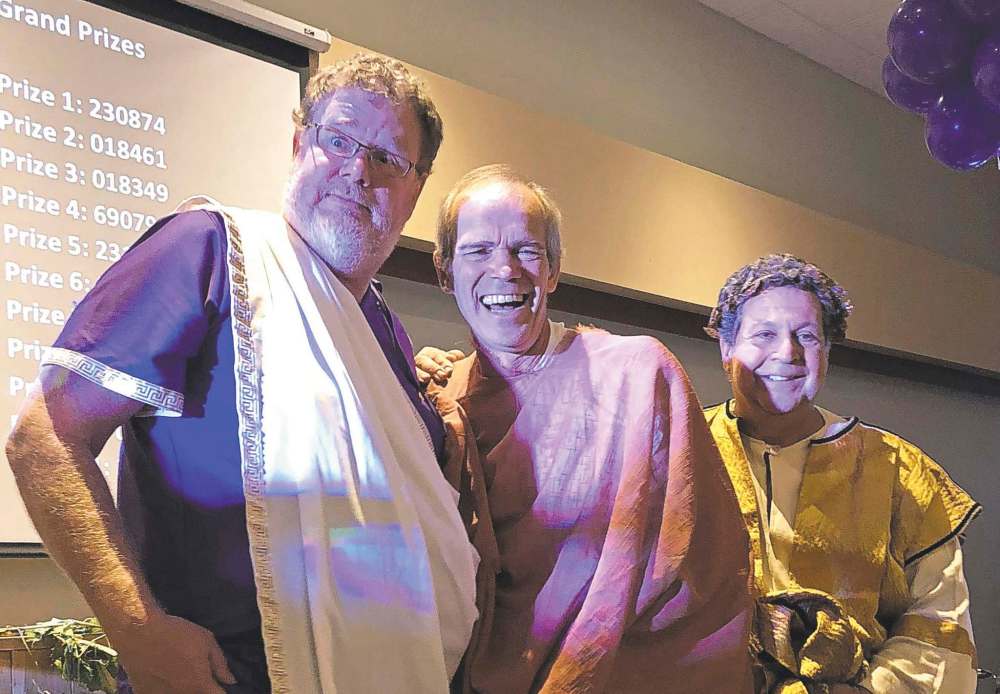
Doug Speirs (from left), Bob Cox and Joe Grande stomp grapes at the Stomp to Remember fundraiser for Alzheimer Society Manitoba. (Supplied)

I say that because the first time I stomped was in support of Special Olympics Manitoba, and when I was finished, I discovered I had managed to break my big toe by smashing it into the side of the barrel.

When I got home and displayed my mangled digit, which resembled a mutant black-and-purple eggplant, to my wife, She Who Must Not Be Named, she simply frowned at me and declared, “You’re an idiot.”

For the record, that was the same response I got a few weeks later when I turned to my spouse for sympathy after being the only guy at a women-only pole-dancing class, wherein I bruised an area of my anatomy I will describe as the “Maximus Buttoculus” after plummeting to the floor while attempting a manoeuvre known as the “fireman.”

Getting back to my point, however, I once again found myself spending time in the barrel last week when I agreed to be the MC for Mona Lisa Ristorante’s Stomp to Remember, a grape-stomping gala dinner in support of the Alzheimer Society of Manitoba.

It was a Roman-themed affair, which meant almost everyone at the fundraising dinner was decked out in a toga, many cobbled together from bedsheets or table linens. What with being the master of ceremonies, I decided to impress everyone by shelling out $14.99 for an authentic plastic Roman centurion’s helmet from a party store, along with a very realistic $3.99 plastic Roman sword.

It is difficult, using mere words, to describe how thrilling it was to watch a bunch of toga-clad human beings attempting to remain in the upright and locked position while simultaneously flailing around to pounding rock music in a barrel containing 36 cases of imported grapes, but I will try: it was very, very thrilling!

There’s nothing my buddy Joe Grande, Mona Lisa’s ebullient owner, enjoys more than stomping grapes with friends and family, because it takes him back to his childhood days in the village of Amato in southern Italy.

“The town made community wine,” Joe, who arrived at the stomp on top of a chariot and dressed like a Roman emperor, told me. “They’d all go to the centre of town and stomp grapes in big tubs.

“My uncle picked me up and plopped me in the tub. I was pretty much up to my neck in grapes. I was only five or six. It was like quicksand for me, but they were singing and dancing because it’s a fun thing. When we left Italy for Canada, that memory stuck with me.”

In the 35 years he’s been running his Corydon Avenue landmark, Joe has helped out a lot of charities, but raising money for families affected by Alzheimer’s, the most prevalent form of dementia, is intensely personal because his 86-year-old father, Angelo, is struggling with the disease.

“My father came down with the illness about seven years ago,” Joe told me in a quiet moment. “When he first got it, it didn’t seem that bad a disease, but as time goes on and as they go through more stages, it becomes more difficult.

“The changes in people’s lives are hard to comprehend. My dad can’t do the things he used to do. My mother now has to be a totally different person — the things my dad used to do, she has to do now, like all the banking.”

That’s the cruel truth about this degenerative brain disease: it doesn’t just affect individuals, it profoundly affects families.

“It’s really hard when your father sees you and doesn’t recognize you for the first time and doesn’t know your name,” Joe said softly. “You are already starting to lose your father before he’s even passed away.

“My father is still alive, but I haven’t had a father for over five years that I can go see and ask for advice.”

My effusive buddy is the kind of overtly passionate guy who will hug anyone who wanders within a 30-yard radius, so it was impossible for him to hide his joy when he informed me the Stomp to Remember managed to raise $32,000 to help families affected by Alzheimer’s.

I am also pleased to inform you that, as far as I know, no one broke a toe or mangled any other medically important appendages while thrashing about in the gigantic wooden barrel parked on the crowded stage at the Caboto Centre.

Accompanied by my buddy Bob, who also happens to be my boss, I managed to spend roughly two minutes turning grapes into wine, and my Hobbit-sized feet into blocks of purple ice.

“I can no longer feel my feet!” is what Bob declared as we gingerly climbed out of the slippery barrel. Bob is an extremely fit human being, but my heart was pounding like the drummer for a heavy metal band because stomping is pretty intense cardiopulmonary exercise.

The highlight for me came when we got to sit down and have toga-clad volunteers gently scrub our feet with warm water to wash away the mucus-like layer of grape slime.

The grapes were cold, but when we stomped away, our hearts felt more than a little warm and fuzzy. And I’d feel even better if someone wouldn’t mind telling me how to get (bad word) grape stains out of a toga.

doug.speirs@freepress.mb.ca
Report Error Submit a Tip

More Stories

No more trashing paper coffee cups

Malak Abas 6 minute read Preview

No more trashing paper coffee cups

Malak Abas 6 minute read Wednesday, Jul. 15, 2026

Mahalia Lepage and Joshua Bassman know their way around a recycling bin.

They try to take reusable cups when they go to their local coffee shop, and even volunteered with Folk Fest’s “enviro crew” last weekend. A large part of that job, they said, was informing guests about which items were recyclable.

The one item that stood out was paper coffee cups.

They weren’t considered recyclable until Wednesday — when Winnipeg recycling organizations announced paper cups can be thrown into blue bins around the province, effective immediately.

Read
Wednesday, Jul. 15, 2026

City tries to find the right balance in regulating personal e-vehicles

Zoe Pierce and Joyanne Pursaga 10 minute read Preview

City tries to find the right balance in regulating personal e-vehicles

Zoe Pierce and Joyanne Pursaga 10 minute read 6:00 AM CDT

Patty Wiens was already a cycling enthusiast when she got an electric bicycle in early 2023, but she didn’t realize how much it would transform the way she got around Winnipeg.

She started riding throughout winter and stopped relying on her vehicle. Eventually, she sold her car.

“It’s not a replacement for a bike,” she said. “It’s a replacement for a car.”

Wiens, who has been dubbed the “Bike Mayor of Winnipeg” by a global cycling advocacy organization, said her e-bike is a cheaper and more environmentally friendly way to get around the city, especially as the cost of living mounts.

Read
6:00 AM CDT

Courts remain last defence of democracy

Gwynne Dyer 5 minute read 2:00 AM CDT

India and the United States are the world’s two biggest democracies, and both seem to be in danger. In each of them, populist federal governments are deliberately polarizing the population, radicalizing the politics and seeking to undermine the impartial rule of law.

In other places, such an approach has often ended in tyranny or civil war.

India’s Prime Minister Narendra Modi is a classic populist leader, although he prefers an austere and religious style to the more florid approach favoured by Donald Trump. Both men control their political parties with an iron hand, both flaunt their religions in public (although only Modi really has one), and both try to eliminate or co-opt all rival centres of power.

Both men also have a complete disregard for the truth. Their rhetoric about helping the poor while actually serving the purposes of the rich is the same. Above all, their scapegoating of minorities is the same. (For Modi, it’s Muslims, for Trump it’s practically anybody non-white.) Yet neither man is really preparing to stage a violent takeover.

The next Duff’s Ditch must be medical

Rafiq Andani 5 minute read Preview

The next Duff’s Ditch must be medical

Rafiq Andani 5 minute read Yesterday at 2:00 AM CDT

A runaway rail trolley hurtles towards five people tied to the tracks. You stand at the switch lever. If you pull the lever, the trolley veers onto a sidetrack, where one person is tied down. Do nothing and five die. Pull the lever and one dies by your hand.

A health minister needs no introduction to the weight of that choice. Every budget season, governments confront this dilemma with one cruel modification — the lever switches between today and tomorrow. Down the near track sits this year’s emergency, a crowded emergency department, a surgical backlog, a crisis demanding a decision by Friday. Down the far track, in the distance, over the horizon, waits a geriatric demographic that has not arrived yet. Each year’s budget cannot simultaneously rescue both.

Philosophers treat the trolley scenario as a thought experiment. A health minister calls it Tuesday.

The actual choice is crueller, because both tracks hold real people. The stroke patient in today’s hallway deserves rescue, as do the patients down the line. Two scholars, Guido Calabresi and Philip Bobbitt, analyzed such allocations as tragic choices — scarcity forces a society to preserve one value by sacrificing another. Their darker observation concerned method. Societies rarely make these choices in the open. The lever keeps directing traffic away from the immediate noise, toward the far track.

Read
Yesterday at 2:00 AM CDT

Steadfast support of International Criminal Court

Stuart Hendin 5 minute read 2:00 AM CDT

On July 2, the United States Department of Justice issued a forceful statement rejecting the jurisdiction of the International Criminal Court over American nationals. The declaration described any attempt by the court to assert authority over Americans as illegitimate and a violation of national sovereignty.

It was unusually categorical, and it arrived at a moment when Washington has been sharpening its political posture toward international criminal accountability. Canada should not be unsettled by it. Canada’s position has been clear for more than two decades, and this new declaration does not alter Canada’s commitments or responsibilities.

The context surrounding the July 2 statement matters. It was issued under Attorney General Todd Blanche, who also continues to serve as President Donald Trump’s personal attorney.

That dual role is highly unusual, and it inevitably shapes the tone of the department’s communications. President Trump has long expressed strong hostility toward the court, and the July 2 statement reflects that longstanding view. It is part of a broader political environment in Washington, where international criminal accountability is increasingly framed as a challenge to national sovereignty rather than a shared global responsibility.

Long-held core values of openness, inclusion, empathy set Convalescent Home apart from the personal care home pack

Janine LeGal 19 minute read Preview

Long-held core values of openness, inclusion, empathy set Convalescent Home apart from the personal care home pack

Janine LeGal 19 minute read Yesterday at 1:50 PM CDT

Life in a personal care home isn’t something many dream of. In fact, these days, it’s more common to dread the idea.

Manitoba has 124 licensed care homes. Some have been criticized for substandard care, chronic understaffing and depressing meals, or flagged for neglect, abuse and lack of transparency.

Though there are provincial standards in place, there is little consistency among them. More than a few are evasive, unwilling to communicate about issues of importance to residents and their families.

So, imagine finding a care home determined to do it right.

Read
Yesterday at 1:50 PM CDT