California to build largest wildlife crossing in world

Advertisement

Advertise with us

LOS ANGELES - Like many urban singles, the mountain lion P-22 lives a solitary life in a too-small habitat. And he has a hard time finding a mate in the big city.

Read this article for free:


or

Already have an account? Log in here »

To continue reading, please subscribe:

Subscribe and receive a limited-edition Free Press branded hat or tote.

Digital Subscription

One year of digital access for only $205*

  • Enjoy unlimited reading on winnipegfreepress.com
  • Read the E-Edition, our digital replica newspaper
  • Access News Break, our award-winning app
  • Play interactive puzzles

*First annual payment billed as $205.00 + GST for one year. This annual subscription will automatically renew at $233.00 + GST every 52 weeks (10% off the regular annual price of $259.35). Offer available to new and qualified returning subscribers only. Cancel any time.

To continue reading, please subscribe:

Add Free Press access to your Brandon Sun subscription for only an additional

$1 for the first 4 weeks*

  • Enjoy unlimited reading on winnipegfreepress.com
  • Read the E-Edition, our digital replica newspaper
  • Access News Break, our award-winning app
  • Play interactive puzzles
Start now

*Your next Brandon Sun subscription payment will increase by $1.00 and you will be charged $17.95 plus GST for four weeks. After four weeks, your payment will increase to $24.95 plus GST every four weeks.

Hey there, time traveller!
This article was published 20/08/2019 (2563 days ago), so information in it may no longer be current.

LOS ANGELES – Like many urban singles, the mountain lion P-22 lives a solitary life in a too-small habitat. And he has a hard time finding a mate in the big city.

Famous for travelling across two freeways and making a huge Los Angeles park his home, the lonesome big cat has become a symbol of the shrinking genetic diversity of wild animals that must remain all but trapped by sprawling development or risk becoming roadkill.

Hoping to fend off the extinction of mountain lions and other species that require room to roam, transportation officials and conservationists will build a mostly privately funded wildlife crossing over a major Southern California highway. It will give big cats, coyotes, deer, lizards, snakes and other creatures a safe route to open space and better access to food and potential mates.
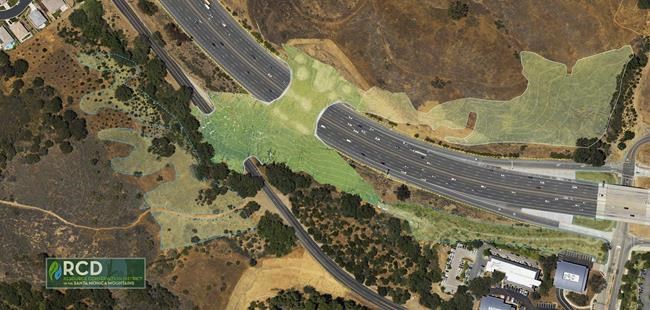
This undated artist's rendering provided by the Resource Conservation District of the Santa Monica Mountains shows a planned wildlife crossing over U.S. Highway 101 in Agoura Hills, Calif. Hoping to fend off the extinction of mountain lions and other species that require room to roam, transportation officials and conservationists will build a mostly privately funded wildlife crossing over the freeway. (Clark Stevens, Architect/Raymond Garcia, Illustration/RCD of the Santa Monica Mountains via AP)

The span along U.S. 101 will only be the second animal overpass in a state where tunnels are more common. Officials say it will be the first of its kind near a major metropolis and the largest in the world, stretching 200 feet (61 metres) above 10 lanes of busy highway and a feeder road just 35 miles (56 kilometres) northwest of downtown LA.

“When the freeway went in, it cut off an ecosystem. We’re just now seeing impacts of that,” Beth Pratt of the National Wildlife Federation told The Associated Press.

Scientists tracking mountain lions fitted with GPS collars found that roadways are largely trapping animals in the Santa Monica Mountains, which run along the Malibu coast and across the middle of Los Angeles to Griffith Park, where P-22 settled.

“They can’t get out of here to get dates, and cats can’t get in to get dates. … For those of us in LA, having a romance prospect quashed by traffic is something we can all relate to,” Pratt said.

The result of that isolation, researchers say, is imminent genetic collapse for mountain lions. Habitat loss has driven the populations to inbreeding that could lead to extinction within 15 years unless the big cats regularly connect with other populations to increase their diversity, according to a study published this year by the University of California, Los Angeles; University of California, Davis; and the National Park Service.

The $87 million bridge last month entered its final design phase. It’s on track for groundbreaking within two years and completion by 2023, according to engineer Sheik Moinuddin, project manager with the California Department of Transportation. Construction will take place mostly at night and won’t require any lengthy shutdowns of the 101 freeway, officials said.

Moinuddin said Caltrans considers it a “special” project that the agency hopes will inspire others like it across the state.

One of the reasons it’s special is that 80% of the money to build it will come from private sources, Pratt said. She’s in charge of fundraising and is using P-22 — “the Brad Pitt of the cougar world” — as the poster cat for the campaign.

“He is world famous, handsome, everybody loves him,” she said about the cougar that’s been photographed in his park home with the Hollywood sign as a backdrop.

Despite being the face of the project, P-22 is unlikely to use the bridge because he’s confined to the park many miles away. But many of his relatives could benefit, Pratt said.
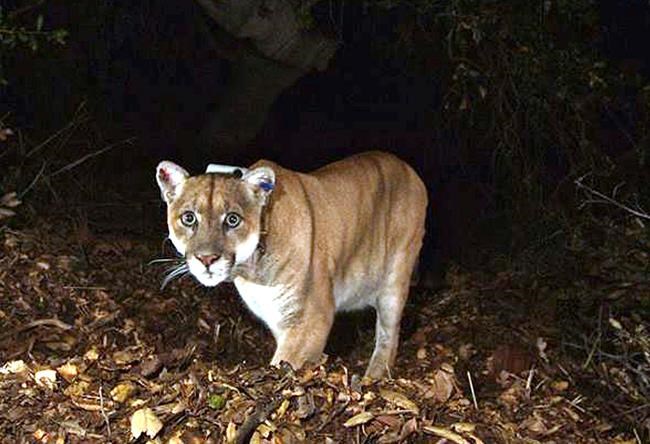
FILE - This November 2014 file photo provided by the U.S. National Park Service shows a mountain lion known as P-22, photographed in the Griffith Park area near downtown Los Angeles. Hoping to fend off the extinction of mountain lions and other species that require room to roam, California is building a mostly privately funded wildlife crossing over U.S. Highway 101 in Agoura, Calif. It will give big cats, coyotes, deer, snakes and other creatures a safe route to open space and better access to food and potential mates. The span will be the only animal overpass in a state where tunnels are more common. (National Park Service, via AP, File)

More than $13.5 million in private funding has already been raised, Pratt said. Officials are considering offering naming rights to the bridge if an entity or individual — perhaps a Hollywood studio or star — ponies up a significant donation, she said.

The remaining 20% will come from public funds already allocated toward conservation projects, officials said.

Some 300,000 cars a day travel that stretch of the 101 in Agoura Hills, a small city surrounded by a patchwork of protected wildland that the new crossing will connect. Residents regularly spot tarantulas, coyotes and bobcats in their yards and enjoy a short walk to hiking and biking trails that offer sweeping views of the Pacific Ocean.

Drivers on the busy freeway in the Liberty Canyon area might do a double-take as they speed under a bridge 165 feet (50 metres) wide with brush and trees growing on top, seamlessly joining hillsides on both sides of the lanes.

“And who knows, you might see an animal peeking over as it’s crossing,” Pratt said.

From the perspective of that animal meandering to or from the Santa Monica Mountains, the topography will hopefully be indistinguishable from the scenery on either side, said architect Clark Stevens. His design will total about 8 acres of landscape — of which the bridge top occupies about an acre.

He’s working with biologists and engineers to design berms and hollows with high edges that will block sound and light from the lanes below.

“Ideally the animals will never know they’re on a bridge,” said Stevens, with the Resource Conservation District of the Santa Monica Mountains. “It’s landscape flowing over a freeway. It’s putting back a piece of the ecosystem that was lost.”

Wildlife crossings — bridges and tunnels — are common in western Europe and Canada. A famous one in Banff National Park in Alberta spans the Trans-Canada Highway and is frequently used by bears, moose and elk. The first one in California opened with little fanfare last October near Temecula, about 60 miles (97 kilometres) north of San Diego.

The Los Angeles-area bridge has enjoyed nearly universal support, unusual for a public works project. The draft environmental impact document received nearly 9,000 comments — with only 15 opposed, according to the NWF.
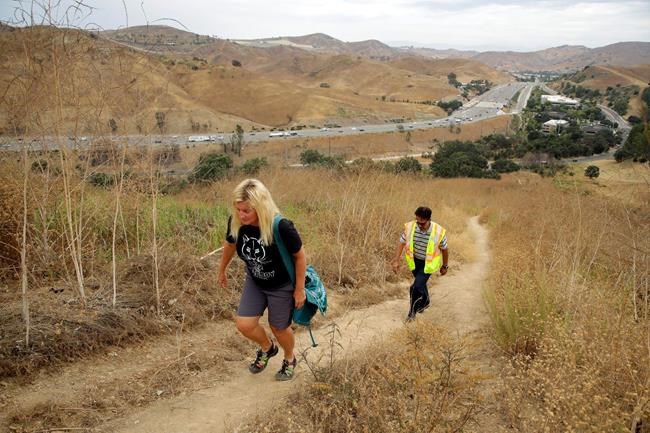
In this July 25, 2019, photo, Beth Pratt, California director for the National Wildlife Federation, left, and Cal Trans project manager Sheik Moinuddin walk along a hiking trail near a proposed wildlife crossing over U.S. Highway 101, background, in Agoura Hills, Calif. Pratt has been an advocate for the wildlife crossing, hoping for wildlife to have wider roaming spaces. (AP Photo/Marcio Jose Sanchez)

Agoura Hills resident Fran Pavley, a retired state senator, said one of her neighbours was initially concerned about cost.

“He came on board after learning it would be funded privately,” she said.

Stevens said he’s encouraged by Caltrans’ devotion to the project and its promise to consider more like it.

“Every hole in the freeway ought to be exploited. It’s a game of odds,” he said. “The more options animals have, the better off they’ll be.”

___

Follow Weber at https://twitter.com/WeberCM
Report Error Submit a Tip

More Stories

Waverley West council candidates say city services haven’t kept up with fastest-growing ward

Joyanne Pursaga 5 minute read Preview

Waverley West council candidates say city services haven’t kept up with fastest-growing ward

Joyanne Pursaga 5 minute read Updated: Yesterday at 7:50 PM CDT

A new city councillor will be elected this fall to lead Winnipeg’s fastest-growing ward that remains short on city services despite it being the most populated.

Read
Updated: Yesterday at 7:50 PM CDT

‘Buy Canadian’ takes on new meaning

Gabrielle Piché 6 minute read Preview

‘Buy Canadian’ takes on new meaning

Gabrielle Piché 6 minute read Yesterday at 6:30 PM CDT

The “Buy Canadian” push has re-emerged as the federal government rolls out tariffs on $27.6 billion worth of imports from the United States.

Premier Wab Kinew led the Manitoba charge Tuesday, hours after the federal government announced the retaliatory levies that will take effect Sept. 8.

“Whether you look at it as an affordability initiative, or you look at it as a way to support our economy here, buying local always makes sense,” Kinew said at an unrelated press conference. “It makes even more sense right now.”

Mark Carney’s government has responded to new 50 per cent tariffs imposed by the United States on $27.6 billion worth of Canadian products. Trade talks between the countries broke down late Friday.

Read
Yesterday at 6:30 PM CDT

Arts & Life team taste-tests new Kraft concoction

AV Kitching 4 minute read Preview

Arts & Life team taste-tests new Kraft concoction

AV Kitching 4 minute read 2:00 AM CDT

Prepare your tongue for the ultimate thrill, as Kraft Dinner has once again veered wildly out of its box and into new territory.

Just when we all thought the brand had peaked after unleashing its limited-run New York-style KD Mac & Cheesecake earlier this summer, the beloved pantry staple set its sights on dethroning another kitchen cupboard essential: instant noodles.

Emboldened by the rapturous reception of cheesecake lovers nationwide who had clearly been hankering for the savoury-sweet combo, the convenience food’s latest mashup pairs its infamous neon-orange cheese powder with classic ramen soup seasoning and dehydrated noodles.

The resulting bowl is a respectable attempt at creating a North American version of the South Korean trend of noodle lovers adding slices of processed cheese to their ramyeon to temper spice levels and added creaminess.

Read
2:00 AM CDT

The rural/urban immigration difference

Patrick MacKenzie and Enver Naidoo 5 minute read 2:00 AM CDT

Conversations about immigration often pretend that managing the numbers and where they go is as simple as turning a dial up or down. Like most things, the truth is more nuanced.

The Immigrant Employment Councils of Canada network’s 18-month engagement with over 1,100 employers, community and settlement service stakeholders made this apparent in many ways but, perhaps an underappreciated facet is the contrast between urban and rural immigration, and what challenges both immigrants and employers face in each context.

Rural and urban labour markets differ in structure, services and constraints, and a one-size solution will underdeliver everywhere.

This is why we have government programs such as the Rural Community Immigration Pilot, currently active in 14 areas across the country, as well as the provincial nominee program and provincial rural immigration pilots such as Manitoba’s West-Central Immigration Initiative.

Inflation-battered U.S. voters could prove to be key Canadian ally in fight against Trump’s trade tyranny

Dan Lett 5 minute read Preview

Inflation-battered U.S. voters could prove to be key Canadian ally in fight against Trump’s trade tyranny

Dan Lett 5 minute read Monday, Aug. 24, 2026

Is there anything or anyone that can help Canada and the United States avoid an unprecedented trade war?

Both nations stand poised on the precipice of a tariff battle that could — in the worst-case scenario — trigger an economic downturn. Both countries have a lot to lose, but neither country is showing any sign of backing down.

Canadian Prime Minister Mark Carney has, by all accounts, given negotiation a full chance to defuse the trade war. It didn’t work and it appears now that nothing — neither thoughtful negotiation or retaliatory measures — will dissuade U.S. President Donald Trump from his war of trade attrition.

Increasingly, it appears that if Trump is going to back away from punitive tariffs against Canada, it will be because of mounting pressure from within the United States and not because of tough talk and countermeasures from this side of the border.

Read
Monday, Aug. 24, 2026

Blue Bombers volunteer seriously injured in collision with e-scooter

Malak Abas and Zoe Pierce 7 minute read Preview

Blue Bombers volunteer seriously injured in collision with e-scooter

Malak Abas and Zoe Pierce 7 minute read Monday, Aug. 24, 2026

A longtime Winnipeg Blue Bombers volunteer was rushed to hospital and now faces months of recovery after being hit by an e-scooter while directing football fans after a home game last month.

Read
Monday, Aug. 24, 2026