A tail of excess
The rise and fall of '50s automobile fins
Advertisement
Read this article for free:
or
Already have an account? Log in here »
To continue reading, please subscribe:

Digital Subscription
One year of digital access for only $205*
- Enjoy unlimited reading on winnipegfreepress.com
- Read the E-Edition, our digital replica newspaper
- Access News Break, our award-winning app
- Play interactive puzzles
*First annual payment billed as $205.00 + GST for one year. This annual subscription will automatically renew at $233.00 + GST every 52 weeks (10% off the regular annual price of $259.35). Offer available to new and qualified returning subscribers only. Cancel any time.
To continue reading, please subscribe:
Add Free Press access to your Brandon Sun subscription for only an additional
$1 for the first 4 weeks*
- Enjoy unlimited reading on winnipegfreepress.com
- Read the E-Edition, our digital replica newspaper
- Access News Break, our award-winning app
- Play interactive puzzles
*Your next Brandon Sun subscription payment will increase by $1.00 and you will be charged $17.95 plus GST for four weeks. After four weeks, your payment will increase to $24.95 plus GST every four weeks.
Read unlimited articles for free today:
or
Already have an account? Log in here »
Hey there, time traveller!
This article was published 06/11/2009 (6115 days ago), so information in it may no longer be current.
The tail fin trend started modestly. Following the Second World War, Harley Earl, General Motors’ colourful styling chief, decided Cadillac needed a more distinctive rear-end appearance as a styling signature.
In an era when society was enthralled with rockets and jets, Earl was the right man in the right place. It was a styling theme that blended perfectly with the chief stylist’s personal flair and flamboyance.
Earl had been so captivated by the look of the twin-boom tail stabilizers of the P-38 Lockheed Lightning fighter plane he carried the idea over into GM’s automobile styling. When his P-38-inspired raised tail lights appeared on the 1948 Cadillac, it was obvious he had perfectly captured the public’s optimistic mood. Cadillac’s tail fins, as they were quickly dubbed, became an instant success.
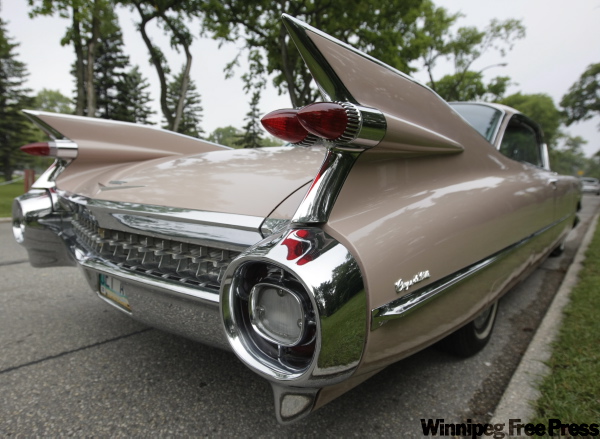
Fins could have a stabilizing effect on cars in crosswinds, as demonstrated by the pioneering work of professor W.I.E. Kamm and others at the Stuttgart Research Institute in Germany. But Earl wasn’t an engineer; his fins were conceived strictly as a styling statement that expanded styling to the rear of the car, a previously bland and unadorned area. They quickly became a Cadillac trademark.
Tail fins proliferated but remained reasonably restrained until 1957 when the Chrysler Corp. fired a styling shot across Cadillac’s bow by introducing bigger and higher fins than anything on GM’s finest. While Chrysler claimed its 1957 fins reduced steering correction by up to 20 per cent, nobody really took that seriously. The real impetus was styling, not stability.
Lincoln, also trying to take a chunk out of Cadillac’s luxury market, brought out huge, canted fins for 1957; they made the Cadillac fins look puny.
The tail-fin war was on and Cadillac was not about to be outdone. Under the aegis of Cadillac stylist Bill Mitchell, designers set to work to recover the fin crown, and the 1959 Cadillac clearly re-established the marque as the king of fins.
Never before had fins soared so high or made such a garish styling statement. The term "wretched excess" was coined to describe American cars of that era and the 1959 Cadillac could be called the most wretchedly excessive of them all. It was excessive not only in its styling but in its size. It stretched a full 5,715 millimetres and rode on a 3,302-mm wheelbase. It had almost 2,268 kg of road-smothering weight and a 6.4-litre, 325-h.p. V8.
The pinnacle of the fins marked the zenith of the domestic auto industry’s postwar strength. With virtually no competition in the world’s most prosperous society, it was the king of all it surveyed.
Although the independent automakers were always fighting for survival and the postwar period’s pent-up demand for cars attracted newcomers such as Tucker, Playboy, Davis and Kaiser-Frazer, only Kaiser-Frazer would get established. And with the return of a buyer’s market, K-F would leave the North American car market in 1955 before it had time to add fins.
There were some pesky Europeans such as Volkswagens, Renaults, Austins, Volvos and Mercedes-Benzes being sold, but American cars, particularly from the Big Three — GM, Ford and Chrysler — dominated the world’s largest automobile market.
The wane of fins in a way equated to the decline of the American auto industry, and the 1960s could be called a watershed decade. Just as fins were beginning to recede, Detroit was about to encounter some real competition. Recognizing a growing interest in smaller, more economical cars, the Big Three brought out their 1960 compacts to compete with the imports.
The Chevrolet Corvair, Ford Falcon and Chrysler’s Valiant did temporarily reduce the imports’ penetration, but they would ultimately recover, led by the funky Volkswagen. Other than a slight hint on the Valiant, there wasn’t a fin to be seen on the new compacts.
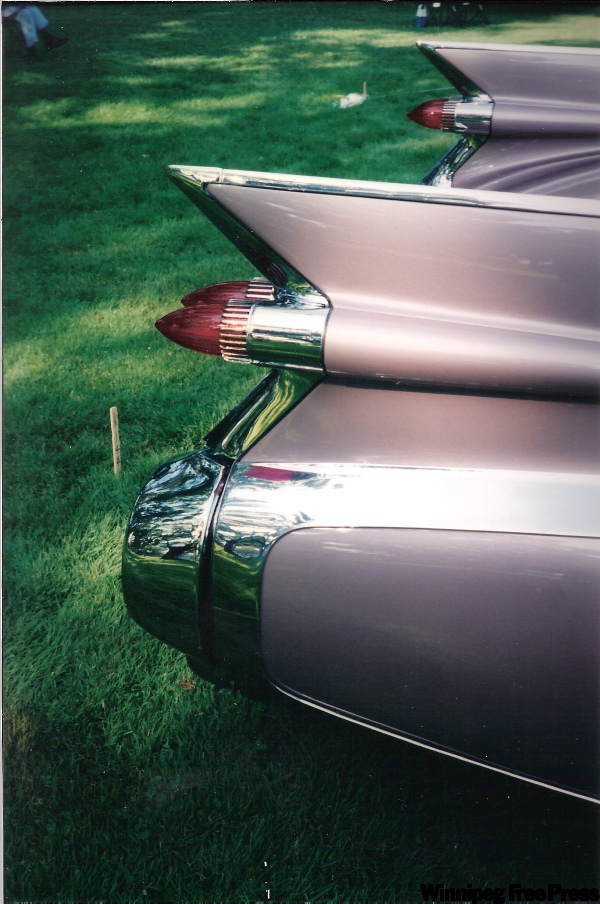
Just as 1960 was the year that imported cars were acknowledged as a threat, it was also the year Cadillac’s fins started to fall. The double, bullet-shaped tail lights were removed from the fins and replaced by slender lenses integrated into blades that were now smaller, lower and slimmer.

Cadillac fins would continue to shrink through the 1960s, and, after a lull, import sales would continue to rise. Other manufacturers followed suit and gradually abandoned fins.
The 1959 Cadillac fins stand as an instantly recognizable monument to the styling excesses of the American auto industry during the 1950s. Somewhat ironically, they have also helped make the 1959 Caddy a sought-after collectible.
— Canwest News Service