All rise for the Judge
Advertisement
Read this article for free:
or
Already have an account? Log in here »
To continue reading, please subscribe:

Digital Subscription
One year of digital access for only $205*
- Enjoy unlimited reading on winnipegfreepress.com
- Read the E-Edition, our digital replica newspaper
- Access News Break, our award-winning app
- Play interactive puzzles
*First annual payment billed as $205.00 + GST for one year. This annual subscription will automatically renew at $233.00 + GST every 52 weeks (10% off the regular annual price of $259.35). Offer available to new and qualified returning subscribers only. Cancel any time.
To continue reading, please subscribe:
Add Free Press access to your Brandon Sun subscription for only an additional
$1 for the first 4 weeks*
- Enjoy unlimited reading on winnipegfreepress.com
- Read the E-Edition, our digital replica newspaper
- Access News Break, our award-winning app
- Play interactive puzzles
*Your next Brandon Sun subscription payment will increase by $1.00 and you will be charged $17.95 plus GST for four weeks. After four weeks, your payment will increase to $24.95 plus GST every four weeks.
Read unlimited articles for free today:
or
Already have an account? Log in here »
Hey there, time traveller!
This article was published 17/12/2010 (5746 days ago), so information in it may no longer be current.
Few can argue the historical significance of the Pontiac GTO. Credited with starting the 1960s muscle car revolution in 1964, it also brought a degree of class to going fast. A factory hot rod with style and comfort, it offered buyers as much pizzazz as performance.
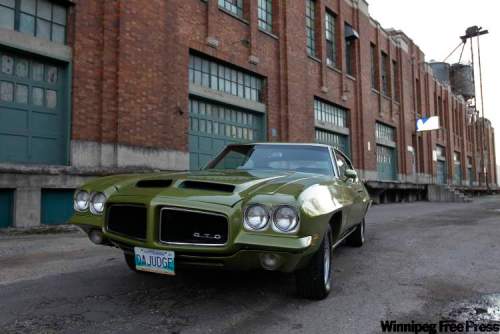
In 1969 “The Judge” model was launched. Named after a skit on Rowan & Martin’s TV comedy show, Laugh-In, where comics would repeatedly use the phrase, “Here comes The Judge”. Initially conceived as a competitor for the low cost Plymouth Road Runner, the Judge actually ended up as costing $337.02 more than the standard GTO. The Judge option included the LS5, 335 horsepower, HO 455 cubic inch V8, Rally II wheels, (less trim rings), hood air-inlet system, rear deck airfoil, black-textured grille and specific stripes and “The Judge” decals.
By 1970 the GTO, in Judge form, was at its pinnacle as a muscle car in terms of performance, handling and presence. With the tightening of smog laws and escalating insurance rates for performance vehicles, General Motors entered the marketplace in 1971 with lower compression engines, running on regular fuel and a new engine rating system. Instead of the familiar SAE horsepower ratings, General Motors now rated net horsepower. While the numbers were tempered a little, the actual seat-of-the-pants feel had changed little from previous models.

A change that really hit home was sales for 1971. From a healthy 40,149 GTO and Judge models sold in 1970, sales fell to only 10,532. Of this total 357 were Judge hardtops and only 17 Judge convertibles. Sales were so bad “The Judge” option was officially discontinued in January of 1971. Clearly the GTO and the Judge were on the ropes.
For Bruce Christian of Winnipeg, the 1971 GTO Judge he owns started as a pile of parts in the corner of his Lily Street repair shop. “I opened Automotive Connection in 1985 and shared space with a month-to-month tenant that did body and paint work and the GTO sat in a corner stall,” says Christian. As Christian’s business picked up he needed more space and began occupying the whole shop, so the GTO and his tenant found other quarters.
Christian says, “A few years later in 2000 a buddy of mine asked if I knew of a GTO for sale, so I tracked down the GTO project car only to find the owner had given it to his son.” Christian’s friend went on to buy a ’69 GTO convertible. A few months later the fellow with the GTO called and said his son wanted to sell the car and Christian said he was interested in buying it. “I had just sold my ’68 Pontiac Beaumont and thought it might be a good project so we made a deal for the car and all the parts and I bought it sight unseen”, says Christian. Days later as Christian’s new toy was arriving he got a real dose of reality. “I just about died when I saw what the tow truck had hauled into my shop.” A stripped down car with parts piled inside and pieces jutting out from where the windows should be was a real eye-opener and it again took up residence in the corner of Christian’s shop.
After spreading the parts out on the floor Christian found the rear deck lid spoiler that is part of the Judge option. Christian says, “These air foils and Judge badges have been available in the aftermarket for years and didn’t necessarily mean the car is a real Judge, but I took the serial number and engine number and sent it off to Pontiac Historical Services to decode the car,”
Ten days later Christian had his answer form the Pontiac Historical Services and the verification that he indeed owned one of the 357 Judge models produced in 1971. From this he was able to secure documented proof of the car’s provenance and a copy of the factory window sticker. Armed with the new information he dug a bit deeper into the pile of parts and found the actual build sheet for the car. The build sheet is a coded line order form that tells the assembly technicians what equipment to place on the car. The search was complete, next came a full restoration.

The body was sent to Winnipeg Sandblasting where it was media blasted to bare metal removing all of the old paint and rust. The brakes, steering and suspension systems were rebuilt by Christian as was the powertrain. The 455 HO V8 received a full rebuild including an Edelbrock polished aluminum intake manifold topped by the original Rochester Quadra-Jet four-barrel carburetor. For the exhaust system Christian installed a set of free-breathing Headman headers leading to a custom dual exhaust system, with correct chrome valance tips, expertly installed by Minute Muffler. One of 169 Judge models for 1971equipped with a Turbo Hydra-Matic 3 speed automatic transmission and 3.55:1 ratio Safe-T-Track differential, Christian rebuilt both before reinstalling them. It all rolls on a set of Pontiac Rally II wheels shod with Cooper Cobra raised white letter radial tires.
To get the body into shape new rear quarter panels were installed and Christian purchased an entire front clip from an Arizona wrecking yard. The front fenders are unique to the 1971 Judge and no reproductions are available, so if you don’t have useable rust-free originals you’re dead in the water with your restoration. Refinished with PPG base/clear Tropical Lime paint and new Judge stripe package and badges from Phoenix Graphics it looks better than when it rolled off of the assembly line.
Inside, Top Stitch replaced the original seat upholstery with new jade green Comfort-Weave vinyl seat upholstery supplied by Year One. Equipped with the optional Ralley gauge package including tachometer, custom 3-spoke steering wheel, tinted glass, power steering, power front disc brakes, rear window defroster, power windows dual mirrors with left-hand remote and AM/FM CD player it’s a fully equipped cruiser.
Finished in 2004, Christian has thoroughly enjoyed driving his GTO Judge throughout the summer months and taking in many of the local car shows. With only 16 of the 1971 Judge coupes accounted for in the Judge registry one has to wonder where the rest went.
For 1972 the GTO would lose its individual model status and return as an option package on the LeMans model and sales slipped even further. Gone from the dealerships Pontiac was officially retired from the General Motors lineup earlier this year and though we may never see any new models, Pontiac’s history and the legacy they leave of fine collectable automobiles ensure the Marque will never be forgotten.