Shortened ’59 Chevy a long story
It took 10 years of dedication, but novice builder engineers a beaut
Advertisement
Read this article for free:
or
Already have an account? Log in here »
To continue reading, please subscribe:

Digital Subscription
One year of digital access for only $205*
- Enjoy unlimited reading on winnipegfreepress.com
- Read the E-Edition, our digital replica newspaper
- Access News Break, our award-winning app
- Play interactive puzzles
*First annual payment billed as $205.00 + GST for one year. This annual subscription will automatically renew at $233.00 + GST every 52 weeks (10% off the regular annual price of $259.35). Offer available to new and qualified returning subscribers only. Cancel any time.
To continue reading, please subscribe:
Add Free Press access to your Brandon Sun subscription for only an additional
$1 for the first 4 weeks*
- Enjoy unlimited reading on winnipegfreepress.com
- Read the E-Edition, our digital replica newspaper
- Access News Break, our award-winning app
- Play interactive puzzles
*Your next Brandon Sun subscription payment will increase by $1.00 and you will be charged $17.95 plus GST for four weeks. After four weeks, your payment will increase to $24.95 plus GST every four weeks.
Read unlimited articles for free today:
or
Already have an account? Log in here »
Hey there, time traveller!
This article was published 16/12/2011 (5351 days ago), so information in it may no longer be current.
A custom car is an individual’s interpretation of what the vehicle should be. It takes patience, planning and various degrees of skill and imagination.
Once the plan is in place, the actual build needs someone familiar with metalworking and often adapting and fitting components from other vehicles into the build. For many, custom vehicles only exist on the pages of car magazines or at car shows, and to actually build or own one remains in one’s imagination.
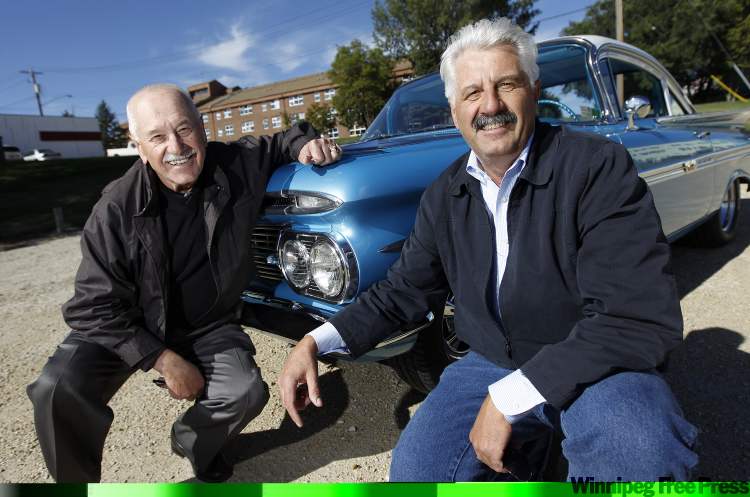
For Will Slota of Winnipeg, it all began in 2000 when he wanted to restore his father Nick’s old 1959 Chevy four-door sedan.
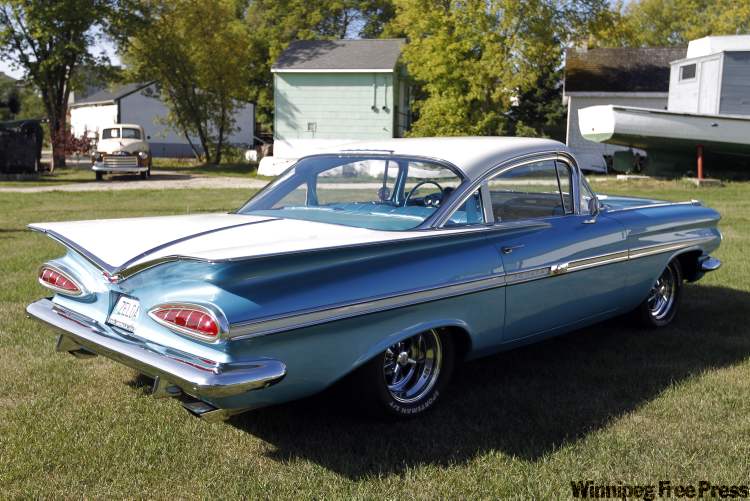
“My Dad only owned three vehicles in his life and I remember the ’59 the most and wanted to restore it,” says Slota.
Being his first restoration, and with only some knowledge of welding and brazing with a torch in the early 1970s, he tried to concentrate on formulating a workable plan. After purchasing another ’59 donor car for parts, he realized the project would require plenty of rust repair and panel fabrication.
“It was then that I began to regret that my Dad hadn’t purchased a two-door model,” Slota says. “It would be much more valuable after the extensive effort and money I was anticipating putting into the project.”
Faced with the task ahead, he couldn’t stop thinking about converting the four-door to a two-door. Where to start was the question, and after taking a tape measure to the car, simply cutting the car up and removing the rear doors wasn’t going to work. Most shortened cars look just as the term implies — out of proportion and almost cartoonish.
Planning seemed the logical route, and with pictures printed from the web, Slota sat at the kitchen table and did a cut-and-paste to see how the car could be shortened while still keeping the great ’50s body lines.
The plan came down to removal of 22 inches from the overall body length, but this car-building/restoring was all-new territory for Slota, so before he went any further, he had to know if it was even possible to fabricate the new doors.
After purchasing a mig welder and additional doors from a wrecker, he cut and fabricated the doors. “The roof was easy — it just followed the doors and everything lined up.”
With the car body shortened, Slota looked for a more modern frame to place under the car instead of sectioning the original frame and adding upgrades. After some research, he found a late-1980s Monte Carlo had a full frame with a 109-inch wheelbase and he purchased a 1987 model at an auction. The last of the full-frame, rear-drive cars produced by General Motors, it offered modern suspension, power rack-and-pinion steering and power front disc brakes.
To fit the new frame, 10 inches were removed from the floor pan behind the front seat and 12-inches from the floor of the trunk area. This allowed the car to fit on the 109-inch wheelbase frame, but the rear wheel wells had to be pulled back 10 inches in line with the rear axle. After taking new rear quarter panels from Mid Canada Classic and fabricating the required wheel openings, Slota went to work reconstructing the overall body. Five years lapsed before the job was complete and the body was set on the frame. Next, the body was removed again and the process of stripping the paint and completing the necessary bodywork was undertaken.
The frame received all-new parts, including brakes, suspension and steering components. The rear axle received a full rebuild, along with a 3.73:1 axle ratio and positraction unit and a 700 R4 automatic overdrive transmission prepared by Rene Ring at Ultra Transmission.
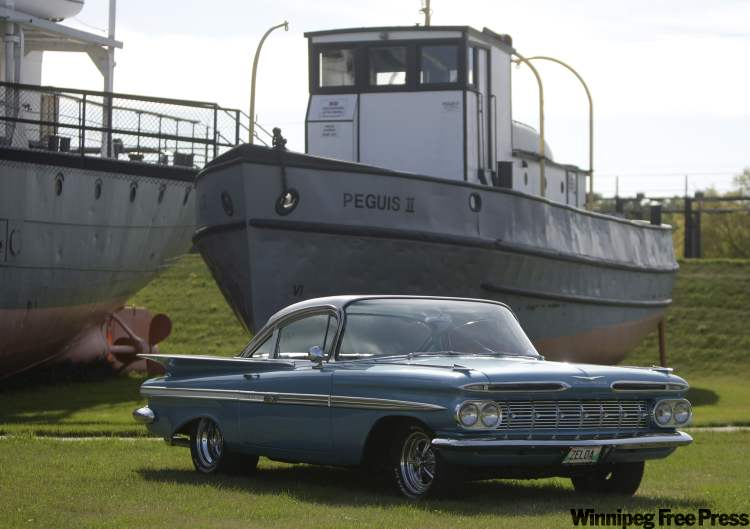
For the engine, Slota purchased a new General Motors crate unit from Grandrud Parts Center in Green Bay, Wis. The ZZ4 350-cubic-inch V-8 was fitted with a special tri-power aluminium intake manifold and Holley carburetors from Carl’s Ford Parts. Cooling is accomplished with an aluminium radiator from Performance Cooling, and the fuel tank was supplied by Piston Ring Service. “They were very helpful in selecting a new tank that fit the dimensions and fuel spout location I needed,” Slota says.
Riding on Crager five-spoke mag wheels, with spinners from Newstalgia Wheel and Mickey Thompson raised white-letter radials supplied by Fountain Tire, the rolling stock oozes that mid-’60s custom theme to a tee. Exhaust is comprised of ceramic-coated headers from White Performance, leading to a 2.5-inch-diameter custom dual exhaust system with Magnaflow mufflers fabricated by Gil Maynard at True-Way Muffler Centre.
For final block sanding and application of the new Pearl White and Custom Blue paint finish, the old ’59 was turned over to Gerry Giesbrecht at Brunswick Auto Body. Replated bumpers were purchased from eBay, window channels and felt kits are from Restoration Specialties and all the miscellaneous parts from Lutty’s Chevy Warehouse in Cheswick, Pa.
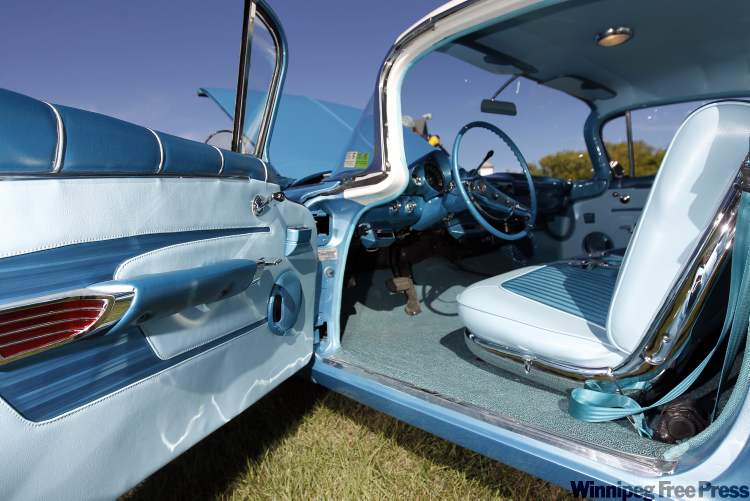
For the passenger compartment, Ron Schewe at Ron’s Custom Upholstery stitched the turquoise vinyl-and-fabric interior into what to most looks like factory upholstery. The cloth is actually for a 1966 Studebaker and the door panels, headliner and carpet are all custom fabricated to fit the shortened Chevy. What at first appears to be the factory seatback on the rear seat is really an upholstered panel that slides upward to access a lockable storage compartment made from shortening the trunk area.
Options on the Chevy include power steering, power front disc brakes, power windows, power door locks, Vintage Air air-conditioning, tinted windshield, in-dash AM radio and an AM/FM stereo in the glove box supplied by Custom Autosound.
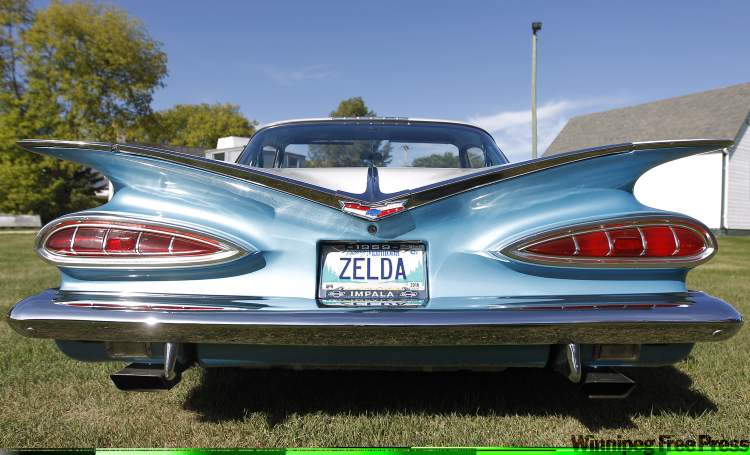

Built to be a driver and handle the open road, Slota’s Chevy really hits the mark, with a modern drivetrain and chassis. Slota credits the patience of his wife, Maxine, for the culmination of a dream and 10 years of hard work.
“I basically spent every moment I could in the shop working on it, with late evenings and a lot of complete weekends where I only came out for meals and to sleep, so I’m very grateful for her patience.”
In return for taking up much of her husband’s time, Maxine treated the Chevy like Will’s mistress and named her Zelda. “It received more gifts in the mail and more attention from Will than I ever had.”
Completed in time for its debut at the March 2011 World of Wheels car show at the Winnipeg Convention Centre, the Chevy has been received very well. Slota’s planning and sheer determination are testament to what can be done with old-fashioned hard work by an admitted novice. He pulled it off like a pro builder.
All I can add about the short Chevy is… less is more!