2012 BMW 528i: Fast and frugal-ish
BMW's tiny turbo is super slick
Advertisement
Read this article for free:
or
Already have an account? Log in here »
To continue reading, please subscribe:

Digital Subscription
One year of digital access for only $205*
- Enjoy unlimited reading on winnipegfreepress.com
- Read the E-Edition, our digital replica newspaper
- Access News Break, our award-winning app
- Play interactive puzzles
*First annual payment billed as $205.00 + GST for one year. This annual subscription will automatically renew at $233.00 + GST every 52 weeks (10% off the regular annual price of $259.35). Offer available to new and qualified returning subscribers only. Cancel any time.
To continue reading, please subscribe:
Add Free Press access to your Brandon Sun subscription for only an additional
$1 for the first 4 weeks*
- Enjoy unlimited reading on winnipegfreepress.com
- Read the E-Edition, our digital replica newspaper
- Access News Break, our award-winning app
- Play interactive puzzles
*Your next Brandon Sun subscription payment will increase by $1.00 and you will be charged $17.95 plus GST for four weeks. After four weeks, your payment will increase to $24.95 plus GST every four weeks.
Read unlimited articles for free today:
or
Already have an account? Log in here »
Hey there, time traveller!
This article was published 24/02/2012 (5284 days ago), so information in it may no longer be current.
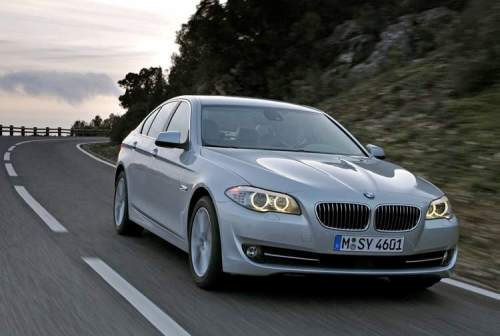
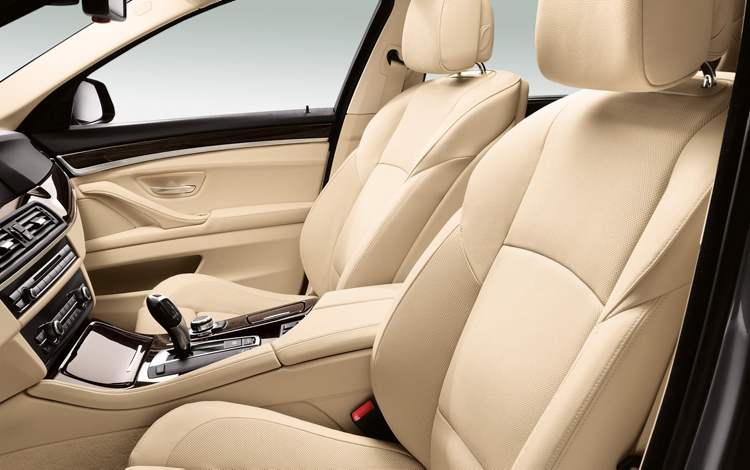
This may be the most significant BMW of the last decade. Yes, I know it looks just like any other nondescript — if any $56,900 luxury sedan by BMW can be labelled nondescript — black-with-a-tan-interior 5 Series. So, what’s the big whoop, you ask?
BMW — as all automakers the world over — is struggling to meet ever more stringent fuel-economy standards. Whether it be the EU’s 120 grams-per-mile CO2 mandate or U.S. President Barack Obama’s 56.2-miles-per-gallon dictum, BMW is expected to be pushed to go both farther and faster as government edict goes up against consumer desires.
That’s why BMW, like Ford, has embraced turbocharging. BMW may have labelled its program differently — EfficientDynamics versus Dearborn’s EcoBoost — but the premise is the same: Replace big V8s with smaller, turbocharged versions, small V8s with blown sixes and sixes with turbo fours. The smaller displacement/fewer pistons promise superior fuel economy; the turbochargers guarantee there’s sufficient power when called upon.
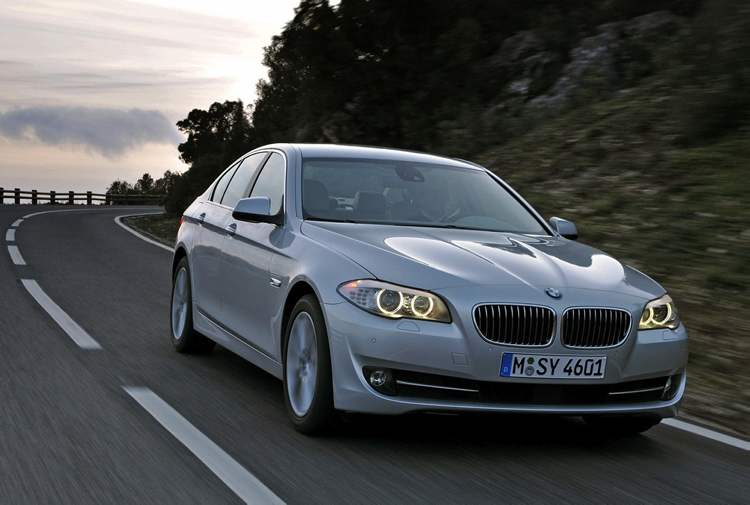
Starting to make its way through BMW’s lineup is the company’s N20 2.0L turbocharged four. Its 240 hp and 258 pound-feet of torque are more than the naturally aspirated in-line six it is scheduled to replace in most of BMW’s lineup.
So far, we’ve only seen the N20 in BMW’s X1, an entry-level model, though the 1 and 3 Series sedans will almost assuredly will get the 2.0L soon.
But now comes the 528, trying to foist a four-banger on a much more discerning clientele. How will the clientele of $60,000 luxury sedans react to having four measly pistons underfoot when it’s long been accustomed to six or eight?
If BMW had simply dumped the X1’s 2.0L as-is into the 5 Series, I suspect things might not have gone swimmingly. Adequate for the SAV, the 2.0 was hardly sonorous or wonderfully smooth. One never lacked for the six’s power, but the four’s comportment lacked a certain sophistication.
Not so the 528’s application. With different engine mounting, superior noise attenuation and some judicious exhaust pipe tuning, the small N20 is, with one small exception, right at home in the 528.
First and foremost, it never, ever feels underpowered. Though the 2.0L’s numbers are impressive — 200 horses and 258 pound-feet of torque — they don’t convey how truly powerful the N20 feels at low rpm. Indeed, though many of us associate turbos with high-rpm racing, the true magic of turbocharging is its ability to let small engines produce the low-end torque of big engines.
Mated to the smooth-shifting eight-speed transmission and its gear for every purpose and power, this is one slick powertrain. BMW claims 6.6 seconds are needed for the 528 to accelerate to 100 kilometres an hour, impressive numbers at the very least. But the real trick is how effortlessly the four small pistons make the entire process.
Its performance didn’t surprise me quite as much as its comportment. Loyal readers will know I am a huge fan of BMW’s in-line sixes, if not for their pure power then the ripping-silk music they make when screaming for redline. No four can compare.
And, indeed, the N20 can’t. But, and this is perhaps the 528’s biggest surprise to me, it’s not so bad. Oh, at low speeds, the little 2.0L is a little tramp-steamerish, its exhaust note a tad droning. But it’s well subdued and, since it’s unaccompanied by any vibration, it’s not very noticeable.
And, unlike other in-line fours, save perhaps Audi’s exemplary 2.0T, when you mat the throttle and the revs start flying, the little four sounds — dare I say it — almost sporty. No, it’s not five-octave Mariah Carey but neither is it cat-scratching-chalkboard Avril Lavigne. Four will never replace six in this regard, but, in circumstances where other four-bangers might embarrass, BMW’s sounds the part.
As for fuel economy, I have to say turbocharging is only partially successful in improving real-world numbers. Certainly, any gains in efficiency require you not dip into the 2.0L’s horsepower well; otherwise, it’s as profligate as any other 240-hp engine, four pistons or no. I suspect most people won’t have much problem approximating the 528’s 5.9 L/100 km highway rating, but playing with the N20’s responsive throttle will make the city 8.8-L/100-km rating more unattainable.
BMW has added an EcoPower mode, which sees the 528 shifting early. But, then, thanks to the aforementioned prodigious low-end torque, it hardly affects driveability, even when shifting at 2,500 rpm. That said, I averaged only about 11 L/100 km in my time in the 528, no doubt the result of my frequent toying with the turbochargers.
I came away from a week in the 528 even more impressed by BMW’s switch to turbocharging. Yes, I will miss the in-line six (and, indeed, if BMW ever gets rid of it completely, I will be the first to shout from the rooftops). But if the 528’s little four is the invention that all these new fuel-efficiency regulations necessitate, then the future is not so bleak after all.
The new four-banger not only matches the old six’s performance, it exceeds it.
— Postmedia News
THE SPECS
Type of vehicle: All-wheel-drive mid-sized luxury sedan
Engine: Turbocharged 2.0L DOHC four-cylinder
Power: 240 hp 5,000 rpm; 258 lb-ft of torque 1,250 rpm
Transmission: Eight-speed automatic

Brakes: Four-wheel disc with ABS
Tires: P245/45R18
Price: base/as tested: $56,900/$70,250
Destination charge: $1,995
Transport Canada fuel economy (L/100 km): 8.8 city, 5.9 hwy.