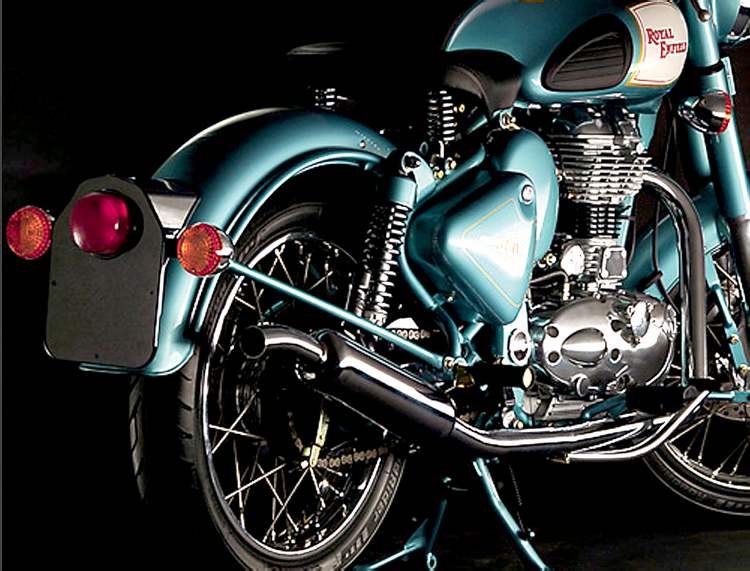
Royal Enfield’s Bullet Classic oozes old school
Royal Enfield's Bullet Classic oozes old school
Advertisement
Read this article for free:
or
Already have an account? Log in here »
To continue reading, please subscribe:

Digital Subscription
One year of digital access for only $205*
- Enjoy unlimited reading on winnipegfreepress.com
- Read the E-Edition, our digital replica newspaper
- Access News Break, our award-winning app
- Play interactive puzzles
*First annual payment billed as $205.00 + GST for one year. This annual subscription will automatically renew at $233.00 + GST every 52 weeks (10% off the regular annual price of $259.35). Offer available to new and qualified returning subscribers only. Cancel any time.
To continue reading, please subscribe:
Add Free Press access to your Brandon Sun subscription for only an additional
$1 for the first 4 weeks*
- Enjoy unlimited reading on winnipegfreepress.com
- Read the E-Edition, our digital replica newspaper
- Access News Break, our award-winning app
- Play interactive puzzles
*Your next Brandon Sun subscription payment will increase by $1.00 and you will be charged $17.95 plus GST for four weeks. After four weeks, your payment will increase to $24.95 plus GST every four weeks.
Read unlimited articles for free today:
or
Already have an account? Log in here »
Hey there, time traveller!
This article was published 30/03/2012 (5241 days ago), so information in it may no longer be current.
SIMPLE is sometimes better.
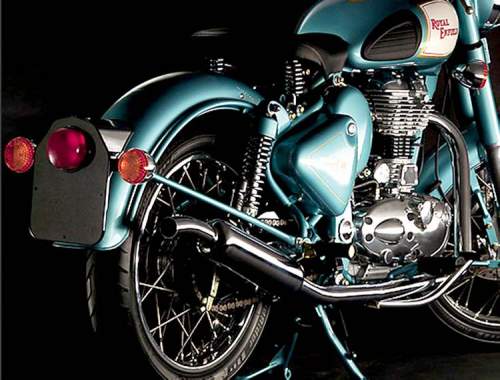
Such is the case with the Royal Enfield Bullet Classic 500cc motorcycle.
Although updated with an electric starter, electronic fuel injection and unit-construction engine, the Bullet harks back to a different era.
Royal Enfield is a company with some history. First registered in Britain in 1898, the Enfield Cycle Company of Redditch began producing bicycles, and with the advent of the internal combustion engine, motorcycles. Several sizes and styles of Royal Enfield motorcycles were produced, from 125cc single-cylinder units to powerful 1,140cc v-twin machines.
Royal Enfield was a division of the British armament manufacturer Royal Small Arms, and the connection led to the motorcycle company’s motto of “Made like a gun.”
In 1931, Royal Enfield introduced a single-cylinder motorcycle in both 350cc and 500cc displacement, called, what else, the Bullet. By 1949, the Bullet featured swing-arm rear suspension and proved to be a capable and popular model for use in off-road ‘trials’ events.
In the early 1950s, the 500cc Bullet came to the attention of the government in India. They were looking for a motorcycle the police and military could put into service. In 1954, the Indian government placed an order for 800 Bullets, straining the Royal Enfield factory to its limits. The quota was met, but when another larger order was placed, the English company sought to establish a factory on Indian soil.
At first, the machines were simply sent in kit form for assembly in Madras (now known as Chennai), but eventually the Enfield India, Ltd. factory was producing complete motorcycles.
Royal Enfield (England) continued to offer the Bullet while refining its range of machines, and by the mid-1960s was also constructing powerful parallel twin motorcycles, notably the 750cc Interceptor model.
Although the Interceptor gained favourable reviews, the company couldn’t meet production demands and was soon in financial peril. Like so many other British motorcycle-makers, the doors to the Redditch factory closed in 1970.
However, at that time, Enfield India was still producing the Bullet — exactly the same way they had learned to build the machine 15 years earlier. Production of the Bullet in India continued unabated, with 30,000 motorcycles rolling off the line every year.
By the mid-1990s, however, production-quality concerns caught up to Enfield India and the company was in a downward spiral until purchased by Eicher Motors. Funds were invested and the traditional Royal Enfield name was purchased.
To meet much more stringent pollution requirements, the revitalized Royal Enfield had to engineer a cleaner-running powerplant, and design work ultimately resulted in the new-for-2007, all-alloy unit-construction engine.
For Calgary motorcyclist Bruce Docherty, 43, the Royal Enfield Bullet Classic is an appealing package.
“Sometimes there’s too much technology and not enough of an esthetic appeal,” Docherty says about new motorcycle products. “I really like the old-school kind of look of the Royal Enfield.”
Docherty was born in Belleville, Ont., but moved to Calgary with his family in the late 1970s.
He grew up riding dirt bikes, and since 22 has always had a street bike — including the 1977 Kawasaki KZ650 he bought for $300 in the late 1980s. Alongside the KZ650 in Docherty’s garage there’s a 1984 Yamaha FJ1100 and his most recent addition, a 2007 Buell Ulysses.
Occasionally, Docherty takes a longer trip such as the ride he and his brother recently took to B.C. and Washington. With a young family. Docherty says most of his saddle time is found aboard the Buell on his 70-kilometre round-trip daily commute.
Docherty spent a few days aboard a 2010 (the 2011 model has a kick-start in addition to the electric start, the only significant difference between the two) Royal Enfield Bullet Classic, and says he enjoyed slowing down.
“I took a meandering after-work ride in and around Bragg Creek,” Docherty says of his first evening on the machine. “I turned down a very busy lifestyle to literally cruise on narrow, quiet roads at a more than manageable pace, a pace I’m not used to. I revelled in the moments. I stopped and took down a few notes. I think I heard a moose huffing nearby. Seriously!”
Docherty put the bike through its paces the afternoon he picked up the machine from Royal Enfield Calgary. He spent time idling along in heavy traffic, moving along secondary roads, even managing a short blast along the high-speed Trans-Canada Highway.
“I’m not a guy who tries to scrape my knee when I’m cornering,” Docherty says, and adds, “I’m just an everyday rider.”
Docherty felt the 27.5 horsepower produced by the revised Royal Enfield 500cc single was a little light, but says, “Don’t go comparing horsepower — put the number out of your mind. Climb a hill on the Trans-Canada with a headwind and you’ll have to twist out every ounce the bike has. It’s not worth it. Take a secondary road. Ride to work in town. Appreciate the few drops of fuel it will use to get you there.
“This is a great bike for around town. It keeps up with traffic and will dash away at the lights without hesitation. It gets a lot of attention as well.”

Clutch action was light, and the new unit gearbox was easy to shift. Suspension was rated as firm, and Docherty liked some of the extra springing found in the solo saddle.
The Bullet Classic is fitted with a disc brake up front and a drum brake at the rear. Docherty says the front disc did a great job of slowing the whole plot down, and adds that he felt more response from the rear drum on the Royal Enfield than the rear disc on his Buell.
Fit and finish was given a thumbs-up, but Docherty, who is just over six feet tall, might install different handle bars, possibly a more original-looking seat (“not that there is anything wrong with the stock one”) and make an adjustment to the kickstand so that it’s easier to swing into the upright position.
“This is a feel-good bike,” Docherty concludes. “I got out my old leather jacket, a funky helmet and felt like I was in my 20s again.”
— Postmedia News