201`2 HONDA PILOT: Friend of the family
Honda's Pilot built to haul -- around town or down the highway
Advertisement
Read this article for free:
or
Already have an account? Log in here »
To continue reading, please subscribe:

Digital Subscription
One year of digital access for only $205*
- Enjoy unlimited reading on winnipegfreepress.com
- Read the E-Edition, our digital replica newspaper
- Access News Break, our award-winning app
- Play interactive puzzles
*First annual payment billed as $205.00 + GST for one year. This annual subscription will automatically renew at $233.00 + GST every 52 weeks (10% off the regular annual price of $259.35). Offer available to new and qualified returning subscribers only. Cancel any time.
To continue reading, please subscribe:
Add Free Press access to your Brandon Sun subscription for only an additional
$1 for the first 4 weeks*
- Enjoy unlimited reading on winnipegfreepress.com
- Read the E-Edition, our digital replica newspaper
- Access News Break, our award-winning app
- Play interactive puzzles
*Your next Brandon Sun subscription payment will increase by $1.00 and you will be charged $17.95 plus GST for four weeks. After four weeks, your payment will increase to $24.95 plus GST every four weeks.
Read unlimited articles for free today:
or
Already have an account? Log in here »
Hey there, time traveller!
This article was published 07/09/2012 (5147 days ago), so information in it may no longer be current.
If you’re in the market for a family hauler perfect for a weekend getaway or an extended vacation, the 2012 Honda Pilot ranks as a top choice.
General Motors has some larger crossovers that are a bit roomier — the Chevrolet Traverse, Buick Enclave and GMC Acadia — but among the midsize class, the Pilot shines.
It’s also a perfect alternative for those who don’t particularly want to drive a minivan such as Honda’s other great family hauler, the Odyssey, but need the eight-passenger capacity.
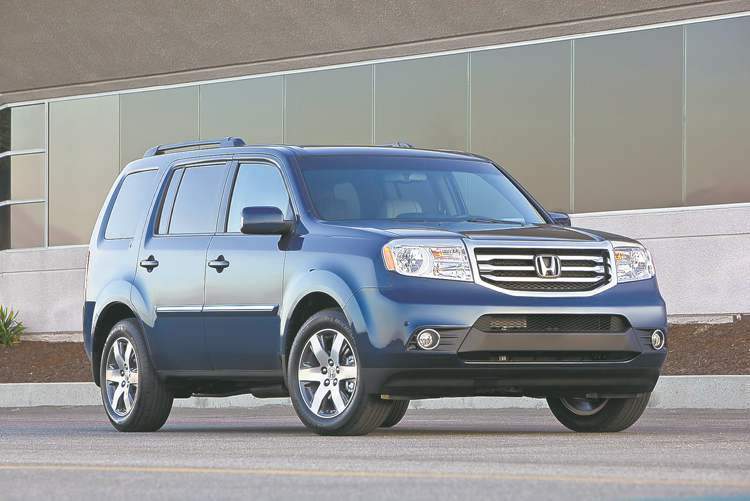
This is one of the most family-friendly vehicles ever built, and it’s just as versatile as a minivan for the routine daily duties of hauling kids, dogs, soccer equipment and groceries.
For 2012, there are four trim levels — LX, EX, EX-L and Touring — and 12 total variations, depending on what extras are added, such as four-wheel drive, navigation and rear-seat entertainment. The EX-L models come with leather interiors; that’s what the L stands for. Four-wheel drive is optional on all levels.
Prices range from $34,920 for the base LX two-wheel drive to $48,520 for the top-of-the-line Touring four-wheel drive with navigation and rear entertainment.
We tested the fully-equipped EX-L RES four-wheel drive with navigation and rear entertainment, priced at $44,720.
The Pilot is nearly as elegant and well-equipped as its premium Acura counterpart, the MDX, which is built on the same chassis.
Under the hood is a 3.5-litre V-6 engine, rated at 250 horsepower and 253 foot-pounds of torque, connected to a five-speed automatic transmission. It’s a smooth, powerful drivetrain that moves the vehicle effortlessly.
We had four people and their luggage on board for a long road trip that included some mountain driving, and the Pilot handled the hills with ease, as well as routine uphill freeway ramps.
The Pilot is mostly quiet at highway speeds, although some wind noise does come through. It’s still easy to conduct a conversation at normal volume levels, even at 120 km/h.
Although the ride is soft and easy on the body, the Pilot’s suspension is strong enough to hold the vehicle steady on curves, and the steering is crisp and responsive. That’s one of the pluses of the crossover’s car-style unibody chassis compared with the body-on-frame arrangement of the traditional sport utility vehicle, such as the Ford Expedition and Toyota Sequoia.
The Pilot’s V-6 engine has variable cylinder management, which shuts off up to three cylinders during highway cruising. That helps give the Pilot its Transport Canada highway rating of 7.8 litres per 100 kilometres in the front-wheel-drive model, and 8.2 with four-wheel drive. City ratings are 11.8 L/100km for the front-drive model, and 12.3 for the four-wheel drive.
The test vehicle came with Honda’s full-time variable torque management four-wheel-drive system, designed to improve traction mostly in rain or snow, but also gives the car some off-road capability.
There is no transfer case to provide low-range gearing for extreme trail driving, but there is a dash button that locks the system to allow for maximum torque in first and second gears at speeds up to 30 km/h, to simulate low range. That could help the vehicle extricate itself from mud holes or allow it to negotiate steep off-road slopes.
Ground clearance is just 20 centimetres, which doesn’t allow enough room to clear rocks and other obstacles that most true sport utility vehicles can handle.
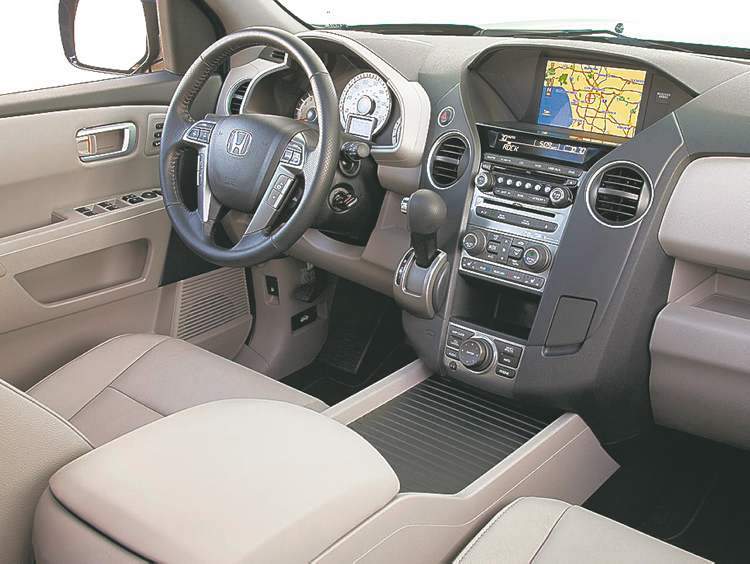
There are lots of nooks and crannies in the cabin of the Pilot to keep mobile devices secure and within easy reach. Three 12-volt power outlets are within reach of the driver and front passenger, along with a 110-volt outlet for a game console or a wall charger for a laptop, for example.
As for cupholders and cubbies to keep stuff organized, nobody has this covered like Honda does. Besides two cupholders in the centre console between the two front seats, there are trays in front and behind them and three more trays on top of the glove box.
With a full load of passengers, everyone has at least one usable cupholder, and some have more than one.
There are cubbies in the dash for more devices, and in the back, there are map pockets and door pockets and other places to stow stuff to keep it from flying all over the car when brakes are applied or on a sharp turn.
In the centre console there are USB and audio connections for iPods and other MP3 players, allowing them to be played through the in-dash audio system.
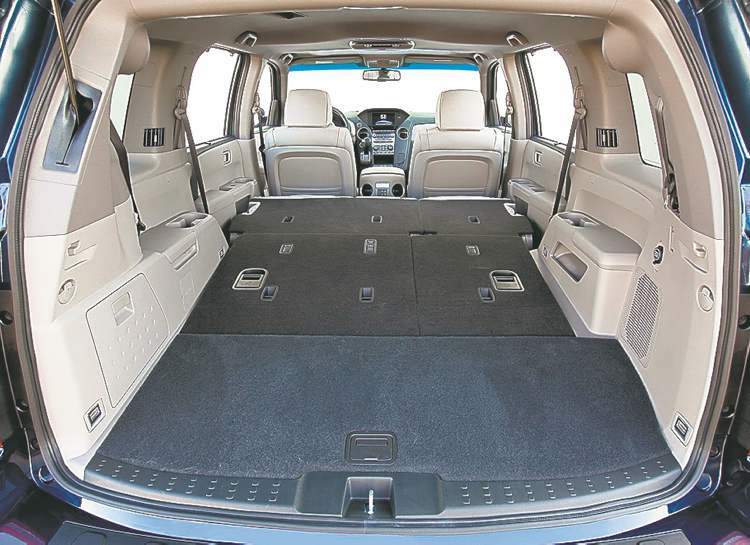
This roomy and comfortable vehicle has nearly 153 cubic feet of passenger space and a cargo area that expands to 87 cubic feet with the middle and rear seats folded. With all the seats in place, there is an 18-cubic-foot space behind the third row, which is larger than found in most midsize SUVs with a third seat. That doesn’t include a hidden 2.8-cubic-foot storage well, which can keep valuables out of sight.
The second and third rows can hold up to three people each, but the third row is best left to children, as is the middle position in the middle row. For easy access to the third row, the second-row seat can be moved forward easily. Four child-seat anchors are provided — three in the second row and one in the third.
The Pilot, at just over 486 cm long, is easier to park than some of its eight-passenger competitors. Some of those are as much as 60 cm longer than the Pilot, which Honda calls “garage-friendly.”
Among safety features, the Pilot comes with Honda’s Advanced Compatibility Engineering body structure, designed to make it match the bumper heights of most other vehicles on the road.
Other standard safety gear includes electronic stability control, three-row side-curtain airbags with rollover sensors, driver and front-passenger seat-mounted side airbags, active front head restraints and antilock brakes with electronic brake distribution and brake assist.
The Pilot has been designated a top safety pick by the U.S. Insurance Institute for Highway Safety, and the vehicle received the best possible ratings in front- and side-crash safety tests conducted by the U.S. National Highway Traffic Safety Administration.
Among standard amenities on all models are front and rear air conditioning with air filtration, keyless entry, tilt and telescopic steering column, cruise control, power windows/mirrors/door locks, AM/FM/compact-disc audio system with seven speakers (including subwoofer) and the Radio Data System, trip computer, digital compass, automatic headlights, heat-rejecting tinted glass, and integrated tow-hitch receiver.
With the EX, you’ll also get tri-zone automatic climate control with humidity control and air filtration, a 10-way power driver’s seat with lumbar support, a six-disc in-dash CD changer, security system, XM radio, body-colour side mirrors and door handles, alloy wheels, roof rails, fog lights, exterior temperature indicator and a universal garage opener.
The EX-L adds leather seating surfaces, heated front seats, a four-way power front passenger seat, a one-touch power moon roof, acoustic windshield glass and an automatic-dimming rear-view mirror.
Also included on top-end models are a rear-view camera, premium audio, Bluetooth phone connectivity, a multi-information display, corner and backup sensors, exclusive alloy wheels, power tailgate and outside-mirror integrated turn signals.
THE SPECS
Type of vehicle: Front or 4-wheel-drive, full-sized SUV
Engine: 3.5L i-VTEC V6
Power: 250 hp @ 5,700 rpm; 253 lb-ft of torque @ 4,800 rpm
Transmission: Five-speed automatic
Brakes: Four-wheel disc with ABS
Length: 486.1 cm
Wheelbase: 277.6 cm
CURBWEIGHT: 2,091 kg
CARGO SPACE: 2,091 L (max)
TOWING CAPACITY: 2,045 kg
Price: $38,820 — $48,520
Destination charge: $1,530
Transport Canada fuel economy (L/100): 12.3 city, 8.2 hwy.