Sunshades help cool, protect car’s interior
Advertisement
Read this article for free:
or
Already have an account? Log in here »
To continue reading, please subscribe:

Digital Subscription
One year of digital access for only $205*
- Enjoy unlimited reading on winnipegfreepress.com
- Read the E-Edition, our digital replica newspaper
- Access News Break, our award-winning app
- Play interactive puzzles
*First annual payment billed as $205.00 + GST for one year. This annual subscription will automatically renew at $233.00 + GST every 52 weeks (10% off the regular annual price of $259.35). Offer available to new and qualified returning subscribers only. Cancel any time.
To continue reading, please subscribe:
Add Free Press access to your Brandon Sun subscription for only an additional
$1 for the first 4 weeks*
- Enjoy unlimited reading on winnipegfreepress.com
- Read the E-Edition, our digital replica newspaper
- Access News Break, our award-winning app
- Play interactive puzzles
*Your next Brandon Sun subscription payment will increase by $1.00 and you will be charged $17.95 plus GST for four weeks. After four weeks, your payment will increase to $24.95 plus GST every four weeks.
Read unlimited articles for free today:
or
Already have an account? Log in here »
Hey there, time traveller!
This article was published 16/08/2013 (4755 days ago), so information in it may no longer be current.
I don’t see as many sunshades in vehicle windows as I used to a few years ago but, if you park your vehicle outside in the sun, using one is definitely something you should consider.
The most popular sunshades sit inside the windshield of your vehicle, covered in highly reflective foil to reflect the sun’s heat away from inside the passenger compartment. Covers that fit over the outside of the windshield would probably have even a greater benefit, but are more difficult to install and subject to theft.
Amazingly enough, sunshades have really only been marketed commercially since the mid-1980s, and that now-familiar folding cardboard sunshade with the huge sunglasses picture on them was one of the first popular models.
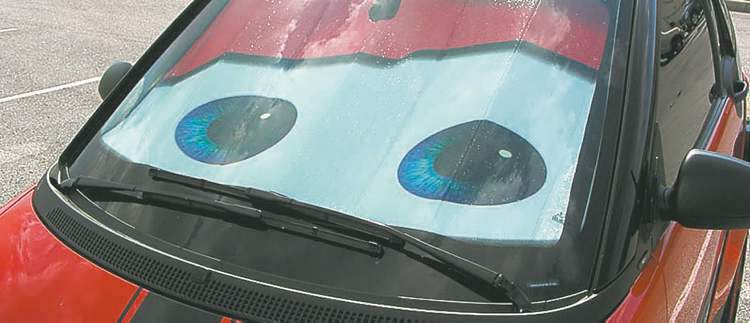
According to information provided by Auto Expressions, a folding accordion-style sunshade keeps dashboard surfaces an average of 23.8 C cooler and blocks 99 per cent of the sun’s direct ultraviolet rays. I was curious about these statements, so I did a little digging and research on my own.
Even though it’s well-recognized that interior vehicle temperatures get extremely high when a vehicle sits in direct sunlight, there’s not much public information on how hot it gets. The automakers do their own testing, but this is more for vehicle-durability standards than public information.
General Motors and Chevrolet, in combination with Safe Kids Worldwide, are again raising awareness of the dangers of hot cars through their Never Leave Your Child Alone campaign, but little is offered in the way of facts or figures. They do point out that exterior temperatures even as mild as 15.5 C can create dangerous heat inside a closed vehicle in minutes.
One of the better studies available was done by Jan Null, adjunct professor, department of geosciences, San Francisco State University. In her report, Study of Excessive Temperatures in Enclosed Vehicles, August 2003, she measured interior vehicle temperatures of different-coloured vehicles while they were sitting in the sun.
While several tests were done, here is a typical example of her results. On a cloudless, 25 C day, the vehicle interior temperature reached 35.6 C in 10 minutes, 41.1 C within 20 minutes and 43.3 C in half an hour. Letting the vehicle sit for a full 60 minutes, the temperature continued to climb to 50 C. Longer periods had no appreciable increase in interior temperature.
Both dark-blue and light-grey vehicles were used. We all know dark vehicles heat up more, right? Wrong! While exterior surface temperatures may differ, Null found only minor differences in interior temperatures. Even opening the side windows 1.5 inches made little difference in the results.
Medical specialists recognize heatstroke can occur when a person’s body temperature reaches 105 degrees F; death at 107 degrees F. Higher humidity levels also decrease the body’s ability to disperse heat, as do smaller surface areas. Children are more at risk than adults because of their smaller size.
The U.S. Centers for Disease Control made a report to Congress stating cars parked in direct sunlight can reach internal temperatures of up to 55 C to 77 C when the outside temperatures are only 27 C to 38 C. So leaving a person in a car while it’s parked in the sun could be deadly within just a few minutes.
Sunshades are not designed to protect vehicle occupants, but do they protect vehicles? I tested five vehicles parked in the sun on a 25 C cloudless day. The tests were done between noon and 2 p.m. with the sun directly overhead. The vehicles were a black crew-cab mid-size pickup, a grey mid-size SUV, a navy-blue full-size pickup, a red coupe and a yellow compact sedan.
The yellow car was in the shade and measured 26 C. The navy pickup had a sunshade in the windshield and was facing south. It measured 38 C. All the other vehicles were facing north and had interior temperatures between 36 C and 38 C. I moved the yellow car into the sun and the interior temperature immediately climbed. Within 15 minutes, it measured 32 C. After sitting for a full hour, it was 41 C.
I then cooled the vehicle and placed a sunshade in the windshield. After sitting for 30 minutes, the temperature had risen to 33 C and slowly climbed to about 37 C within an hour.
Even though I tested the sunshade in the windshield of the vehicles facing north, it had little effect. The back windows were tinted and provided some heat protection. I suspect a sunshade in the rear windows would have had more effect on these vehicles.
In the navy pickup, I removed the sunshade. Temperatures immediately started to climb. From 38 C with a sunshade, it rose to 46 C within 15 minutes and 49 C in 30 minutes. The sunshade was obviously working.
While my testing is not very scientific, it did show me there was little difference in temperatures based on vehicle colour and that sunshades do help keep temperatures lower. High interior heat dries out lubricants on moving parts, warps plastics and cracks dashboards.
While I could not test Auto Expressions’ claim of blocking 99 per cent of UV rays, it seems obvious that a solid, reflective sunshade blocks sunlight, protecting the interior from fading.

My conclusions: Park in the shade whenever possible, and use a sunshade to protect your vehicle’s interior when you can’t. Parking facing north may help, but more research needs to be done.
And remember: Don’t leave any person or animal in a parked car even for a couple minutes on a sunny day. Interior temperatures quickly rise to deadly levels.
Jim Kerr is a mechanic, instructor of automotive technology, freelance journalist and member of the Automobile Journalists’ Association of Canada.
kerr.jim@sasktel.net