Toyota chasing youngsters with Corolla revamp
Advertisement
Read this article for free:
or
Already have an account? Log in here »
To continue reading, please subscribe:

Digital Subscription
One year of digital access for only $205*
- Enjoy unlimited reading on winnipegfreepress.com
- Read the E-Edition, our digital replica newspaper
- Access News Break, our award-winning app
- Play interactive puzzles
*First annual payment billed as $205.00 + GST for one year. This annual subscription will automatically renew at $233.00 + GST every 52 weeks (10% off the regular annual price of $259.35). Offer available to new and qualified returning subscribers only. Cancel any time.
To continue reading, please subscribe:
Add Free Press access to your Brandon Sun subscription for only an additional
$1 for the first 4 weeks*
- Enjoy unlimited reading on winnipegfreepress.com
- Read the E-Edition, our digital replica newspaper
- Access News Break, our award-winning app
- Play interactive puzzles
*Your next Brandon Sun subscription payment will increase by $1.00 and you will be charged $17.95 plus GST for four weeks. After four weeks, your payment will increase to $24.95 plus GST every four weeks.
Read unlimited articles for free today:
or
Already have an account? Log in here »
Hey there, time traveller!
This article was published 14/02/2014 (4579 days ago), so information in it may no longer be current.
MINNEAPOLIS, Minn. — Toyota has sold 40 million Corollas, but the company is neither satisfied nor comfortable. Looking over its shoulder at stylish challengers such as the Honda Civic, Hyundai Elantra and Ford Focus, Toyota set out to broaden the Corolla’s appeal for 2014.
The goal was to create a new look and “make the Corolla a car people want to buy,” as opposed to a smart, but boring choice, said Paul Holdrige, Toyota’s vice-president of sales.
The result is a car that bears no resemblance to previous Corollas, thanks to a big, bold lower grille, fast windshield and sloping C-pillar.
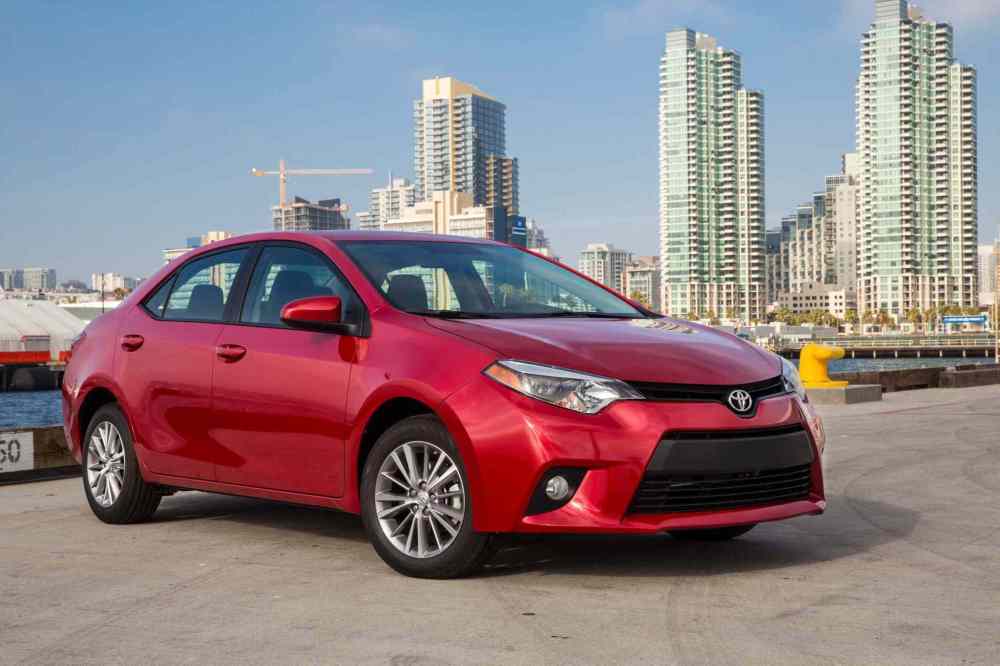
Toyota also added new engine and transmission technology. For the first time, virtually all Corollas sold in North America will be built here. Japan traditionally built some Corollas that were sold here, but Toyota expects its plants in Mississippi and Ontario to satisfy North American demand with about 330,000 Corollas annually.
Toyota desperately wants the Corolla to attract younger buyers. Holdrige expects 20 per cent to be under 35. That’s a dramatic increase from the outgoing model’s 15 to 17 per cent.
“Ultimately, the world is going to get younger,” said Holdrige. “We’ve watched other brands die. If you don’t change your demographics over time, you put yourself in a perilous position.
“Elantras and Civics have shown us the buyer wants more style and more equipment” than the Corolla traditionally offered, he said.
It’s hard to imagine a world without Toyota, but there was a time when you could have said that about Mercury, Pontiac, Packard, Saab and Morris.
Fear and humility are useful survival tools, even for the world’s biggest automakers.
Toyota has been trying to spice up its designs for years. Time will tell if they succeeded with the 2014 Corolla. A sudden proliferation of tweaked and dressed-up Corollas among enthusiasts and tuners would be the ultimate, unlikely endorsement.
In October, I spent a day driving 2014 Corollas around Minneapolis and along the picturesque bluffs lining the Mississippi River. Some of the changes are obvious. The passenger compartment and trunk are among the biggest in any compact sedan. The rear seat offers surprising leg- and headroom. The 2014 Corolla is 2.5 inches longer and has 5.1 inches more rear legroom than the outgoing model.
The dashboard is very flat, like a throwback to 1960s and 1970s cars.
The engine choices are interesting, and a bit peculiar. The new Corolla uses the same 1.8-litre four-cylinder as the current model, but the low-volume LE Eco model adds a special cylinder head that uses variable valve lift to boost fuel economy. It’s called Valvematic. Toyota has offered it in Europe and Japan since 2005, but it’s just getting to North America now.
Toyota makes the cylinder heads in Japan. Its production is limited, which means the Eco’s combination of 5.6 litres per 100 kilometres fuel consumption and higher power will be available on just 30,000-35,000 Corollas.
The base Corolla uses an antiquated four-speed automatic transmission, but the vast majority sold will feature a continuously variable transmission. CVTs replace a traditional transmission’s gear with a couple of pulleys. It’s cool in some quarters — primarily car magazines — to diss CVTs for their noise and performance. The complaints make as much sense as swearing off hamburgers because you got a bad one once. Some CVTs are good, some aren’t. Avoid the bad ones. Rancid hamburger, too.

The Corolla’s CVT seemed inoffensive. It helps non-Eco models score a 6.1 l/100k highway fuel economy rating.
Despite the talk about styling, Toyota’s counting on traditional Corolla virtues such as fuel economy and price to win customers it lost to flashy competitors.
“Consumers are less loyal today than ever before,” Holdrige said. “If you don’t build what the consumer wants, they’re going to go elsewhere. We are not guaranteed anything.”
That’s what I like to hear from a giant global corporation with one of the best-selling cars in history: fear and hunger.
— Detroit Free Press
Related Articles
2014 TOYOTA COROLLA S: Low-end luxury
Advertisement Advertise With Us
Advertisement Advertise With Us