Cadillac leads the way in vehicle communication

New technology could make roads safer

Advertisement

Advertise with us

It’s here. Cars can talk to each other! It is currently very limited — presently the only vehicles on the road able to communicate with each other are 2017 Cadillac CTS models built since March 2017 — but this is an important first step in improving safety for all drivers.

Read this article for free:


or

Already have an account? Log in here »

To continue reading, please subscribe:

Subscribe and receive a limited-edition Free Press branded hat or tote.

Digital Subscription

One year of digital access for only $205*

  • Enjoy unlimited reading on winnipegfreepress.com
  • Read the E-Edition, our digital replica newspaper
  • Access News Break, our award-winning app
  • Play interactive puzzles

*First annual payment billed as $205.00 + GST for one year. This annual subscription will automatically renew at $233.00 + GST every 52 weeks (10% off the regular annual price of $259.35). Offer available to new and qualified returning subscribers only. Cancel any time.

To continue reading, please subscribe:

Add Free Press access to your Brandon Sun subscription for only an additional

$1 for the first 4 weeks*

  • Enjoy unlimited reading on winnipegfreepress.com
  • Read the E-Edition, our digital replica newspaper
  • Access News Break, our award-winning app
  • Play interactive puzzles
Start now

*Your next Brandon Sun subscription payment will increase by $1.00 and you will be charged $17.95 plus GST for four weeks. After four weeks, your payment will increase to $24.95 plus GST every four weeks.

Hey there, time traveller!
This article was published 05/01/2018 (3192 days ago), so information in it may no longer be current.

It’s here. Cars can talk to each other! It is currently very limited — presently the only vehicles on the road able to communicate with each other are 2017 Cadillac CTS models built since March 2017 — but this is an important first step in improving safety for all drivers.

Vehicle-to-vehicle (V2V) communications are done using dedicated short-range communications and global positioning sensors which send a thousand messages per second up to nearly 300 metres of distance between vehicles.

The messages are sent on the 5.9-gigahertz band. This radio frequency was set aside for automotive use by the United States Congress in 1999 as an unlicensed frequency able to send messages from roadside nodes as part of an intelligent transportation system, or from vehicle-to-vehicle.
GM Canada
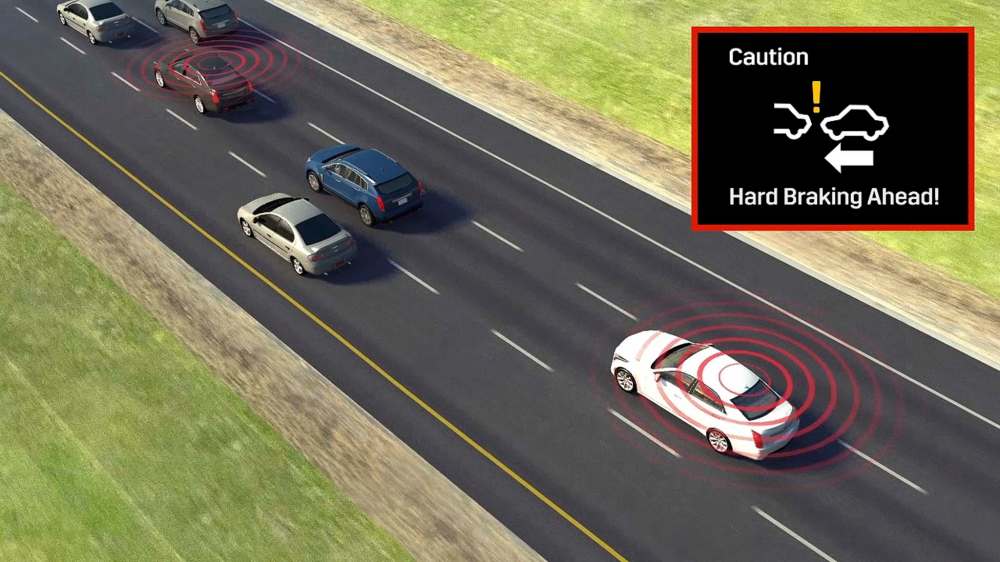
When a vehicle-to-vehicle equipped car is detected to be braking hard, 2017 Cadillac CTS drivers will get a 'Hard Braking Ahead' alert, giving them extra time to react.
GM Canada When a vehicle-to-vehicle equipped car is detected to be braking hard, 2017 Cadillac CTS drivers will get a 'Hard Braking Ahead' alert, giving them extra time to react.

In Canada, the 5.9 GHz frequency is dedicated for automotive use by Innovation, Science and Economic Development Canada.

There are many auto manufacturers working on V2V communications, including BMW, FCA, Ford, Honda, Audi, Toyota, Volvo and Mercedes-Benz — but Cadillac is the first to actually bring it to market.

While the safety advantages of the system are very limited when it is only on the Cadillac CTS, it is a case of which comes first, the chicken or the egg? As more vehicles enter the marketplace with V2V communications, the safer it will make all vehicles with V2V communications.

So how does it work? The on-board transmitter will send the location, speed, direction and traffic conditions out to connected vehicles to warn other drivers of potential hazards, which may otherwise be invisible.

One of the priorities of the system is to protect customer privacy. The vehicle does not send out any identifying information such as vehicle serial number, registration information or wireless identity code. Firewalls and encryption are used to ensure the signals cannot be interfered with so they can only be exchanged between valid modules.

To ensure this, a rapidly changing security code is sent out with each signal so only valid signals will be used for information.

One of the signals sent occurs when a vehicle’s brakes are applied hard. This will flash a caution message and warning chime on the receiving vehicle, advising there is hard braking ahead. This gives the driver additional time to react, which is especially useful on blind curves or hills, in dense traffic or when travelling at highway speeds.

If the stability or ABS system on a transmitting vehicle is activated due to slippery or rough roads, a caution message is received in the following vehicle and advises there is slippery road ahead. The driver can then drive with additional caution.

If the hazard lights are activated or an airbag has deployed on a transmitting vehicle, the following vehicle receives a caution message there are hazard lights ahead and a range to the other vehicle is given.

This is especially useful when there is limited visibility such as fog, heavy rain or snow.

Cadillac is leading the way with V2V communications and is committed to pioneering innovative advanced safety technology.

V2V supports Cadillac’s vision of zero collisions. Right now the system is limited because it is only on the CTS and they won’t comment on future vehicles, but I would expect future Cadillac vehicles will also include V2V communications, and other manufacturers won’t be far behind.

A few seconds of warning could make the difference between a safe drive and a serious collision, and V2V communications can give us much-needed additional time to help keep us safe.

Even vehicles not equipped with V2V communications can benefit, as their drivers respond to vehicles that have been warned in advance — resulting in fewer last-second reactions.

james.kerr@sasktel.net

Report Error Submit a Tip

More Stories

Now-independent ex-Tory leader skips legislature’s first question period in four months

Chris Kitching 5 minute read Preview

Now-independent ex-Tory leader skips legislature’s first question period in four months

Chris Kitching 5 minute read Tuesday, Sep. 29, 2026

Crime rates, the cost of living and the state of health care were on the agenda Tuesday when the legislature’s fall sitting began a day after Obby Khan’s abrupt resignation from the Tory caucus.

Read
Tuesday, Sep. 29, 2026

Cadillac leads the way in vehicle communication

Jim KerrAuto Tech 4 minute read Preview

Cadillac leads the way in vehicle communication

Jim KerrAuto Tech 4 minute read Friday, Jan. 5, 2018

It’s here. Cars can talk to each other! It is currently very limited — presently the only vehicles on the road able to communicate with each other are 2017 Cadillac CTS models built since March 2017 — but this is an important first step in improving safety for all drivers.

Vehicle-to-vehicle (V2V) communications are done using dedicated short-range communications and global positioning sensors which send a thousand messages per second up to nearly 300 metres of distance between vehicles.

The messages are sent on the 5.9-gigahertz band. This radio frequency was set aside for automotive use by the United States Congress in 1999 as an unlicensed frequency able to send messages from roadside nodes as part of an intelligent transportation system, or from vehicle-to-vehicle.

In Canada, the 5.9 GHz frequency is dedicated for automotive use by Innovation, Science and Economic Development Canada.

Read
Friday, Jan. 5, 2018

Jets new backup Stevenson ‘stoked’ to be in tandem with Skinner

Mike McIntyre 6 minute read Preview

Jets new backup Stevenson ‘stoked’ to be in tandem with Skinner

Mike McIntyre 6 minute read Yesterday at 4:23 PM CDT

It didn’t take long to get the dirt on the newest member of the Winnipeg Jets.

Meet Clay Stevenson, who has no problem if you prefer to refer to him by his long-standing nickname of “Mud.”

“You know, Clay is in the mud, and there you go. That’s it, right there,” Stevenson said Wednesday with a laugh. “I got it in juniors when I was playing in Coquitlam, and kind of stuck ever since.”

Stevenson is now hoping to make a name for himself in a city that, quite fittingly, translates to “muddy water” in Cree. The 27-year-old from Alberta was placed on waivers by the Washington Capitals and claimed by the Jets, who were looking to clarify a goaltending situation which was as murky as the Red River.

Read
Yesterday at 4:23 PM CDT

In a smart-device world, some families keep phone jacked into the wall

Sheldon Birnie 8 minute read Preview

In a smart-device world, some families keep phone jacked into the wall

Sheldon Birnie 8 minute read Tuesday, Sep. 29, 2026

When the phone rings in Kristin Shiach and Jordan Sobkowicz’s Riverview home, their three daughters race to see who can be the first to answer.

“It depends who is closest,” says 13-year-old Emily. “If I’m sitting in my room, I can get to it quickest.”

“That’s because it’s always in your room,” Anna, 10, replies. “You never put it back!”

“Usually, when the phone rings,” explains Sobkowicz, “someone yells really loudly —”

Read
Tuesday, Sep. 29, 2026

Wawanesa rebrands newest branch WSI

Aaron Epp 5 minute read Preview

Wawanesa rebrands newest branch WSI

Aaron Epp 5 minute read 8:00 PM CDT

Wawanesa Mutual Insurance Co. has completed its acquisition of Ontario-based Everest Insurance Company of Canada and rebranded it as WSI, expanding Wawanesa’s commercial capabilities.

WSI will operate as a distinct organization within the Wawanesa group of companies, retaining the expertise, talent and underwriting discipline that established Everest as a respected player in the speciality market, Wawanesa announced on Thursday.

Wawanesa acquired Everest Canada from Everest Group Ltd., a Delaware-based global reinsurance and insurance provider. The deal was first announced in March and received regulatory approval in September. Financial terms were not disclosed.

“It was a very competitive process,” Wawanesa president and CEO Evan Johnston said. “This was a sought-after asset and we were the successful bidder, which I’m very proud of.”

Read
8:00 PM CDT

Health minister warns $1.2 billion in annual federal funding set to expire in March

Scott Billeck 4 minute read Preview

Health minister warns $1.2 billion in annual federal funding set to expire in March

Scott Billeck 4 minute read 6:58 PM CDT

Manitoba’s health minister is warning of possible cuts to health care with $1.2 billion in annual funding from Ottawa set to expire next year.

“We’re very concerned that what would be the largest cut to health care in a generation is right in front of us,” Health Minister Uzoma Asagwara said Thursday at the Manitoba legislature. “It means that services that Manitobans depend on will be in jeopardy and be at risk.

“Any reductions, any cuts from Canada, will have direct impacts on the health outcomes of Manitobans.”

Asagwara, who serves as the provincial and territorial health minister lead, chaired a virtual meeting Tuesday with provincial and territorial health ministers to discuss federal funding for health care, mental health care and substance use services, which is scheduled to expire March 31, 2027.

Read
6:58 PM CDT