Ford Mustang pace car a rare find
Owner plans to return car to stock condition
Advertisement
Read this article for free:
or
Already have an account? Log in here »
To continue reading, please subscribe:

Digital Subscription
One year of digital access for only $205*
- Enjoy unlimited reading on winnipegfreepress.com
- Read the E-Edition, our digital replica newspaper
- Access News Break, our award-winning app
- Play interactive puzzles
*First annual payment billed as $205.00 + GST for one year. This annual subscription will automatically renew at $233.00 + GST every 52 weeks (10% off the regular annual price of $259.35). Offer available to new and qualified returning subscribers only. Cancel any time.
To continue reading, please subscribe:
Add Free Press access to your Brandon Sun subscription for only an additional
$1 for the first 4 weeks*
- Enjoy unlimited reading on winnipegfreepress.com
- Read the E-Edition, our digital replica newspaper
- Access News Break, our award-winning app
- Play interactive puzzles
*Your next Brandon Sun subscription payment will increase by $1.00 and you will be charged $17.95 plus GST for four weeks. After four weeks, your payment will increase to $24.95 plus GST every four weeks.
Read unlimited articles for free today:
or
Already have an account? Log in here »
Hey there, time traveller!
This article was published 06/04/2018 (3061 days ago), so information in it may no longer be current.
For 1979, Ford introduced a new Mustang to replace the Mustang II.
Built on an all-new Fox unit-body platform, the fifth-generation Mustang’s sheet metal was designed and proven through use of a wind tunnel, to reduce drag and improve performance.
The result set a milestone for Ford, producing a fastback with a slippery 0.44 coefficient of drag. Coupled with thinner glass, advanced plastics, aluminum and high-strength low-alloy steel, it was 200 pounds lighter than the previous model.

With engine-management technology still quite primitive, Ford introduced a new lighter 2.3-litre turbocharged, four-cylinder engine, with a two-barrel carburetor. Rated at 131 horsepower, it produced just nine horsepower less than the 5.0-litre V-8 and ran a comparable time in 0-100 km/h acceleration testing.
Other available engines included a naturally-aspirated 2.3-litre inline four-cylinder, 2.8-litre V-6 and a 3.3-litre inline six-cylinder.
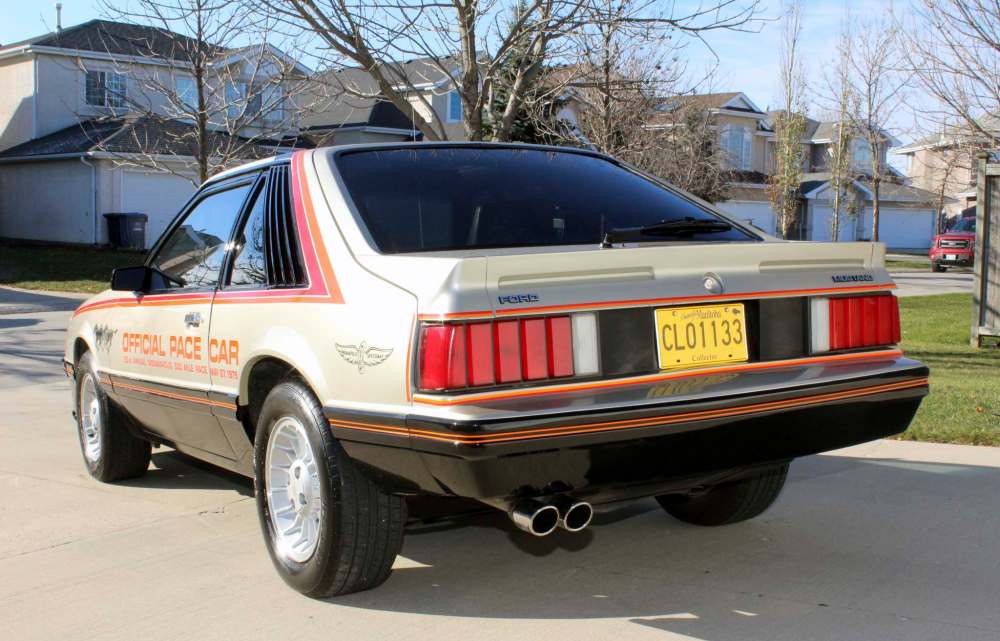
A coupe or three-door hatchback with a Ghia and Mach I package as available options were offered. There was also the Official Pace Car edition, commemorating the 63rd Annual Indianapolis 500, complete with graphics, ground effects and a special equipment package. The Pace Car package easily doubled the Mustang’s base price and by adding just a few options, the list price would near $10,000.
Ron Rabski of Winnipeg started off looking for a replacement for an early 1979 to 1982 Mercury Capri he previously owned. In 2014 he came upon an online for sale ad for the Mustang pace car in Perham, Minn. An original Kansas car with 107,000 miles on the odometer, it featured a completely rebuilt 2.3-litre turbocharged engine mated to a Borg-Warner four-speed manual transmission, leading to a 3.45:1 ratio rear axle.
Finished in Pewter Silver with the pace car graphics, it was in good condition, with only an aftermarket stereo installed. Inside it is equipped with black and white cloth and vinyl Recaro reclining bucket seats, centre console, power steering, power front disc brakes, electric rear window defroster, flip-open sunroof tinted glass, three-spoke, leather-wrapped steering wheel, Marchal fog lamps, SelectAire air conditioner and sport-tuned exhaust with twin chrome exhaust tips. There’s also the northern climate package, which includes the rare $63 optional rear window wiper and washer.
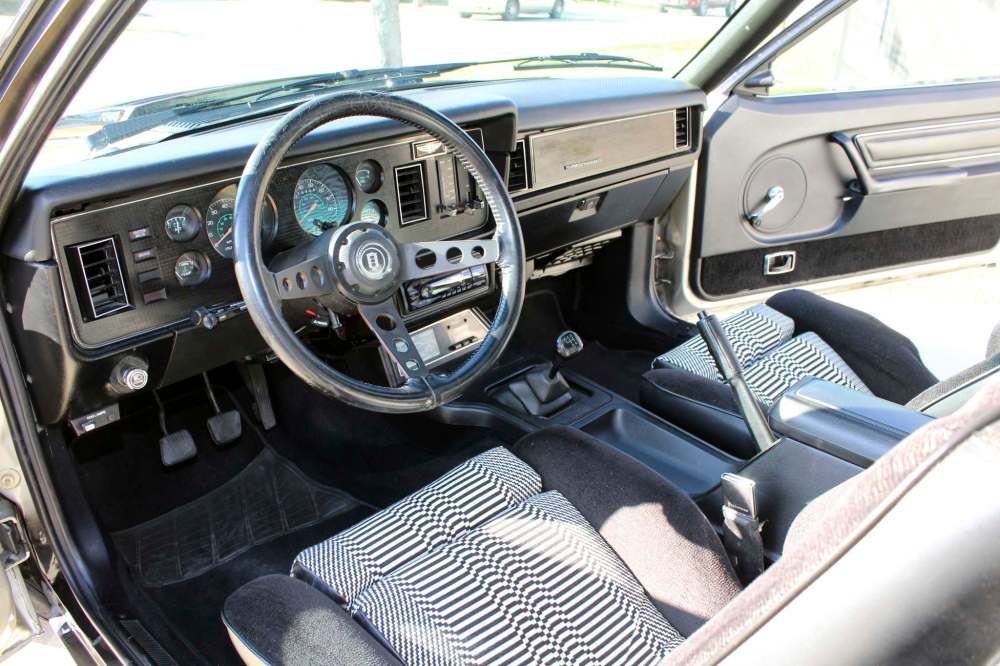

Originally the car came with forged Metric aluminum wheels with Michelin TRX radial tires, but now rides on a set of 15-inch wheels from a 1988 Mustang GT wrapped in 60-series radial tires. Rabski has rebuilt the instrument cluster and tail lamp housings, and installed new rear suspension including upgraded control arms.
A member of the Manitoba Mustang and Ford Association since 2015, Rabski says, “I bought it to drive it and tinker with it and my goal is to return it back to stock condition, including the original stereo and the correct Metric wheels and TRX tire package.”
Total pace car production for 1979 was 10,478 units, but Rabski’s Mustang pace car is one of only 5,970 equipped with the 2.3-turbo four-cylinder with four-speed manual transmission. Replaced in 1994, the Fox platform would serve the Mustang well and with an impressive 14-year run.
The Mustang has served as an Indianapolis 500 pace car three times. First in 1964 followed by 1979 and again in 1994. May 27 will mark the 102nd running of the Indianapolis 500.
57ford@mymts.net