Used car prices, sector inventory stabilizing

Advertisement

Advertise with us

There’s a little relief starting to emerge from the COVID-19 pandemic-era high-priced used car market. However, the days of patiently waiting it out for a steal of a price on the exact car you’ve been looking for appear likely over.

Read this article for free:


or

Already have an account? Log in here »

To continue reading, please subscribe:

Subscribe and receive a limited-edition Free Press branded hat or tote.

Digital Subscription

One year of digital access for only $205*

  • Enjoy unlimited reading on winnipegfreepress.com
  • Read the E-Edition, our digital replica newspaper
  • Access News Break, our award-winning app
  • Play interactive puzzles

*First annual payment billed as $205.00 + GST for one year. This annual subscription will automatically renew at $233.00 + GST every 52 weeks (10% off the regular annual price of $259.35). Offer available to new and qualified returning subscribers only. Cancel any time.

To continue reading, please subscribe:

Add Free Press access to your Brandon Sun subscription for only an additional

$1 for the first 4 weeks*

  • Enjoy unlimited reading on winnipegfreepress.com
  • Read the E-Edition, our digital replica newspaper
  • Access News Break, our award-winning app
  • Play interactive puzzles
Start now

*Your next Brandon Sun subscription payment will increase by $1.00 and you will be charged $17.95 plus GST for four weeks. After four weeks, your payment will increase to $24.95 plus GST every four weeks.

Hey there, time traveller!
This article was published 24/07/2024 (809 days ago), so information in it may no longer be current.

There’s a little relief starting to emerge from the COVID-19 pandemic-era high-priced used car market. However, the days of patiently waiting it out for a steal of a price on the exact car you’ve been looking for appear likely over.

The good news for consumers is average used car prices in Canada have gone down by 8.3 per cent over the past 12 months and, on some dealers lots, the used inventory is significantly higher.

Average prices for both new and used cars in Canada, however, remain significantly higher than they were before the pandemic — and Baris Akyurek, vice-president of insights and intelligence at AutoTrader.ca, does not believe they will be crashing back down.
JOHN WOODS / FREE PRESS
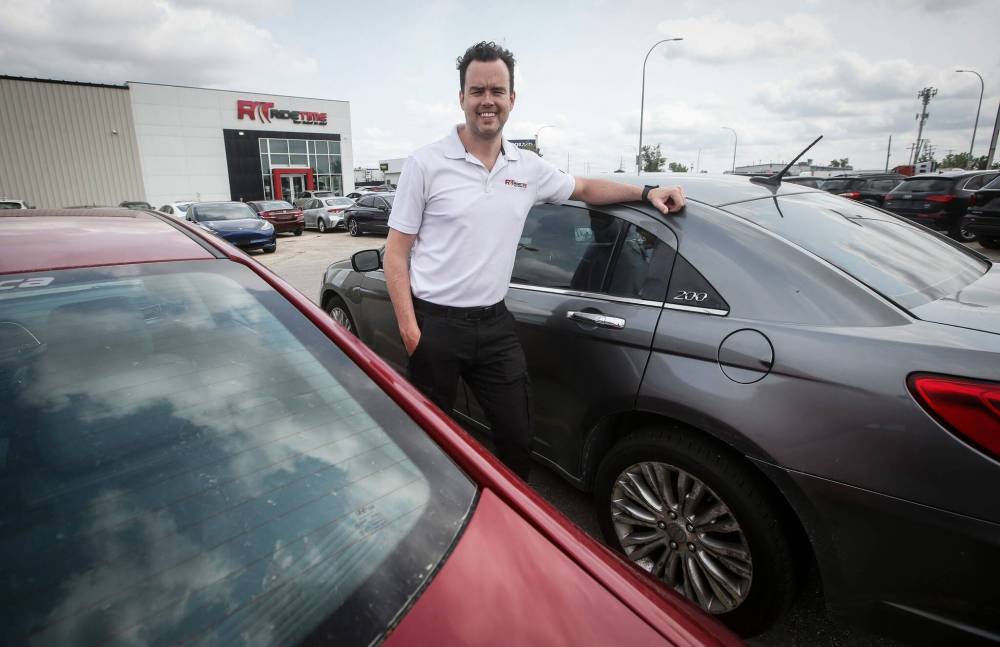
                                Andrew MacIver, co-owner of Ride Time, an independent used car dealership in Winnipeg, says sector dealerships are facing unique postCOVID-9 pandemic struggles, including a lack of affordable inventory and increased competition in the auction market.

JOHN WOODS / FREE PRESS

Andrew MacIver, co-owner of Ride Time, an independent used car dealership in Winnipeg, says sector dealerships are facing unique postCOVID-9 pandemic struggles, including a lack of affordable inventory and increased competition in the auction market.

In AutoTrader’s most recent quarterly price index report, Akyurek notes both used and new inventory availability is much better – up 28.2 per cent and 70.4 per cent, respectively, since a year ago. He points out that since 2019 — “the last normal year” — prices of new vehicles are up 48 per cent (to $66,807 from $45,204) and used cars are up 40 per cent (to $36,342 from $26,042).

(Black Book Canada and other car price services have slightly different numbers.)

Even still, Akyurek said: “On a general level, things are moving in the right direction. That is the point we are trying to make.”

Meantime, the realities on the street are tough when it comes to affordability.

Andrew MacIver, one of the so-called “Bargain Brothers” of Winnipeg used car dealership Ride Time, said: “Being in the used car side of the business post-pandemic has been a lot more challenging than being in the new car side.”

When the pandemic hit and auto manufacturers started shipping fewer new vehicles to dealers, those dealerships started to hit the used car auctions to beef up their inventories (whereas previously about 70 per cent of used inventories would have come from trade-ins).

That drove up the sticker price of used cars.

Then, there was the rental car businesses, which had let inventories decline and then had to replenish them … at the used car auctions.

“They were able to pay prices more than the used car dealers were willing to pay because they could charge more to rent that car to offset the cost,” said MacIver. “They were the better end user for some of those vehicles.”

As well, dealers and manufacturers cut back on leases during the pandemic, which effectively culled what, now three years later, would otherwise have been a healthy source of used inventories now.

Many other factors came into play — not the least of which were inflation and rising interest rates — which all contributed to jacking prices up some more.

But consumer demand remains, because people need cars.

MacIver said consumers waiting for the right car at the right price can only wait so long.

“It’s like an airplane circling a runway waiting to land. At some point, it will run out of gas and be forced to land,” he said, adding Ride Time’s business is up about 20 per cent this year.

Steve Chipman, president of Birchwood Automotive Group in Winnipeg, owners of 22 dealerships, said: “Our used inventory is significantly higher now than it was a couple of years ago. It would be more if we could get the right used vehicles.”

That said, Birchwood sales are trending up about 10 per cent this year.

MacIver has the same concerns. His dealership changed its focuses to lower-priced vehicles — “Everyday cars for everyday people” is the way he puts it.

He figures the noted 8.3 per cent decline in prices on used vehicles is mostly coming from the higher-priced ones.

AutoTrader’s website has an average of about 410,000 vehicles at any given time — down from about 450,000 before the pandemic — while the selling price declined on 31 per cent of cars listed in June, Akyurek said. That’s the most in a single month dating to the start of the pandemic.

Ride Time has been able to maintain about 100 cars on its lot through the last few years. “Whereas other lots looked like maybe they were going out of business,” MacIver said, because of inventory challenges,

He pointed out another anomalous factor that has added to the demand pressure on the market: the influx of new Canadians.

“They’re not looking to buy $66,000 cars,” he said, which is Black Book Canada’s average price of new car. “They’re not even looking to buy a $34,000 car,” which is the average price of a used car.

Partially because of that new demand, cohort prices at the low end of the used car market haven’t decreased by that noted 8.3 per cent total average. MacIver said those lower-end prices (around $25,000) have held steady for a couple of months.

“We had a better time at the auction earlier in the year,” he said.

Meantime, higher-priced used vehicles are coming down, partially because of rebates and incentives manufacturers are now offering on new cars.

Chipman said, during the pandemic, manufactures were not delivering a lot of “lower-trim” inventory, loading up instead on more profitable, fully loaded models.

That’s starting to change, theoretically making new vehicles more affordable.

martin.cash@freepress.mb.ca

Report Error Submit a Tip

More Stories

Is this the season of secession?

David McLaughlin 5 minute read Preview

Is this the season of secession?

David McLaughlin 5 minute read Yesterday at 2:01 AM CDT

Canada has entered its season of secession. Like El Nino, the currents of grievance can blow hot and cold. Today, they are hot. But how hot for how long? The odds of Alberta and now Quebec separating from Canada are not high, but they are never zero.

After a year of waving the flag in a surge of national patriotism to confront Donald Trump’s attacks on Canada — economic and verbal — it is both jarring and frustrating for most Canadians to be reminded of the pervasive and persistent tensions that come with governing our federation.

When we need new national purpose to confront big economic sovereignty and security challenges from outside, that purpose is undermined and diminished by having to confront homegrown grievances.

We’ve seen and seen off two separation referendums in Quebec. Now we have a newly elected separatist party coming to power. In Alberta, voters will soon decide whether the independence road is one they want to travel.

Read
Yesterday at 2:01 AM CDT

Towing company hands stolen car back, but not to owner

By Matthew Frank 4 minute read Preview

Towing company hands stolen car back, but not to owner

By Matthew Frank 4 minute read Friday, Oct. 9, 2026

A Manitoba man says he is dumbfounded after his car was stolen, impounded by a Winnipeg towing company and given back — to someone that wasn’t him.

Cody Lamb lives in the western Manitoba community of Douglas, about 18 kilometres east of Brandon, but spends weeks away from home working on oil rigs in Alberta.

The 24-year-old says on Sept. 11, while away for work, he heard from his girlfriend who told him his car wasn’t in their driveway. Lamb reported the car stolen to Brandon RCMP the same day.

After filing the report, he heard from Steinbach RCMP on Oct. 1 that his car was recovered that day in the community of Mitchell, roughly five km west of Steinbach.

Read
Friday, Oct. 9, 2026

Puppies, stocks — ‘zoomies’ abound

Andrew Froese 4 minute read Yesterday at 2:01 AM CDT

This spring, I adopted a three-month-old rescued German Shepherd mix. To say she is easily excitable is an understatement.

It is not really her fault. A puppy’s frontal cortex, the part of the brain that helps with decision-making and impulse control, is still developing. When an older dog, or a human, gets tired, we generally understand we should rest. Puppies have not quite figured that out. They often interpret tiredness as a signal something is wrong, which makes them more alert, more reactive and harder to settle.

That creates a feedback loop. The puppy gets tired, which makes her frantic, which makes her more tired, which makes her even more frantic. Eventually, this becomes what people call the “zoomies”: frantic sprinting, biting, jumping and general chaos.

From the outside, it looks like the puppy has too much energy. In reality, the opposite is true. The zoomies are not a sign of excess energy. They are a sign the puppy is overtired and does not know it yet.

Protein crests current appetite wave

Laura Rance-Unger 4 minute read Preview

Protein crests current appetite wave

Laura Rance-Unger 4 minute read Yesterday at 2:01 AM CDT

Holiday feasts often reflect the latest fads and trends influencing how we eat.

This Thanksgiving’s table is likely to feature more Canadian content than it might otherwise as a point of national pride.

In the recent past, the carb-free craze has made cauliflower a substitute for the mashed potatoes on some family spreads. Some have gone meatless, while others have added more. Still others offer gluten-free, dairy-free or fat-free alternatives.

Nowadays, it seems consumers can’t get enough protein. Desmond Sobool, deputy chief economist Farm Credit Canada, told a recent economic update for the agri-food sector there are two converging influences in play.

Read
Yesterday at 2:01 AM CDT

Longtime voice of the Blue and Gold marks major milestone

David Sanderson 8 minute read Preview

Longtime voice of the Blue and Gold marks major milestone

David Sanderson 8 minute read Friday, Oct. 9, 2026

Bob McGregor made his debut as the Winnipeg Blue Bombers’ public-address announcer on June 7, 1997, during a pre-season game at Winnipeg Stadium between the hometown Blue Bombers and their western rivals, the Calgary Stampeders.

McGregor will be behind the microphone again this Saturday, detailing the action on the field in addition to leading a boisterous Princess Auto Stadium crowd through what has become his signature call, “And that is another Winnipeg Blue Bombers first down!”

The Bombers’ final home date of the 2026 regular season will mark a major milestone for McGregor, and the former newscaster feels it’s only fitting the same two teams as 10,717 days ago — the Bombers and Stampeders — will be the ones butting helmets.

“I knew at the start of the season I was closing in on 300 games as the PA guy, only it wasn’t until I went through the schedule that I realized my 300th would be Winnipeg-Calgary, which struck me as kind of cool,” McGregor says, seated in a St. James breakfast nook, dressed in dark trousers and a blue-and-gold Blue Bombers golf shirt.

Read
Friday, Oct. 9, 2026

Phoneless concert a beautiful chance to bask in moment

Jen Zoratti 5 minute read Preview

Phoneless concert a beautiful chance to bask in moment

Jen Zoratti 5 minute read Yesterday at 2:01 AM CDT

Outside the Scotiabank Arena in Toronto, digital billboards flashed fans their singular photo op for the night: “I took this photo before I saw Phoebe Bridgers: The Lost Tour 2026.”

It is, as it is for so many other people, my only documentation of a concert by one of my favourite artists. The American singer-songwriter — who I discovered at the Winnipeg Folk Festival in 2018 — has had a meteoric rise in the past few years, winning three Grammys in 2024 as one third of Boygenius, the indie-rock supergroup rounded out by Lucy Dacus and Julien Baker, and opening for Taylor Swift on select dates of her titanic Eras Tour.

Now, Bridgers is touring in support of Lost Weekend, her third album and first since 2020’s Punisher. It’s a feat of a record, a richly textured meditation on loss and grief, written in the aftermath of the death of her dad, with whom she had a complicated relationship.

So she is in a position to not only play multiple sold-out arena shows, but also insist that those shows be phone-free.

Read
Yesterday at 2:01 AM CDT