Canadian researchers find ‘silent’ strokes common for seniors after surgery

Advertisement

Advertise with us

HAMILTON - Canadian researchers say so-called "silent" strokes are common in seniors after they have elective, non-cardiac surgery and double their risk of cognitive decline one year later.

Read this article for free:


or

Already have an account? Log in here »

To continue reading, please subscribe:

Subscribe and receive a limited-edition Free Press branded hat or tote.

Digital Subscription

One year of digital access for only $205*

  • Enjoy unlimited reading on winnipegfreepress.com
  • Read the E-Edition, our digital replica newspaper
  • Access News Break, our award-winning app
  • Play interactive puzzles

*First annual payment billed as $205.00 + GST for one year. This annual subscription will automatically renew at $233.00 + GST every 52 weeks (10% off the regular annual price of $259.35). Offer available to new and qualified returning subscribers only. Cancel any time.

To continue reading, please subscribe:

Add Free Press access to your Brandon Sun subscription for only an additional

$1 for the first 4 weeks*

  • Enjoy unlimited reading on winnipegfreepress.com
  • Read the E-Edition, our digital replica newspaper
  • Access News Break, our award-winning app
  • Play interactive puzzles
Start now

*Your next Brandon Sun subscription payment will increase by $1.00 and you will be charged $17.95 plus GST for four weeks. After four weeks, your payment will increase to $24.95 plus GST every four weeks.

Hey there, time traveller!
This article was published 15/08/2019 (2591 days ago), so information in it may no longer be current.

HAMILTON – Canadian researchers say so-called “silent” strokes are common in seniors after they have elective, non-cardiac surgery and double their risk of cognitive decline one year later.

Cardiologist and co-lead researcher PJ Devereaux of Hamilton Health Sciences says that “silent” — or covert — strokes are actually more common than overt strokes in surgery patients aged 65 or older.

While an overt stroke causes obvious symptoms such as weakness in one arm or speech problems, a covert stroke is not obvious except on brain scans.

Cardiologist and co-lead researcher PJ Devereaux, a senior scientist at the Population Health Research Institute of McMaster University and Hamilton Health Sciences, is shown in handout photo. Canadian researchers say so-called
Cardiologist and co-lead researcher PJ Devereaux, a senior scientist at the Population Health Research Institute of McMaster University and Hamilton Health Sciences, is shown in handout photo. Canadian researchers say so-called "silent" strokes are common in seniors who have elective, non-cardiac surgery and double their risk of cognitive decline one year later.THE CANADIAN PRESS/HO-McMaster University/Hamilton Health Sciences MANDATORY CREDIT

Overt stroke occurs in less than one per cent of adults after non-cardiac surgery but researchers found that covert stroke occurred among seven per cent of the 1,114 study participants.

The global study detected MRI evidence of the more subtle condition among 78 patients aged 65 years and older who underwent surgery between March 24, 2014, and July 21, 2017.

These patients were also more likely to experience cognitive decline, delirium, overt stroke or a mini-stroke within one year, compared to patients who did not have a silent stroke.

The results of the NeuroVISION study were published Thursday in The Lancet.

Co-lead investigator, Dr. Marko Mrkobrada of Western University, said the findings underscore the risks involved when older patients undergo surgery, especially as improving surgical and anesthetic techniques allow surgeons to operate on older and sicker patients.

“Despite the benefits of surgery, we also need to understand the risks,” Mrkobrada, an associate professor of medicine at the London, Ont., university, said in a news release.

The report concludes by calling for more research to determine the cause of covert stroke following surgery and to establish whether anything can be done to prevent cognitive decline.

The patients came from 12 health centres in North and South America, Asia, New Zealand, and Europe.

All patients received an MRI within nine days of surgery but only 1,001 completed the one-year follow-up.

Of those, 69 had suffered a covert stroke, and among those patients, 29 experienced cognitive decline, or 42 per cent.

Meanwhile, 274 patients — or 29 per cent — of the 932 participants who did not suffer a covert stroke experienced cognitive decline.

The most common types of surgeries were orthopedic, urological or gynecological. The mean age of participants was 73 years, and 56 per cent were men, 64 per cent had a history of hypertension, and five per cent had a history of stroke.

Major funders of the study included the Canadian Institutes of Health Research, the Ontario Strategy for Patient Oriented Research support unit, the Ontario health ministry, Government of the Hong Kong Special Administrative Region, China, and The Neurological Foundation of New Zealand.

— by Cassandra Szklarski in Toronto

Report Error Submit a Tip

More Stories

Man gets 18 year sentence for sex assault that impregnated teen girl

Tessa Adamski 4 minute read Yesterday at 2:01 AM CDT

BRANDON — A 29-year-old man has been sentenced to 18 years in prison for sexually abusing and impregnating a 14-year-old girl in 2024.

“Sexual abuse of a child is inherently a grave violation of the child’s bodily integrity, dignity, and security, and in this case, the consequences were compounded by the victim’s pregnancy and the need to undergo a termination,” Brandon provincial court Judge Patrick Sullivan said on Tuesday.

The accused had pleaded guilty to two counts of sexual interference and two counts of breaching a court order banning him from contacting anyone under 18.

A publication ban prohibits the publication of information that could identify the 14-year-old, who is from a western Manitoba First Nation, and two other minors with whom he communicated.

‘She was looking to destroy me’: convicted harasser faces new charges

Dean Pritchard 6 minute read Preview

‘She was looking to destroy me’: convicted harasser faces new charges

Dean Pritchard 6 minute read 6:54 PM CDT

When Agnieszka Ciochon-Newton moved into the 55-plus apartment building on Stradbrook Avenue last year, she came across as “timid, soft-spoken and sensitive,” said building manager Tanya Owen.

Little did Owen know the meek-looking 58-year-old woman would soon turn her life and the lives of many of her tenants upside down and threaten her career and family.

“She was looking to destroy me for a simple tenant disagreement,” Owen said Thursday.

Court records show Ciochon-Newton was arrested earlier this month and charged with seven counts of criminal harassment, two counts of uttering threats and one count each of fraud, breaking and entering, attempting to obstruct justice, intimidation of a justice official, mischief and defamatory libel.

Read
6:54 PM CDT

Police officer faces charges of domestic assault

Free Press staff 2 minute read Preview

Police officer faces charges of domestic assault

Free Press staff 2 minute read 4:26 PM CDT

A Winnipeg police officer has been charged after police said he broke into a woman’s home and attacked her.

Police were sent to a home on Wednesday shortly before 10:20 p.m., the Winnipeg Police Service said in a Thursday news release. When officers arrived, they found the man, 20-year member in his 40s, inside a home assaulting the woman, the release said.

The man was taken into custody and the woman was given medical aid.

She told officers the man broke into the home, threatened to kill her and then attacked her.

Read
4:26 PM CDT

Gerdau recycling workers on strike

Gabrielle Piché 3 minute read Preview

Gerdau recycling workers on strike

Gabrielle Piché 3 minute read 7:29 PM CDT

Workers behind recycling operations for Selkirk’s steel mill walked off the job last week, calling for higher wages.

Unionized members voted to strike July 23, with a 92 per cent mandate. Months of bargaining hasn’t produced a new deal, said United Steelworkers Local 8740. The union represents 78 members striking at Gerdau AmeriSteel Manitoba Metals recycling plant.

“We’re not being recognized for the amount of work we’ve been doing,” Andrew Sealey, acting president of the local, said Thursday. “The mill is a sensational beast … We’ve got to feed her all the time, and she’s always hungry.”

The scrap metal inspected and unloaded at the recycling facility is used in steel mill operations.

Read
7:29 PM CDT

Manitobans mostly optimistic about time change

Nicole Buffie 5 minute read Preview

Manitobans mostly optimistic about time change

Nicole Buffie 5 minute read 6:47 PM CDT

Turning the page on turning back the clocks in Manitoba was met with enthusiasm — and some hesitation — Thursday.

Calling the move “perfect,” the general manager of Larters at St. Andrews Golf & Country Club said a switch to permanent standard time would have hurt men’s and women’s golf leagues.

The course could have tried to open an hour earlier, but some after-work leagues may have been forced to cancel owing to not enough daylight.

“It would get dark too early and people can’t leave work early to go play an hour earlier,” said Geoff Kehler. “It would have been really bad for the business.”

Read
6:47 PM CDT

Manitoba abandoning spring, fall clock changes

Carol Sanders 8 minute read Preview

Manitoba abandoning spring, fall clock changes

Carol Sanders 8 minute read Updated: 5:36 PM CDT

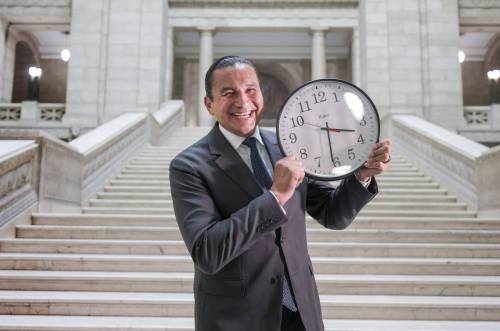
Time’s up for the time change in Manitoba.

Manitobans won’t be setting their clocks back an hour in November. The province has decided to permanently stay on daylight time after surveying residents on the twice annual clock adjustment.

“We heard from Manitobans loud and clear — no more changing the clocks in Manitoba,” Premier Wab Kinew said in a news release Thursday.

Most of the 72,000 votes submitted in an online EngageMB survey — 92 per cent — said they would like to see the practice end. The survey asked if they preferred earlier sunrises in winter with standard time or the later sunsets in summer with daylight time. More than half of survey participants (58 per cent) indicated a preference to stay on permanent daylight time; 34 per cent voted to eliminate the time change but stay on standard time.

Read
Updated: 5:36 PM CDT