Critters fight the jitters
City college welcomes emotional-support animals to help ease students' exam stress

Advertisement
Read this article for free:
or
Already have an account? Log in here »
To continue reading, please subscribe:

Digital Subscription
One year of digital access for only $205*
- Enjoy unlimited reading on winnipegfreepress.com
- Read the E-Edition, our digital replica newspaper
- Access News Break, our award-winning app
- Play interactive puzzles
*First annual payment billed as $205.00 + GST for one year. This annual subscription will automatically renew at $233.00 + GST every 52 weeks (10% off the regular annual price of $259.35). Offer available to new and qualified returning subscribers only. Cancel any time.
To continue reading, please subscribe:
Add Free Press access to your Brandon Sun subscription for only an additional
$1 for the first 4 weeks*
- Enjoy unlimited reading on winnipegfreepress.com
- Read the E-Edition, our digital replica newspaper
- Access News Break, our award-winning app
- Play interactive puzzles
*Your next Brandon Sun subscription payment will increase by $1.00 and you will be charged $17.95 plus GST for four weeks. After four weeks, your payment will increase to $24.95 plus GST every four weeks.
Read unlimited articles for free today:
or
Already have an account? Log in here »
Hey there, time traveller!
This article was published 17/04/2018 (3007 days ago), so information in it may no longer be current.
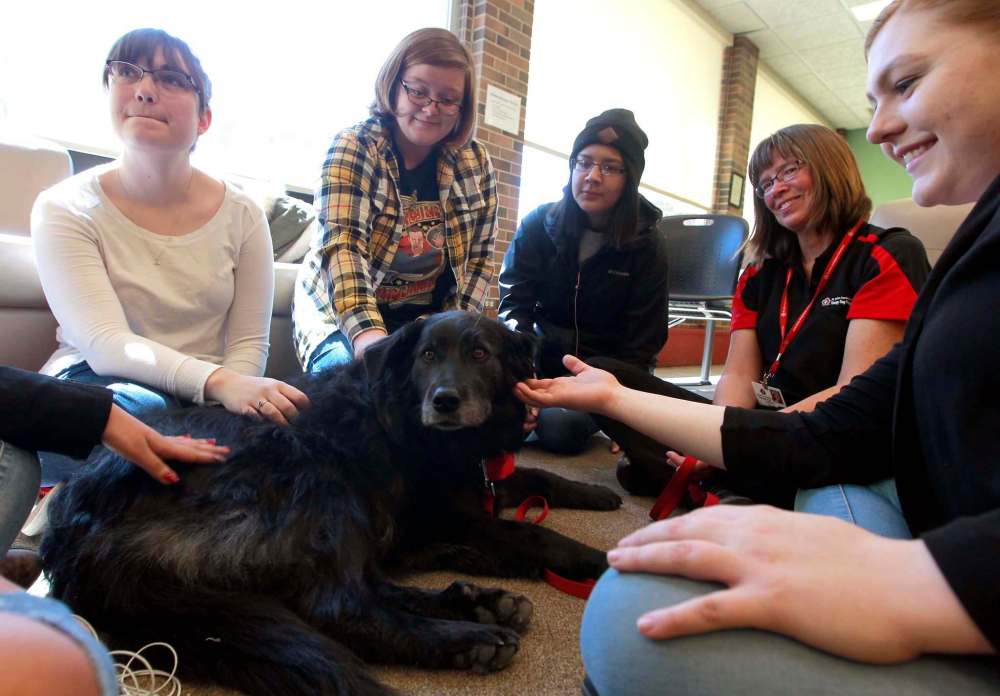
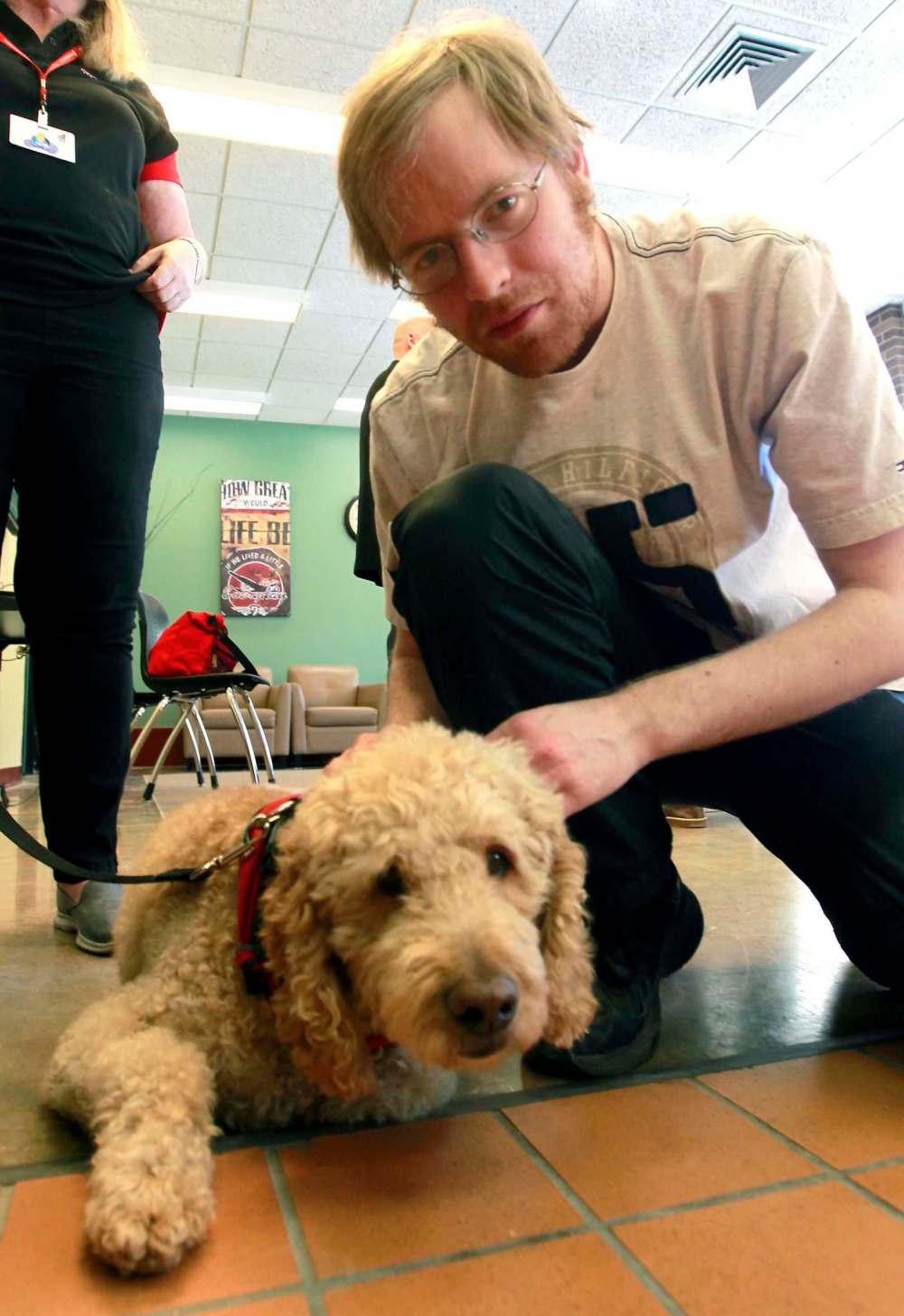
It’s Monday afternoon, and Booth University College has a pair of visitors in its sun-filled common room: a goldendoodle named Dexter and a border collie/lab mix named Claire. Dexter and Claire are surrounded by a small group of students, and are being showered with pats and snuggles.
Claire and Dexter are emotional-support dogs who are visiting from St. John Ambulance on the first day of final exams. They are here to help students cope with stress and anxiety.
“Exam season is stressful, everyone knows that, but the dogs bring a little touch of home,” says Zach Marshall, a 20-year-old business administration student who has a beagle named Maggie back home in St. John’s, N.L. “It brings that calming influence that allows me to push through and focus.”
Sessions with emotional-support dogs are becoming increasingly popular at colleges and universities all over North America, especially during exam time. Although support animals have become ubiquitous — you may recall the emotional-support peacock who was denied a seat on an airliner earlier this year — their effect on humans is still an emerging area of scientific study. But there’s plenty of anecdotal evidence suggesting that interacting with animals can boost mood and mitigate stress.
In 2017, about 172 therapy-dog teams from St. John Ambulance provided about 9,900 hours of support and had around 103,000 people interactions.
Exams, of course, are not the only source of stress for post-secondary students. Along with balancing course loads and exam schedules, many university and college students are living on their own for the first time. They’re navigating that space between being a teenager and being an adult, figuring out what kind of person they’ll be.
And millennials, the youngest cohort of which have just entered university, are said to be the most anxious generation in history. Between social media and its attendant pressures and the rise of the gig economy and increased job insecurity, it’s little wonder students are feeling the squeeze, especially those who are about to graduate. Many touchstones on the generally accepted path of adulthood — degree, career, marriage, house, kids, retirement — are becoming out of reach for upcoming generations, and many young people have rejected those norms. And so, they are breaking new paths — which can also be scary — but instead of being heralded as trailblazers, they are derided for spending all their money on avocado toast.
Insert shrug emoji here.
For some students, a visit with Claire or Dexter might be enough to calm jangled nerves during exam season. For other students living with mental illness, a little more support might be required.
To that end, Booth University College has recently implemented a service/support animal policy for students in residence, allowing those students with a medically documented disability to keep an animal in on-campus housing. (It’s worth noting that emotional-support animals are not the same as service animals. Service animals have specific training, whereas emotional-support animals do not. Booth’s policy covers both.)
“It’s something we’re trying,” says Rhonda Friesen, dean of students. “We feel it has made a positive difference, and we want to be on the proactive edge of things.”
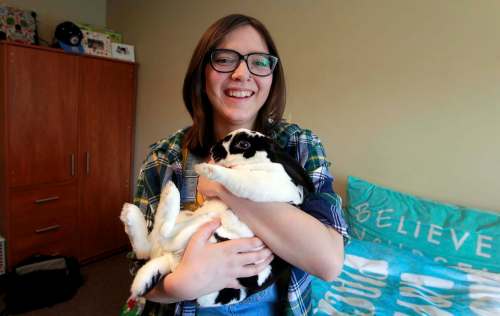
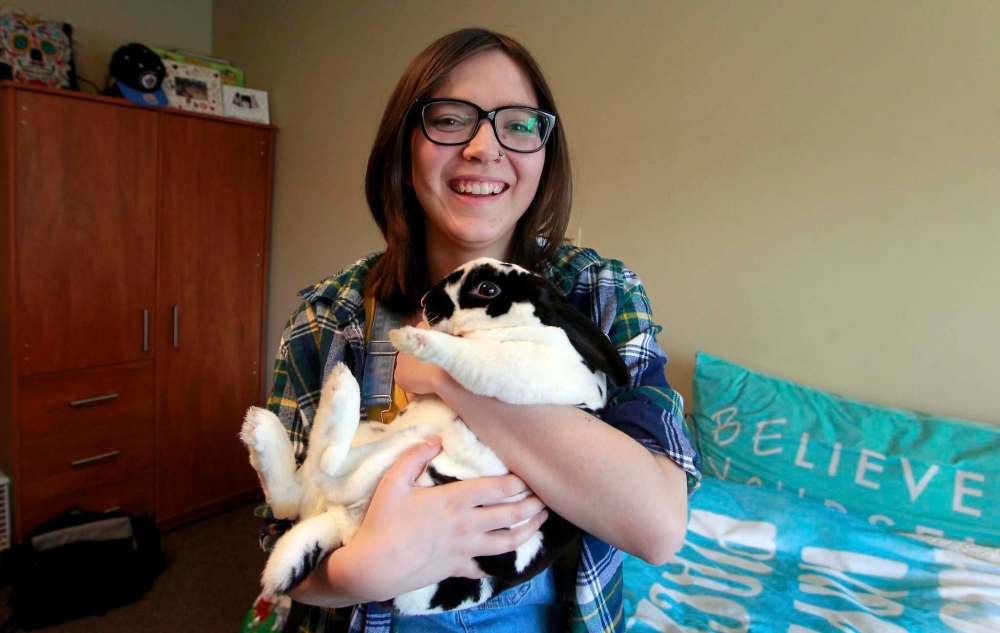
Booth University College has one furry resident so far — a black-and-white rabbit named Chubbster. Chubbster belongs to Quinn Hegg, 19, a second-year behavioural sciences and English student.
Hegg, who comes to BoothUC from Airdrie, Alta., was diagnosed with bipolar disorder, anxiety and obsessive compulsive disorder when she was 17, after years of being misdiagnosed with ADHD, attention deficity hyperactivity disorder.
“Getting a diagnosis was groundbreaking — to have a treatment plan that worked for me and have a label for what was going on,” she says.

Part of that treatment plan included the recommendation of a support animal. Hegg had originally wanted to get a cat, but a fellow student on her floor had a severe allergy. So Hegg suggested a rabbit. She went down to the Winnipeg Humane Society and, when she met the fat rabbit, it was love at first sight.
“He’s a sass ball,” she says with a laugh. “He’s very vocal. He’s a work in progress. We believe he came from a rough situation. He’s slowly becoming more cuddly and affectionate. He loves snacks, nonstop, hence his name. For a rabbit, he’s pretty outgoing.”
Chubbster has changed Hegg’s life.
“It sounds so small, but (having him in residence) changed everything,” she said. “It made school easier, it made studying easier. He’s always around. I have something to look forward to.” When she’s depressed, he helps her get out of bed in the morning. “I have to do what I have to do to take care of him. And having that companionship when I’m feeling alone or isolated — I always have unconditional love.”
jen.zoratti@freepress.mb.caTwitter: @JenZoratti
Jen Zoratti is a columnist and feature writer working in the Arts & Life department, as well as the author of the weekly newsletter NEXT. A National Newspaper Award finalist for arts and entertainment writing, Jen is a graduate of the Creative Communications program at RRC Polytech and was a music writer before joining the Free Press in 2013. Read more about Jen.
Every piece of reporting Jen produces is reviewed by an editing team before it is posted online or published in print – part of the Free Press‘s tradition, since 1872, of producing reliable independent journalism. Read more about Free Press’s history and mandate, and learn how our newsroom operates.
Our newsroom depends on a growing audience of readers to power our journalism. If you are not a paid reader, please consider becoming a subscriber.
Our newsroom depends on its audience of readers to power our journalism. Thank you for your support.
Jen Zoratti is a columnist and feature writer working in the Arts & Life department, as well as the author of the weekly newsletter NEXT. A National Newspaper Award finalist for arts and entertainment writing, Jen is a graduate of the Creative Communications program at RRC Polytech and was a music writer before joining the Free Press in 2013. Read more about Jen.
Every piece of reporting Jen produces is reviewed by an editing team before it is posted online or published in print – part of the Free Press‘s tradition, since 1872, of producing reliable independent journalism. Read more about Free Press’s history and mandate, and learn how our newsroom operates.
Our newsroom depends on a growing audience of readers to power our journalism. If you are not a paid reader, please consider becoming a subscriber.
Our newsroom depends on its audience of readers to power our journalism. Thank you for your support.
Advertisement Advertise With Us
Advertisement Advertise With Us
History
Updated on Tuesday, April 17, 2018 3:51 PM CDT: Fixes abbreviation