Emily Oster crunches parenting data so you don’t have to
Advertisement
Read this article for free:
or
Already have an account? Log in here »
To continue reading, please subscribe:

Digital Subscription
One year of digital access for only $205*
- Enjoy unlimited reading on winnipegfreepress.com
- Read the E-Edition, our digital replica newspaper
- Access News Break, our award-winning app
- Play interactive puzzles
*First annual payment billed as $205.00 + GST for one year. This annual subscription will automatically renew at $233.00 + GST every 52 weeks (10% off the regular annual price of $259.35). Offer available to new and qualified returning subscribers only. Cancel any time.
To continue reading, please subscribe:
Add Free Press access to your Brandon Sun subscription for only an additional
$1 for the first 4 weeks*
- Enjoy unlimited reading on winnipegfreepress.com
- Read the E-Edition, our digital replica newspaper
- Access News Break, our award-winning app
- Play interactive puzzles
*Your next Brandon Sun subscription payment will increase by $1.00 and you will be charged $17.95 plus GST for four weeks. After four weeks, your payment will increase to $24.95 plus GST every four weeks.
Read unlimited articles for free today:
or
Already have an account? Log in here »
Hey there, time traveller!
This article was published 18/04/2019 (2659 days ago), so information in it may no longer be current.
NEW YORK – Breastfeeding, sleep training, food allergies: Parents navigate an onslaught of decisions, particularly fraught from birth to preschool when their own sleep deprivation and inexperience may come into play.
Add the know-it-all internet and well-meaning but perhaps uninformed loved ones to the mix for added chaos and confusion. That’s where Emily Oster comes in. She’s done a lot of the legwork without espousing a specific approach or philosophy.
Oster is an economist, married to an economist and the daughter of two economists. She has written a data-driven parenting guide covering the first three years of life, “Cribsheet,” out this month from PenguinPress.
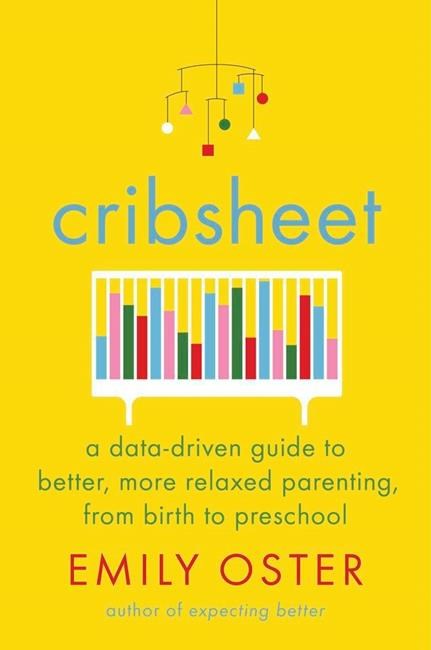
It’s her second book. The first, “Expecting Better,” covers data behind pregnancy and was published in 2013.
“This is really a book about decision making and that is what economists study,” Oster told The Associated Press in a recent interview. “It’s that approach of really stepping back and saying, OK, what are the costs and benefits and how do I combine that with my preferences as a parent?”
Oster, also the mother of two children and an economics professor at Brown University, makes it clear early on that she’s not interested in commenting on policy but on what the data says a parent should do if given a choice. And if a lot of technical data and busy graphs seem mind-blowing, she includes boiled-down takeaways at the end of each chapter and has a relaxed, accessible writing style any panicked parent can appreciate.
Some highlights:
BREASTFEEDING
Oster puts it right out there: Her first turn at breastfeeding, a daughter who is now 8, was hard. Supplementing with formula in the hospital using an elaborate system that involved taping a tube to her breast, as opposed to just handling a bottle, was baffling.
Her second child, a son, got the hang of breastfeeding from the get-go.
The benefits of breastfeeding are many, she notes, but the data isn’t always clear.
“Some of the things that you’ve been told, like it reduces childhood obesity and it raises your kid’s IQ, isn’t supported by the best evidence,” Oster said. “A lot of women struggle to breastfeed and they often are made to feel really, really terrible about that, and told if you don’t do this you’re not giving your child the best start in life. That is simply not supported in the best data.”
CIRCUMCISION
About half of male babies in the U.S. are circumcised, for religious or medical reasons or simply because parents want their son’s penis to look the same as Dad’s. Elsewhere, in Europe for instance, the practice is not typical.
Circumcision remains a hot topic for debate.
Oster says the major risk, as with any surgical procedure, is infection. For infant circumcisions performed in a hospital, the best data she teased out shows that risk is small. Overall, she said, estimates suggest that just 1.5% of infant circumcisions result in minor complications, and virtually none result in serious problems.
“There are some very small risks and some very small benefits,” she said. “The trade-off is minimal.”
FOOD ALLERGIES
We owe a complete turn in the recommended approach to peanut allergies to one Gideon Lack, a researcher at King’s College in London, Oster said.
Until Lack and his fellow researchers published a study in 2015 in the New England Journal of Medicine, the standard advice to parents had been, generally, wait until a baby turns 1 or 2 before introducing peanuts, especially for children at higher risk for the allergy.
In a randomized controlled trial, the kind Oster likes best, the researchers recruited about 700 babies between 4 and 11 months old. They found that children who were exposed to peanuts were far less likely to be allergic to them by age 5 than children who were not.
“The finding is especially notable as it suggests that the standard advice parents were given about peanuts up to this point was entirely wrong,” Oster said.
Early exposure in a controlled setting, she said, is now the prevailing recommendation, especially for children at risk for an allergy.
SWADDLING
Swaddling is one of those early infant practices that gets the internet going at high pitch.
“It’s, should I swaddle right now? When should I take him out of the swaddle? Should I take one arm out of the swaddle first? That kind of panicky decision-making is what leads people to any port in the storm in the middle of the night,” Oster said.
She cited research done in a sleep lab with 26 infants under 3 months of age using a special type of swaddle that could detect movement. Researchers observed the babies during both swaddled and unswaddled sleep.
They found that the babies slept longer overall and with more REM sleep when swaddled.
In cultures where tight swaddling is common, including groups that tie babies to cradleboards, there is a risk of an infant developing hip dysplasia, Oster said.
A baby’s legs must be able to flex at the hip when swaddled, she said. Most of today’s standard swaddling blankets are designed to allow that.
The lab evidence is supported by other studies.
CRYING IT OUT
Go online and ask Dr. Google about sleep training and crying it out, and the perils seem dire. Such opposition is focused on a baby feeling abandoned and, as a result, struggling to form attachments to parents and, ultimately, anyone else.
Where do those alarm bells originate? Romanian orphanages, Oster said.
In the 1980s, thousands of infants and children filled Romanian orphanages, suffering a range of deprivations and abuse. They had nearly no adult contact, and were left in cribs for years at high developmental and psychological cost. Visitors to the orphanages noticed an eerie quiet; infants and babies didn’t cry because they knew no one would come, Oster said.
Those traumas led parents away from a cry-it-out method.
A few nights of sleep training, however, likely will not have the same negative results, Oster said. The literature shows that some form of cry-it-out sleep training works. She found positive results for leaving and not returning, leaving but checking on the baby at intervals, and staying in the room while letting a child cry at bedtime.
There are few solid, randomized studies following children on the lasting impact of crying it out. One, done in Australia with 328 families, showed no difference at age 6 between those left to cry starting at 8 months old and those who were not sleep-trained that way, in terms of emotional stability, behaviour, stress and the parent-child bond, Oster said.
“There doesn’t seem like there’s any downside long-term,” she said. “That doesn’t mean it’s going to be the right choice for everybody but for those who do want to do that, there’s a reassuring picture from the data.”