WEATHER ALERT

Exhibit on US Latina ‘cholas’ opens in Albuquerque

Advertisement

Advertise with us

ALBUQUERQUE, N.M. - A national Hispanic centre is displaying a unique art exhibit on the chola — the working class, Mexican-American urban female often associated with gangs.

Read this article for free:

or

Already have an account? Log in here »

To continue reading, please subscribe:

Subscribe and receive a limited-edition Free Press branded hat or tote.

Digital Subscription

One year of digital access for only $205*

  • Enjoy unlimited reading on winnipegfreepress.com
  • Read the E-Edition, our digital replica newspaper
  • Access News Break, our award-winning app
  • Play interactive puzzles

*First annual payment billed as $205.00 + GST for one year. This annual subscription will automatically renew at $233.00 + GST every 52 weeks (10% off the regular annual price of $259.35). Offer available to new and qualified returning subscribers only. Cancel any time.

To continue reading, please subscribe:

Add Free Press access to your Brandon Sun subscription for only an additional

$1 for the first 4 weeks*

  • Enjoy unlimited reading on winnipegfreepress.com
  • Read the E-Edition, our digital replica newspaper
  • Access News Break, our award-winning app
  • Play interactive puzzles
Start now

*Your next Brandon Sun subscription payment will increase by $1.00 and you will be charged $17.95 plus GST for four weeks. After four weeks, your payment will increase to $24.95 plus GST every four weeks.

Hey there, time traveller!
This article was published 07/03/2019 (2700 days ago), so information in it may no longer be current.

ALBUQUERQUE, N.M. – A national Hispanic centre is displaying a unique art exhibit on the chola — the working class, Mexican-American urban female often associated with gangs.

The National Hispanic Cultural Center in Albuquerque opened the “Que Chola Exhibition” on Friday with pieces by artists from New Mexico, Arizona, California, Texas, and Colorado.

The displays feature the evolution of the chola from the World War II-era to the contemporary figure trying to survive in poor neighbourhoods. Using paintings, photography and sculptures, the exhibit attempts to cover images of the chola as an urban warrior, a mentor, a mother and political figure.
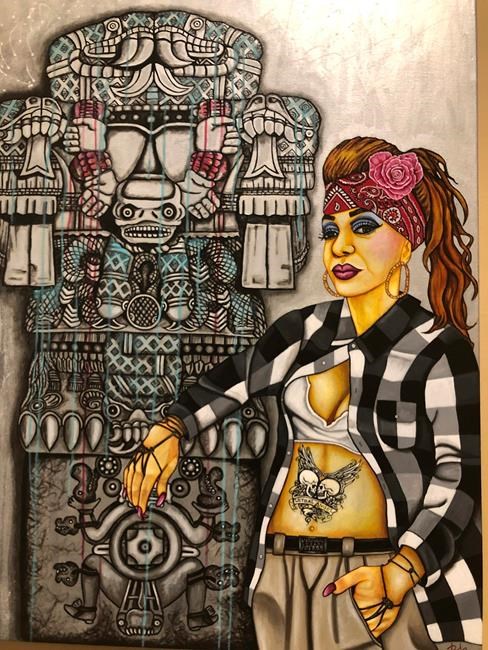
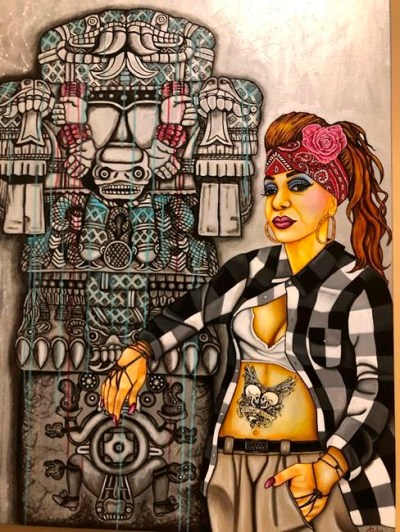
In this Wednesday, March 6, 2019 photo of the painting entitled
In this Wednesday, March 6, 2019 photo of the painting entitled "Coatlicue Lopez" by artist Pola Lopez hangs at the National Hispanic Cultural Center in Albuquerque, before the opening of a exhibit on the chola _ a working-class, Mexican-American female often associated with urban gangs. The "Que Chola Exhibition" opens on Friday, March 8, 2019, with pieces by artists from New Mexico, Arizona, California, Texas, and Colorado. (AP Photo/Russell Contreras)

Cholas, or homegirls, often refers to a particular Latina subculture in the U.S. characterized by a tough demeanour and distinctive style. They are identified by their clothing ranging from flannel shirts and khaki pants to their dark eye makeup and indigenous-theme tattoos.

The image of the chola gained popularity in the late 1980s and early 1990s with movies like “Colors” and “Mi Vida Loca” (My Crazy Life).

In recent years, scholars have countered that the chola represents more than just gang activity. Latina scholars have argued that the chola’s image is a commentary of poverty in urban U.S. cities and symbolized a working-class Latina seeking to battle sexism.

Some Latina academics have playfully said on social media that “you can’t spell scholar without the word ‘CHOLA’.”

Curator Jadira Gurule said she agreed that the chola is more than a so-called dangerous female gang member linked to criminal activity. For many Latinas, Gurule said the chola also represents strength and perseverance.

“Many within our communities either were, or admired and wanted to emulate, the chola growing up,” Gurule said. “She also represents real people with real experiences. The chola is a persona developed in response to racism and sexism. To reduce her to a gang member is shallow.”

Pola Lopez, a Las Vegas, New Mexico, born artist who now lives in Los Angeles, said she was excited when she was asked to participate in the exhibit. “The chola…you can’t mess with her,” said Lopez. “She’s beautiful and represents us in many ways.”

Her painting, “Coatlicue and Chola,” features a homegirl leaning against a statue of an Aztec goddess.

Nanibah Chacon, a Navajo and Hispanic artist from Arizona, said she wanted to create an image of a chola if she had been represented in midcentury advertisements. Her painting, “Xicana Classic,” depicts a chola from the 1970s sitting on a red circle and smiling with confidence.

The exhibit, which runs until Aug. 4, is the latest attempt to create a new image around the chola and expand her meaning.

The Los Angeles-based gang intervention group Homeboy Industries, for example, sells clothing designed by former cholas and runs Homegirl Cafe — a restaurant with food prepared by former gang members gaining new skills. The hip cafe is an offshoot of social enterprises founded by Jesuit priest Greg Boyle.

And Art Laboe, a 93-year-old DJ based in Palm Springs, California, allows cholas every Sunday on his syndicated oldies show “The Art Laboe Connection Show” to call in and give dedications to their loved ones serving time in prison. Scholars and activists say the radio show helps humanize cholas since it allows listeners to hear cholas express emotions of love and pain.

___

Associated Press Writer Russell Contreras is a member of The Associated Press’ race and ethnicity team. Follow Contreras on Twitter at http://twitter.com/russcontreras

___

This story corrects a previous version with the quote “you can’t spell scholar without the word ‘CHOLA’.”

Report Error Submit a Tip

More Stories

‘Eight credible threats’ against Hydro employees: CEO

Chris Kitching 6 minute read Preview

‘Eight credible threats’ against Hydro employees: CEO

Chris Kitching 6 minute read Updated: Yesterday at 4:32 PM CDT

Manitoba Hydro president and CEO Allan Danroth took aim at critics and revealed he and staff members have been threatened while defending the Crown corporation’s plan for three new combustion turbines Monday.

Without identifying individuals, Danroth said “constant, uninformed criticism” of Hydro and misinformation has eroded public trust and contributed to hostilities and an unsafe workplace for employees.

“Manitoba Hydro is currently managing eight credible threats against our employees, five of them directed at me personally,” Danroth told a Public Utilities Board hearing in Winnipeg.

“More troubling is these threats are increasingly affecting our front-line workforce. In the last year, my employees have been threatened with weapons, including guns, while performing their duties, and in one recent incident a homeowner directed his dogs to attack one of our meter readers.”

Read
Updated: Yesterday at 4:32 PM CDT

Landlord asks city to work with him over homeless camp after appeal option turfed

Scott Billeck 4 minute read Preview

Landlord asks city to work with him over homeless camp after appeal option turfed

Scott Billeck 4 minute read Yesterday at 5:44 PM CDT

A West Broadway landlord says the City of Winnipeg has rejected his attempt to appeal an order that requires him to clear a homeless encampment from his riverfront property.

Marvin Sharp, CEO of Astroid Management Ltd., which operates the Pen-Eve Apartments at 35 Balmoral St., said Monday the decision is absurd since his firm was given almost no time to respond to the order.

The city denied his request for an appeal hearing because he failed to respond before the July 18 compliance deadline.

Sharp contends that was impossible because the compliance order, dated July 10, did not arrive at his office until July 17, leaving him just one day to file an appeal. The city clerk’s office is closed on weekends.

Read
Yesterday at 5:44 PM CDT

Province announces review of child welfare funding, governance

Free Press staff 2 minute read Preview

Province announces review of child welfare funding, governance

Free Press staff 2 minute read 2:22 PM CDT

Manitoba’s child-welfare system will undergo a review of its funding and governance models in an effort to build transparency and strength within the sector, the province announced Tuesday.

The move follows long-standing concerns raised by Indigenous leadership and child welfare partners, the government said in a news release.

“This review is about building a stronger system that helps keep children safe and supported while ensuring families, communities and nations have the resources they need to care for their children,” Families Minister Nahanni Fontaine said in the release.

“This review responds directly to calls from Indigenous leadership and rights holders for greater transparency within the provincial system now and as they work to reclaim jurisdiction over child welfare.”

Read
2:22 PM CDT

Today’s horoscope

Georgia Nicols 4 minute read Preview

Today’s horoscope

Georgia Nicols 4 minute read 2:00 AM CDT

MOON ALERT: Caution! Avoid shopping (except food and gas) and important decisions from 1 a.m. until 9:15 p.m. today. After that, the moon moves from Capricorn into Aquarius.

ARIES (March 21-April 19)

Tread carefully, because it’s a moon alert for most of this day. (See above.) Channel your energies into creative activities as this day favours the arts, fun socializing and playful times with kids.

TAURUS (April 20-May 20)

Read
2:00 AM CDT

Police crackdown made news, but did it make a difference?

Tom Brodbeck 5 minute read 2:24 PM CDT

There are many questions — and few answers — about Winnipeg’s recent 10-day police crackdown on open drug use and trafficking.

The Winnipeg Chamber of Commerce gave the crackdown a thumbs-up in a statement last week, saying the inner-city enforcement initiative that began June 24 was necessary because businesses and employees are increasingly concerned about safety.

That’s a legitimate problem. People should be able to work, shop, walk and live in their neighbourhoods without being exposed to open drug use, trafficking and violence. Public spaces cannot be surrendered to criminal activity.

But the chamber’s support also comes with an important caveat: enforcement cannot be the whole strategy.

Exhibit on US Latina 'cholas' opens in Albuquerque

Russell Contreras, The Associated Press 4 minute read Preview

Exhibit on US Latina 'cholas' opens in Albuquerque

Russell Contreras, The Associated Press 4 minute read Friday, Mar. 8, 2019

ALBUQUERQUE, N.M. - A national Hispanic centre is displaying a unique art exhibit on the chola — the working class, Mexican-American urban female often associated with gangs.

The National Hispanic Cultural Center in Albuquerque opened the "Que Chola Exhibition" on Friday with pieces by artists from New Mexico, Arizona, California, Texas, and Colorado.

The displays feature the evolution of the chola from the World War II-era to the contemporary figure trying to survive in poor neighbourhoods. Using paintings, photography and sculptures, the exhibit attempts to cover images of the chola as an urban warrior, a mentor, a mother and political figure.

Cholas, or homegirls, often refers to a particular Latina subculture in the U.S. characterized by a tough demeanour and distinctive style. They are identified by their clothing ranging from flannel shirts and khaki pants to their dark eye makeup and indigenous-theme tattoos.

Read
Friday, Mar. 8, 2019