

‘Eight credible threats’ against Hydro employees: CEO
Regulator told misinformation fuels anger against Crown corporation staff

Advertisement
Read this article for free:
or
Already have an account? Log in here »
To continue reading, please subscribe:

Digital Subscription
One year of digital access for only $205*
- Enjoy unlimited reading on winnipegfreepress.com
- Read the E-Edition, our digital replica newspaper
- Access News Break, our award-winning app
- Play interactive puzzles
*First annual payment billed as $205.00 + GST for one year. This annual subscription will automatically renew at $233.00 + GST every 52 weeks (10% off the regular annual price of $259.35). Offer available to new and qualified returning subscribers only. Cancel any time.
To continue reading, please subscribe:
Add Free Press access to your Brandon Sun subscription for only an additional
$1 for the first 4 weeks*
- Enjoy unlimited reading on winnipegfreepress.com
- Read the E-Edition, our digital replica newspaper
- Access News Break, our award-winning app
- Play interactive puzzles
*Your next Brandon Sun subscription payment will increase by $1.00 and you will be charged $17.95 plus GST for four weeks. After four weeks, your payment will increase to $24.95 plus GST every four weeks.
Read unlimited articles for free today:
or
Already have an account? Log in here »
Manitoba Hydro president and CEO Allan Danroth took aim at critics and revealed he and staff members have been threatened while defending the Crown corporation’s plan for three new combustion turbines Monday.
Without identifying individuals, Danroth said “constant, uninformed criticism” of Hydro and misinformation has eroded public trust and contributed to hostilities and an unsafe workplace for employees.
“Manitoba Hydro is currently managing eight credible threats against our employees, five of them directed at me personally,” Danroth told a Public Utilities Board hearing in Winnipeg.
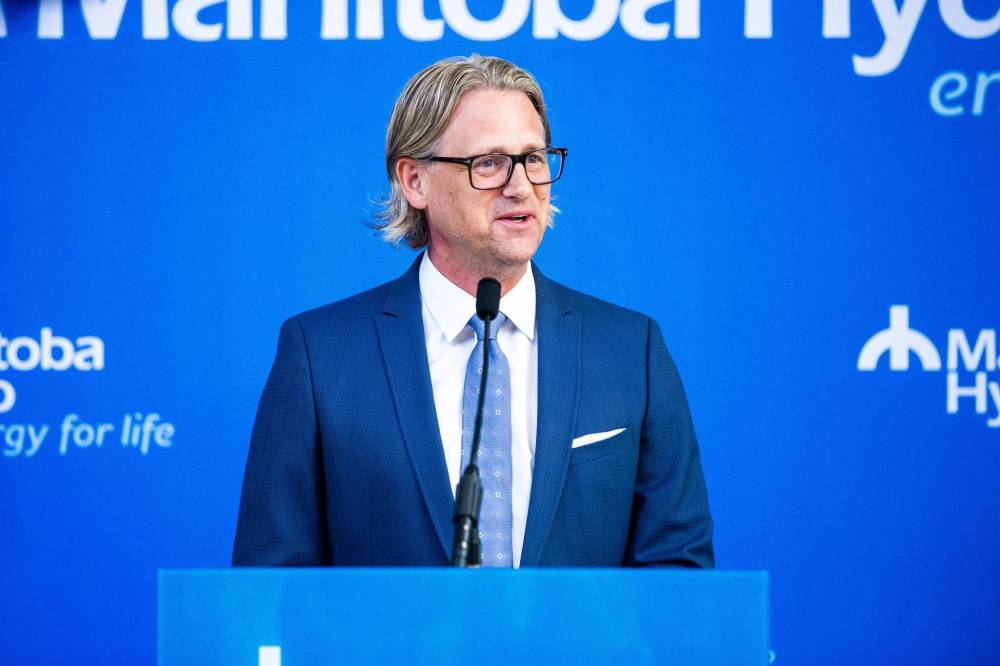
MIKAELA MACKENZIE / FREE PRESS FILES
Manitoba Hydro president and CEO Allan Danroth spoke for 25 minutes on the first day of hearings into Hydro’s proposal for natural gas-powered turbines in Brandon.
“More troubling is these threats are increasingly affecting our front-line workforce. In the last year, my employees have been threatened with weapons, including guns, while performing their duties, and in one recent incident a homeowner directed his dogs to attack one of our meter readers.”
He said the corporation deployed security officers and enhanced protective equipment.
Danroth made the comments on the first day of hearings into Hydro’s proposal for natural gas-powered turbines in Brandon, which have an estimated cost of $3 billion, and a 10-year integrated resource plan to meet growing energy demand. The hearings are scheduled to last six weeks.
Outside the hearing afterward, Hydro declined to provide additional information about the threats or whether they had been reported to police.
The PUB, an independent regulator, also heard opening statements from seven interveners: the Consumers Coalition; a group representing small and medium customer classes; the Manitoba Eco-Network and Environmental Defence Canada; an industrial power users group; Manitoba Keewatinowi Okimakanak, which represents northern First Nations; Sustainable Brandon; and Wa Ni Ska Tan, an alliance of Indigenous communities impacted by Hydro operations.
Hydro projected a shortfall of up to 600 megawatts in firm electricity capacity by the end of 2030. The long-term plan calls for about 1,760 megawatts, largely via new turbines and Indigenous-led wind farms, by 2035, plus about 860 megawatts of energy-saving measures.
“We are here to ask, if renewable energy solutions instead of gas peaker plants can work in other places in the world, why can they not work in Brandon?”
Some Brandon residents and Manitoba organizations that advocate for ratepayers or the environment are concerned about certain proposals. Some interveners said there are deficiencies in the IRP or the analysis used by Hydro to justify the turbines, which it hopes to build by 2030.
Hydro will face questions about whether other options are more appropriate or cost effective.
“We are here to ask, if renewable energy solutions instead of gas peaker plants can work in other places in the world, why can they not work in Brandon?” said Madelyn Robinson, chair of volunteer-led Sustainable Brandon, citing wind and solar energy, and battery storage as possible alternatives.
Byron Williams, a lawyer for the Consumers Coalition, said Hydro’s reliance on natural gas as a solution demonstrates a “comfort trap.”
The coalition’s legal team is concerned overbuilding will lead to higher rates.
“Approving a plan this ripe with analytic flaws is too risky for ratepayers, who will bear the burden of Hydro’s capital investment for decades to come,” he said.
Lawyers for small and medium customer classes, and industrial power users raised concerns about potential impacts on rates.
Danroth said the IRP charts a path that emphasizes safety, reliability, and affordability.
He said Manitoba has one of the greenest electricity grids in Canada and the second-lowest rates in the country.
The turbines are “absolutely necessary” to meet future demand, and would have “virtually no impact” on greenhouse gas emissions, Danroth said.
He pointed to summer and winter electricity usage records set in July and January 2025, respectively.
“Approving a plan this ripe with analytic flaws is too risky for ratepayers, who will bear the burden of Hydro’s capital investment for decades to come.”
Hydro, which is facing a $25-billion debt and aging infrastructure, said the turbines will eventually run on low-carbon fuels when readily available.
Danroth warned Hydro isn’t the “energy superpower” many people think it is because demand is growing, and the utility is susceptible to drought and lower water levels.
Manitoba was a net importer of power for the first time in recent memory, Danroth said, when it imported 5.9 terawatt hours of electricity from the U.S. via the Midcontinent Independent System Operator (MISO), of which Hydro is the lone Canadian member, due to an energy shortfall in January.
He said imports from MISO are becoming more expensive and are likely generated by a fossil fuel, either coal or natural gas.
“So you can see why adding gas-fired generation that will make a small shift in our overall energy portfolio is not something anyone should get too wound up over if you truly care about the environment and truly are the self-avowed expert you claim to be in media story after media story,” Danroth said.
Kent Elson, representing the Manitoba Eco-Network and Environmental Defence Canada, said the organizations will ask the PUB to recommend the decision and build dates for the proposed turbines be deferred by three to eight years to accommodate further long-term planning.
In the short term, the need for additional electricity is small, and cheaper and cleaner resources, such as battery storage, are available, Elson said.
“It would be far better to potentially import some fossil power for a few years, or at least have that as a backstop — hopefully, we don’t even need to use it — than it would be to build a very large fossil fuel plant Manitoba would be saddled with for the next 30 years,” he said.
Danroth said battery storage is not a viable long-term solution owing to extreme cold in the winter, and solar power is not viable because winter’s peak demand occurs in times of darkness.
The 10-year plan includes battery storage for up to five megawatts by 2034.
“Wa Ni Ska Tan’s goal in this hearing is to ensure the diverse perspectives, needs and interests of First Nation people are considered in energy planning and meaningfully incorporated into the IRP.”

MKO will advocate for economic reconciliation and further consideration to isolated, remote or “grid edge” communities in the north, the PUB heard.
Charlotte Connolly, a lawyer for Wa Ni Ska Tan, raised concerns about Hydro’s public consultation process, which Danroth defended, and the involvement of First Nation people.
“Wa Ni Ska Tan’s goal in this hearing is to ensure the diverse perspectives, needs and interests of First Nation people are considered in energy planning and meaningfully incorporated into the IRP,” she said.
The PUB will this fall provide recommendations to the Manitoba government, which has the final say on Hydro’s proposals.
chris.kitching@freepress.mb.ca
Chris Kitching is a general assignment reporter at the Free Press. He began his newspaper career in 2001, with stops in Winnipeg, Toronto and London, England, along the way. After returning to Winnipeg, he joined the Free Press in 2021, and now covers a little bit of everything for the newspaper. Read more about Chris.
Every piece of reporting Chris produces is reviewed by an editing team before it is posted online or published in print — part of the Free Press‘s tradition, since 1872, of producing reliable independent journalism. Read more about Free Press’s history and mandate, and learn how our newsroom operates.
Our newsroom depends on a growing audience of readers to power our journalism. If you are not a paid reader, please consider becoming a subscriber.
Our newsroom depends on its audience of readers to power our journalism. Thank you for your support.
Chris Kitching is a general assignment reporter at the Free Press. He began his newspaper career in 2001, with stops in Winnipeg, Toronto and London, England, along the way. After returning to Winnipeg, he joined the Free Press in 2021, and now covers a little bit of everything for the newspaper. Read more about Chris.
Every piece of reporting Chris produces is reviewed by an editing team before it is posted online or published in print — part of the Free Press‘s tradition, since 1872, of producing reliable independent journalism. Read more about Free Press’s history and mandate, and learn how our newsroom operates.
Our newsroom depends on a growing audience of readers to power our journalism. If you are not a paid reader, please consider becoming a subscriber.
Our newsroom depends on its audience of readers to power our journalism. Thank you for your support.
Related Articles
Manitoba Hydro’s energy plan set to be scrutinized








Advertisement Advertise With Us
Advertisement Advertise With Us
History
Updated on Monday, July 27, 2026 4:32 PM CDT: Updated for quotes and additional details.