From His Grace to Father Jim
Retiring archbishop helped strengthen bond with aboriginal community

Advertisement
Read this article for free:
or
Already have an account? Log in here »
To continue reading, please subscribe:

Digital Subscription
One year of digital access for only $205*
- Enjoy unlimited reading on winnipegfreepress.com
- Read the E-Edition, our digital replica newspaper
- Access News Break, our award-winning app
- Play interactive puzzles
*First annual payment billed as $205.00 + GST for one year. This annual subscription will automatically renew at $233.00 + GST every 52 weeks (10% off the regular annual price of $259.35). Offer available to new and qualified returning subscribers only. Cancel any time.
To continue reading, please subscribe:
Add Free Press access to your Brandon Sun subscription for only an additional
$1 for the first 4 weeks*
- Enjoy unlimited reading on winnipegfreepress.com
- Read the E-Edition, our digital replica newspaper
- Access News Break, our award-winning app
- Play interactive puzzles
*Your next Brandon Sun subscription payment will increase by $1.00 and you will be charged $17.95 plus GST for four weeks. After four weeks, your payment will increase to $24.95 plus GST every four weeks.
Read unlimited articles for free today:
or
Already have an account? Log in here »
Hey there, time traveller!
This article was published 31/08/2013 (4751 days ago), so information in it may no longer be current.
Some call him brother, others call him doctor, but Archbishop James V. Weisgerber would really prefer to answer to a simple “Father Jim.”
Sometime this fall, the Saskatchewan-born Roman Catholic Archbishop of Winnipeg will get his wish when he hands in his mitre and robes and moves back to Regina.
“I worked for 30 years as a priest in Regina and I’m anxious to reconnect with people,” says Weisgerber, who will take on the title of Archbishop Emeritus.
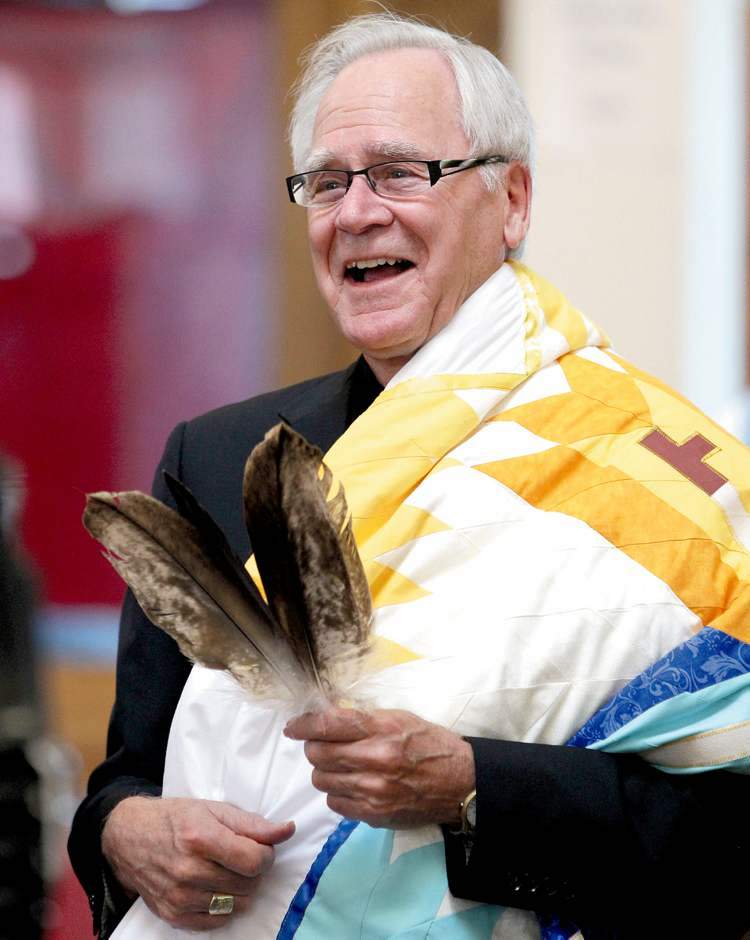
“Everyone in Regina calls me Father Jim.”
In May, Weisgerber celebrated his 50th anniversary as a priest as well as his 75th birthday, the official retirement age for priests and bishops. Although he’s submitted his resignation to the Pope, Weisgerber is still awaiting word about when he will officially step down from his official duties.
“At some date, the Pope will accept my letter and begin a process of searching for a replacement,” explains the sixth archbishop of Winnipeg, who has held that position for 13 years.
On May 29, he was awarded an honorary doctorate from the University of Manitoba, prompting the nickname of Dr. Grace. Archbishops are often addressed as His Grace.
The freshly minted doctor of laws jokes about the new title, but a longtime colleague says it describes the attributes he’s brought to his ministry and his work with the Canadian Council of Catholic Bishops, first as general secretary and later as president.
“He has a common touch and is able to engage with and collaborate with many, many people,” Archbishop Albert LeGatt of Saint Boniface writes in an email.
“He has a particular affection for First Nations people and a personal commitment to their full and rightful place and contribution within the church and within the Canadian fabric as a whole.”
In April 2012, he was adopted into the aboriginal community by two sets of brothers — Phil and Bert Fontaine, and Fred Kelly and his brother, Tobasonakwut Kinew, who died later that year. The ceremony was intended to recognize the role Weisgerber played in facilitating a 2009 meeting between Pope Benedict XVI and Canadian residential school survivors.
“What we want to do is address the issue of reconciliation and to address the issue of racism in Canada and to demonstrate to the Canadian public and the world that if people want to work together, they can work together,” Kinew told the Free Press prior to the adoption ceremony.
In addition to his work in building relationships with the aboriginal community, Weisgerber is proud of his role in establishing Micah House, the archdiocese’s social justice centre located in Winnipeg’s North End.
As one of three Catholic archbishops in the city, Weisgerber, the son of German immigrants to Vibank, Sask., demonstrated insightful leadership of his own Catholic flock and a commitment to work with other faith groups, says the archbishop and metropolitan of the Ukrainian Catholic Church.

“He was a good friend to the Ukrainian community as well, and personally, I will miss his wit and friendship as he returns to his native province of Saskatchewan,” says Metropolitan Lawrence Huculak of the Archeparchy of Winnipeg.
Once he’s freed from the busy schedule of an archbishop, Weisgerber plans to live a quieter life in Regina, enjoying the freedom to choose his activities. He’s renewing old allegiances with his purchase of season tickets to the Saskatchewan Roughriders, but plans to return to Winnipeg to catch the performances of the Manitoba Opera.
Despite his imminent departure from Winnipeg, Weisgerber still has a strong pastoral sense for the more than 100,000 Roman Catholics under his watch for the last 13 years.
“I would want people to have a very clear identity as disciples of Jesus, which would make us different from other people, but not set apart from society.”
brenda@suderman.com
The Free Press is committed to covering faith in Manitoba through our Religion in the News project. This reporting continues because readers like you step forward to fund it.
Donate now to support our reporting on religion.
Your donation is eligible for a charitable tax receipt.
BECOME A FAITH JOURNALISM SUPPORTER
Brenda Suderman has been a columnist in the Saturday paper since 2000, first writing about family entertainment, and about faith and religion since 2006.
Our newsroom depends on a growing audience of readers to power our journalism. If you are not a paid reader, please consider becoming a subscriber.
Our newsroom depends on its audience of readers to power our journalism. Thank you for your support.
The Free Press is committed to covering faith in Manitoba through our Religion in the News project. This reporting continues because readers like you step forward to fund it.
Donate now to support our reporting on religion.
Your donation is eligible for a charitable tax receipt.
BECOME A FAITH JOURNALISM SUPPORTER
Brenda Suderman has been a columnist in the Saturday paper since 2000, first writing about family entertainment, and about faith and religion since 2006.
Our newsroom depends on a growing audience of readers to power our journalism. If you are not a paid reader, please consider becoming a subscriber.
Our newsroom depends on its audience of readers to power our journalism. Thank you for your support.
Advertisement Advertise With Us
Advertisement Advertise With Us
History
Updated on Saturday, August 31, 2013 9:45 AM CDT: Fixed cutline, minor editing of story.
The Free Press acknowledges the financial support it receives from members of the city’s faith community, which makes our coverage of religion possible.