Ancient traditions
Ukrainians celebrate Christmas with rituals that predate Christianity

Advertisement
Read this article for free:
or
Already have an account? Log in here »
To continue reading, please subscribe:

Digital Subscription
One year of digital access for only $205*
- Enjoy unlimited reading on winnipegfreepress.com
- Read the E-Edition, our digital replica newspaper
- Access News Break, our award-winning app
- Play interactive puzzles
*First annual payment billed as $205.00 + GST for one year. This annual subscription will automatically renew at $233.00 + GST every 52 weeks (10% off the regular annual price of $259.35). Offer available to new and qualified returning subscribers only. Cancel any time.
To continue reading, please subscribe:
Add Free Press access to your Brandon Sun subscription for only an additional
$1 for the first 4 weeks*
- Enjoy unlimited reading on winnipegfreepress.com
- Read the E-Edition, our digital replica newspaper
- Access News Break, our award-winning app
- Play interactive puzzles
*Your next Brandon Sun subscription payment will increase by $1.00 and you will be charged $17.95 plus GST for four weeks. After four weeks, your payment will increase to $24.95 plus GST every four weeks.
Read unlimited articles for free today:
or
Already have an account? Log in here »
Hey there, time traveller!
This article was published 19/12/2015 (3917 days ago), so information in it may no longer be current.
Whether it’s the 12-course dinner, the carollers singing their way from home to home, or the sheaf of wheat in each household, Orysia Tracz sees more than tradition in how Ukrainians celebrate Christmas in Canada.
The long-time Winnipegger also sees adaptation, mixed in with ingenuity and lots of respect for the past and those who have gone before.
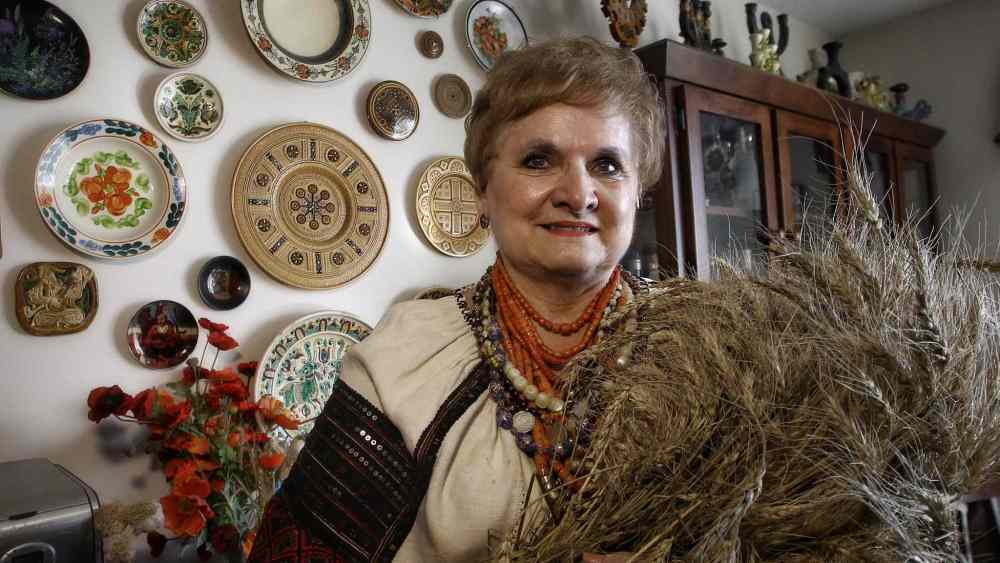
“We’re just happy we have this rich heritage,” the East Kildonan resident says about the customs featured in her first book, First Star I See Tonight: Ukrainian Christmas Traditions, available for $50 locally or online.
“All of this has been part of our history and the church part of it has been layered on top of it.”
Tracz compiled 40 articles previously published in Ukrainian Weekly and the former Winnipeg Free Press New Leisure magazine into a 131-page book packed with beautiful photographs and illustrations of Ukrainian Christmas customs, including dishes from the 12 courses of Christmas dinner, known in Ukrainian as Sviata vercheria.
Although there are regional variations in the meatless courses, the Christmas Eve dinner always begins with kutia, a mixture of wheat, honey, and poppy seed, and ends with uzvar, a compote of dried fruit, and includes favourites such as perogies, cabbage rolls and borscht.
“You start (eating) when the first star comes out and don’t hurry. The point is to sample each dish,” she says of the meal that stretches out for hours.
Whatever the particulars of the family menu, Tracz invites those around the dinner table to understand this meal reaches far back into history to an agrarian time that predates Christianity.
When Ukraine became Christianized in 988, that annual December dinner celebrating the harvest and the souls of departed loved ones was layered with Christian meanings, says Tracz, 70.
“It was believed that the souls of the ancestors in the summer lived in the fields and when this one sheaf of wheat was cut in the harvest, it was believed all the souls stayed in the sheaf of wheat and stayed until Christmas time,” she says of the symbolism of the sheaf of wheat displayed at Christmas.
Traditions such as carolling also harken to those agrarian times, when singers would go door to door singing songs about creation and nature, battles, and kings and queens, she says.
Now carollers sing Christmas hymns along with the old songs, says Tracz, who has already booked a men’s choir to sing for her family of five during the holidays.
“The carolling was to call the ancestors to come and celebrate, and to praise,” says Tracz.
Like Ukraine, many ancient cultures had mid-winter festivals celebrating the abundance of food from the harvest, as well as the return of longer days, says Gerry Bowler, a Winnipeg historian specializing in Christmas.
“The core of the celebration, the nativity, is not pagan,” explains Bowler, now finishing a book on what he dubs “Christmas wars.”
“But what you eat, how you dance or dress is cultural.”
Whatever their origins, traditions around food, greenery and song help Christians reflect on the meaning of the birth of Jesus celebrated at Christmas, says Rev. Mark Gnutel of St. Anne Ukrainian Catholic Church.
“The unknowable and unseeable is experienced in knowable and seeable things in everyday life. That’s why the Christmas supper has deeper meaning,” says Gnutel, also priest at St. Michael’s Ukrainian Catholic in Transcona.
“It’s all about the tangible linking to the intangible.”

For Tracz, who was born in Germany and raised in New Jersey, she finds meaning in how traditions connect the old with the new, and delight that some Ukrainian practices have merged into Canadian traditions.
“The Christmas lights in Winnipeg stay on to Jan. 7,” she says of one example of fused traditions.
“Everyone knows Ukrainian Christmas is in January. And now perogies are a mainstream food.”
brenda@suderman.com
The Free Press is committed to covering faith in Manitoba through our Religion in the News project. This reporting continues because readers like you step forward to fund it.
Donate now to support our reporting on religion.
Your donation is eligible for a charitable tax receipt.
BECOME A FAITH JOURNALISM SUPPORTER
Brenda Suderman has been a columnist in the Saturday paper since 2000, first writing about family entertainment, and about faith and religion since 2006.
Our newsroom depends on a growing audience of readers to power our journalism. If you are not a paid reader, please consider becoming a subscriber.
Our newsroom depends on its audience of readers to power our journalism. Thank you for your support.
The Free Press is committed to covering faith in Manitoba through our Religion in the News project. This reporting continues because readers like you step forward to fund it.
Donate now to support our reporting on religion.
Your donation is eligible for a charitable tax receipt.
BECOME A FAITH JOURNALISM SUPPORTER
Brenda Suderman has been a columnist in the Saturday paper since 2000, first writing about family entertainment, and about faith and religion since 2006.
Our newsroom depends on a growing audience of readers to power our journalism. If you are not a paid reader, please consider becoming a subscriber.
Our newsroom depends on its audience of readers to power our journalism. Thank you for your support.
Advertisement Advertise With Us
Advertisement Advertise With Us
The Free Press acknowledges the financial support it receives from members of the city’s faith community, which makes our coverage of religion possible.