Canadian Human Rights Museum could include Quebec’s secularism legislation

Advertisement

Advertise with us

QUEBEC - The Quebec government's latest attempt to legislate on secularism could find its way into the Canadian Museum for Human Rights in Winnipeg.

Read this article for free:


or

Already have an account? Log in here »

To continue reading, please subscribe:

Subscribe and receive a limited-edition Free Press branded hat or tote.

Digital Subscription

One year of digital access for only $205*

  • Enjoy unlimited reading on winnipegfreepress.com
  • Read the E-Edition, our digital replica newspaper
  • Access News Break, our award-winning app
  • Play interactive puzzles

*First annual payment billed as $205.00 + GST for one year. This annual subscription will automatically renew at $233.00 + GST every 52 weeks (10% off the regular annual price of $259.35). Offer available to new and qualified returning subscribers only. Cancel any time.

To continue reading, please subscribe:

Add Free Press access to your Brandon Sun subscription for only an additional

$1 for the first 4 weeks*

  • Enjoy unlimited reading on winnipegfreepress.com
  • Read the E-Edition, our digital replica newspaper
  • Access News Break, our award-winning app
  • Play interactive puzzles
Start now

*Your next Brandon Sun subscription payment will increase by $1.00 and you will be charged $17.95 plus GST for four weeks. After four weeks, your payment will increase to $24.95 plus GST every four weeks.

Hey there, time traveller!
This article was published 23/05/2019 (2676 days ago), so information in it may no longer be current.

QUEBEC – The Quebec government’s latest attempt to legislate on secularism could find its way into the Canadian Museum for Human Rights in Winnipeg.

The Legault government’s Bill 21 would prohibit public servants in positions of authority — including teachers, police officers, Crown prosecutors and prison guards — from wearing religious symbols on the job.

The Coalition Avenir Quebec government intends to see it passed into law within a month.
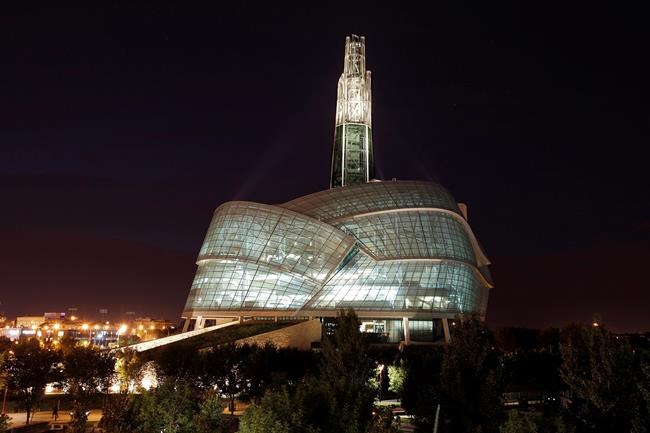
A night view of the Canadian Museum For Human Rights is shown in Winnipeg on September 16, 2014. The Quebec government's latest attempt to legislate on secularism could find its way into the Canadian Museum for Human Rights in Winnipeg. The Legault government's Bill 21 would prohibit public servants in positions of authority -- including teachers, police officers, Crown prosecutors and prison guards -- from wearing religious symbols on the job, and the Coalition Avenir Quebec government intends to see it passed into law within a month. The museum, which has exhibits exploring issues that include freedom of religion and conscience, said it is planning to refresh its exhibit on Quebec's attempts to deal with secularism. THE CANADIAN PRESS/John Woods

The museum, which has exhibits exploring issues that include freedom of religion and conscience, said it is planning to refresh its exhibit on Quebec’s attempts to deal with secularism.

“We are considering ways to update that exhibit, which may include reference to Bill 21, but those decisions have not yet been finalized — partly because the fate of Bill 21 is not yet known,” said museum spokeswoman Maureen Fitzhenry.

Fitzhenry said in an email that the museum already references a 2010 Liberal government attempt to legislate on the matter. Bill 94, which died on the order paper in 2012, would have banned people from giving or receiving government services with their faces covered — mostly affecting Muslim women who wear the niqab or burka.

That prohibition was revived by the Liberals with Bill 62, which became law in 2017 but is currently being challenged in court.

Asked why it was important for the museum to deal with questions about religious beliefs in the country, Fitzhenry replied, “Freedom of religion is a human right that is important and guaranteed by the Canadian Charter of Rights and Freedoms and the Universal Declaration of Human Rights.”

The comments come as a letter from three observers working for the United Nations Human Rights Council raised concerns about Bill 21.

They sent a five-page letter to Canada’s mission office at the UN seeking clarity on Quebec’s bill, which they say undermines “freedom of conscience, religion and equality of citizens.”

The letter, which has now been made public and was dated last Friday, raises several concerns, including a lack of definition of religious symbols, which could result in “a discretionary and potentially discriminatory interpretation of what constitutes religious symbols.”

Quebec Immigration Minister Simon Jolin-Barrette, who is piloting Bill 21, didn’t immediately comment, but the provincial government has defended the proposed law as both moderate and pragmatic.

The museum has a few displays on minorities in Quebec — one looks at the Supreme Court of Canada ruling about the right of a Sikh student in Quebec to wear the kirpan, while another is a photo exhibit called “Ce qui nous voile” (What Covers Us), which is designed to spark conversation about the experience of Muslim women in Quebec who wear the hijab.

“While these exhibits do not specifically refer to Bill 21, they do speak to many of the same human rights issues that are raised by this legislation,” Fitzhenry wrote.

Helene David, the Quebec Liberal critic for secularism, said it’s not ideal for Quebec to be known in this light and expressed concern that it would taint Quebec’s reputation internationally.

“Certainly on the Anglo-Canadian side, there is a lot of skepticism and questioning about our supposedly republican evolution of secularism,” she said in an interview.

Each year, nearly 300,000 people visit the Canadian Museum for Human Rights — which opened in 2014 and whose exhibits are designed to reflect on the treatment of different peoples.

Its mission is to study the theme of human rights with a special but not exclusive focus on Canada. The museum has had themes including the Holocaust, apartheid in South Africa and the persecution of Rohingya people in Myanmar.

Report Error Submit a Tip

The Free Press acknowledges the financial support it receives from members of the city’s faith community, which makes our coverage of religion possible.
More Stories

Teenage e-scooter driver in critical condition after crash

Chris Kitching 6 minute read Preview

Teenage e-scooter driver in critical condition after crash

Chris Kitching 6 minute read Wednesday, Sep. 16, 2026

A teenager riding an e-scooter suffered life-threatening injuries when he was struck by an SUV in southwest Winnipeg on Monday night.

Witnesses provided first aid to the injured rider, who police said is under 18, after the collision happened at Waverley Street and Arbour Meadow Gate/Lake Crest Road at about 9:30 p.m.

“It feels like it happened in slow motion,” said driver Audrey Vanderspek, who was waiting at a red light when she witnessed the incident. “Maybe it’s because you’re helpless, that it just feels like everything slows down in the moment.”

Police said the electric scooter rider was crossing Waverley and was hit by a southbound 2010 Honda CR-V. The posted speed limit on that stretch of Waverley is 70 kilometres per hour.

Read
Wednesday, Sep. 16, 2026

Puzzles Palace

1 minute read Monday, Jul. 27, 2026

To solve our puzzles, please subscribe with this special offer: |

Former Winnipeg Jet doing his part for future of funded deaf athletes

Taylor Allen 5 minute read Preview

Former Winnipeg Jet doing his part for future of funded deaf athletes

Taylor Allen 5 minute read 7:09 PM CDT

Jim Kyte defied the odds to have the hockey career that he did.

The hard-nosed defenceman from Ottawa made history by becoming the first legally deaf NHL player when the Winnipeg Jets drafted him 12th overall in 1982.

“Right now, I’m the only one in history to play in the NHL, but I’d like to be able to say I am the first player — which would imply that there would be a second player, and hopefully a third, fourth, fifth,” Kyte recently told the Free Press.

Between 1982 and 1996, he suited up in 598 career NHL games, including 399 as a member of the 1.0 Jets.

Read
7:09 PM CDT

Day 1 of Jets training camp in the books with pairings essentially cemented

Ken Wiebe 7 minute read Preview

Day 1 of Jets training camp in the books with pairings essentially cemented

Ken Wiebe 7 minute read Yesterday at 6:08 PM CDT

Nearly six minutes into his question-and-answer session, Scott Arniel took a welcome detour from the news of the day.

After exhausting the discussion around the goalie who wasn’t in training camp, the head coach of the Winnipeg Jets finally got a query about the line combinations and defensive pairings that were unveiled in training camp.

And unlike past years, when exhibition games were more frequent and the training camp wasn’t this condensed, Arniel conceded these groupings were intentional and were likely staying together for some time.

The expansion to an 84-game regular season brings with it a reduction to four pre-season games and a much shorter training camp, which could limit the amount of experimentation that Arniel can do during the next two weeks.

Read
Yesterday at 6:08 PM CDT

Province applauds apprenticeship numbers

Gabrielle Piché 4 minute read 7:24 PM CDT

Apprentice use at build sites of the Victoria General Hospital emergency room and four new schools has doubled expectations, the Manitoba government reported on Friday.

The construction projects are subject to Manitoba Jobs Agreements, a controversial policy the New Democrats unveiled last year.

Through the contracts, at least 10 per cent of construction hours must be worked by apprentices. So far, apprentices have covered 21 per cent of hours, Public Service Delivery Minister Mintu Sandhu said.

Work on the schools and Winnipeg emergency room — the first Manitoba Jobs Agreement projects — began this year. The overall number of hours worked wasn’t available by end of day Friday.

Desperate Poilievre wants Canadians to believe the sky is falling when it’s just cloudy outside

Tom Brodbeck 5 minute read Preview

Desperate Poilievre wants Canadians to believe the sky is falling when it’s just cloudy outside

Tom Brodbeck 5 minute read 12:47 PM CDT

Pierre Poilievre has a problem.

Canadians just don’t seem to be paying much attention to him anymore.

So, naturally, the Conservative Opposition leader has decided to turn up the volume.

At a recent party caucus retreat in Penticton, B.C., Poilievre delivered the familiar message: Canada is in trouble, Canadians are hurting and the Liberal government is making everything worse.

Read
12:47 PM CDT