Terror & tourism: Xinjiang eases its grip, but fear remains
Advertisement
Read this article for free:
or
Already have an account? Log in here »
To continue reading, please subscribe:

Digital Subscription
One year of digital access for only $205*
- Enjoy unlimited reading on winnipegfreepress.com
- Read the E-Edition, our digital replica newspaper
- Access News Break, our award-winning app
- Play interactive puzzles
*First annual payment billed as $205.00 + GST for one year. This annual subscription will automatically renew at $233.00 + GST every 52 weeks (10% off the regular annual price of $259.35). Offer available to new and qualified returning subscribers only. Cancel any time.
To continue reading, please subscribe:
Add Free Press access to your Brandon Sun subscription for only an additional
$1 for the first 4 weeks*
- Enjoy unlimited reading on winnipegfreepress.com
- Read the E-Edition, our digital replica newspaper
- Access News Break, our award-winning app
- Play interactive puzzles
*Your next Brandon Sun subscription payment will increase by $1.00 and you will be charged $17.95 plus GST for four weeks. After four weeks, your payment will increase to $24.95 plus GST every four weeks.
Read unlimited articles for free today:
or
Already have an account? Log in here »
Hey there, time traveller!
This article was published 10/10/2021 (1821 days ago), so information in it may no longer be current.
XINJIANG, China (AP) — The razor wire that once ringed public buildings in China’s far northwestern Xinjiang region is nearly all gone.
Gone, too, are the middle school uniforms in military camouflage and the armored personnel carriers rumbling around the homeland of the Uyghurs. Gone are many of the surveillance cameras that once glared down like birds from overhead poles, and the eerie eternal wail of sirens in the ancient Silk Road city of Kashgar.
Uyghur teenage boys, once a rare sight, now flirt with girls over pounding dance music at rollerblading rinks. One cab driver blasted Shakira as she raced through the streets.
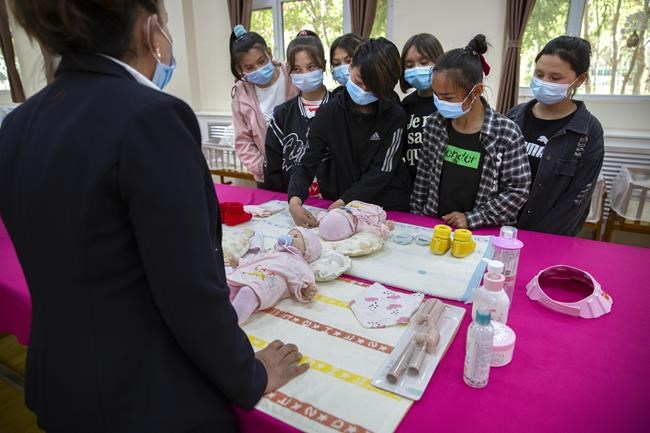
Four years after Beijing launched a brutal crackdown that swept up to a million or more Uyghurs and other mostly Muslim minorities into detention camps and prisons, its control of Xinjiang has entered a new era. Chinese authorities have scaled back many of the most draconian and visible aspects of the region’s high-tech police state. The panic that gripped the region a few years ago has subsided considerably, and a sense of normality is creeping back in.
But there is no doubt about who rules, and evidence of the terror of the last four years is everywhere.
It’s seen in Xinjiang’s cities, where many historic centers have been bulldozed and the Islamic call to prayer no longer rings out. It’s seen in Kashgar, where one mosque was converted into a café, and a section of another has been turned into a tourist toilet. It’s seen deep in the countryside, where Han Chinese officials run villages.
And it’s seen in the fear that was ever-present, just below the surface, on two rare trips to Xinjiang I made for The Associated Press, one on a state-guided tour for the foreign press.
A bike seller’s eyes widened in alarm when he learned I was a foreigner. He picked up his phone and began dialing the police.
A convenience store cashier chatted idly about declining sales – then was visited by the shadowy men tailing us. When we dropped by again, she didn’t say a word, instead making a zipping motion across her mouth, pushing past us and running out of the store.
At one point, I was tailed by a convoy of a dozen cars, an eerie procession through the silent streets of Aksu at 4 in the morning. Anytime I tried to chat with someone, the minders would draw in close, straining to hear every word.
It’s hard to know why Chinese authorities have shifted to subtler methods of controlling the region. It may be that searing criticism from the West, along with punishing political and commercial sanctions, have pushed authorities to lighten up. Or it may simply be that China judges it has come far enough in its goal of subduing the Uyghurs and other mostly Muslim minorities to relax its grip.
Uyghur activists abroad accuse the Chinese government of genocide, pointing to plunging birthrates and the mass detentions. The authorities say their goal is not to eliminate Uyghurs but to integrate them, and that harsh measures are necessary to curb extremism.
Regardless of intent, one thing is clear: Many of the practices that made the Uyghur culture a living thing – raucous gatherings, strict Islamic habits, heated debate – have been restricted or banned. In their place, the authorities have crafted a sterilized version, one ripe for commercialization.
Xinjiang officials took us on a tour to the Grand Bazaar in the center of Urumqi, which has been rebuilt for tourists, like many other cities in Xinjiang. Here, there are giant plastic bearded Uyghur men and a giant plastic Uyghur instrument. A nearby museum for traditional naan bread sells tiny plastic naan keychains, Uyghur hats and fridge magnets. Crowds of Han Chinese snap selfies.
James Leibold, a prominent scholar of Xinjiang ethnic policy, calls it the “museumification” of Uyghur culture. Chinese officials call it progress.
China has long struggled to integrate the Uyghurs, a historically Muslim group of 13 million people with close linguistic, ethnic and cultural ties to Turkey. Since the Communist Party took control of Xinjiang in 1949, Beijing’s leaders have debated whether stricter or softer measures are more effective in absorbing the vast territory, half the size of India.
For decades, policy in Xinjiang swung back and forth. Even as the state granted special benefits to minorities, such as hiring quotas and extra points on entrance exams, glass ceilings, racism, and restrictions on religion alienated and angered many Uyghurs.
The harder the government tried to control the Uyghurs, the more stubbornly many clung to their identity. A few resorted to violence, carrying out bombings and knifings against a state they believed would never accord them genuine respect. Hundreds of innocent civilians, both Han Chinese and Uyghur, perished in increasingly deadly attacks.
The debate ended soon after President Xi Jinping’s rise to power in 2012. The state chose forced assimilation, detaining Uyghurs and other minorities indiscriminately by the thousands and branding them as suspected “terrorists.”
Today, many checkpoints and police stations are gone and the bombings have stopped, but the racial divide remains clear.
Uyghurs live trapped in an invisible system that restricts their every move. It’s near impossible for them to get passports, and on planes to and from Xinjiang, most passengers are from China’s Han Chinese majority.
Uyghurs who live outside Xinjiang must register with local police and report to an officer on a regular basis, their moves tracked and monitored. Many Uyghurs living in Xinjiang aren’t allowed to leave the region.
Information on Xinjiang within China is heavily censored, and state media now promotes the region as a safe, exotic tourist destination. As a result, Han Chinese outside Xinjiang remain largely unaware of the restrictions that Uyghurs face, one of a number of reasons why many in China are supportive of Beijing’s crackdown.
Within Xinjiang, Han Chinese and Uyghurs live side by side, an unspoken but palpable gulf between them. In the suburbs of Kashgar, a Han woman at a tailor shop tells my colleague that most Uyghurs weren’t allowed to go far from their homes.
“Isn’t that so? You can’t leave this shop?” the woman said to a Uyghur seamstress.
Down the street from the tailor shop, I spot Lunar New Year banners with slogans in Chinese characters like “The Chinese Communist Party is good” plastered on every storefront. An elderly Han Chinese shopkeeper tells me that local officials printed the banners by the hundreds, handed them out and ordered them put up, although Uyghurs traditionally celebrate Islamic holidays rather than the Lunar New Year.
She approved of the strict measures. Xinjiang was much safer now, she said, than when she had first moved there with her son, a soldier with the Bingtuan, Xinjiang’s paramilitary corps.
The Uyghurs “don’t dare do anything around here anymore,” she told me.
City centers now bustle with life again, with Uyghur and Han children screeching as they chase each other across streets. Some Uyghurs even approach me and ask for my contact — something that never happened on previous visits.
But in rural villages and quiet suburbs, many houses sit empty and padlocked. In one Kashgar neighborhood, the words “Empty House” is spray-painted on every third or fourth residence. In a village an hour’s drive away, I spot dozens of “Empty House” notices on a half-hour walk, red lettering on yellow slips fluttering in the wind on door upon door.
Control is also tighter deep in the countryside, away from the bazaars that the government is eager for visitors to see.
In one village we stop in, an elderly Uyghur man in a square skullcap answers just one question – “We don’t have the coronavirus here, everything is good” – before a local Han Chinese cadre demands to know what we are doing.
He tells the villagers in Uyghur, “If he asks you anything, just say you don’t know anything.”
Behind him, a drunk Uyghur man was yelling. Alcohol is forbidden for practicing Muslims, especially in the holy month of Ramadan.
“I’ve been drinking alcohol, I’m a little drunk, but that’s no problem. We can drink as we want now!” he shouted. “We can do what we want! Things are great now!”
At a nearby store, I notice liquor bottles lining the shelves. In another town, my colleague and I encounter a drunk Uyghur man, passed out by a trash bin in broad daylight. Though many Uyghurs in big cities like Urumqi have long indulged in drinking, such sights were once unimaginable in the pious rural areas of southern Xinjiang.
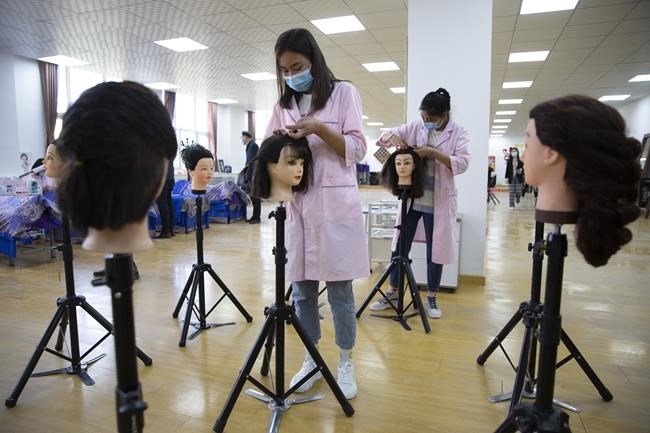
On a government sponsored tour, officials took us to meet Mamatjan Ahat, a truck driver, who declared he was back to drinking and smoking because he had recanted religion and extremism after a stint at one of Xinjiang’s infamous “training centers”.
“It made me more open-minded,” Ahat told reporters, as officials listened in.
Xinjiang officials say they aren’t forcing atheism on the Uyghurs, but rather defending freedom of belief against creeping extremism. “Not all Uyghurs are Muslim,” is a common refrain.
Controls on religious activity have slackened, but remain tightly bound by the state. For example, the authorities have allowed some mosques to reopen, though hours are strictly limited. Small groups of elderly worshippers trickle in and out.
Xinjiang’s unique brand of state-controlled Islam is most on display at the Xinjiang Islamic Institute, a government school for imams.
Here, young Uyghur men chant verses from the Quran and pray five times a day. They get scholarships and opportunities to study in Egypt, officials say as they walk us around. Tens of thousands have graduated, and recently they’ve opened a new campus – albeit one with a police station installed at the entrance.
“Religious freedom is enshrined in China’s constitution,” said a student, Omar Adilabdulla, as officials watch him speak. “It’s totally free.”
As he speaks, I crack open a textbook on another student’s desk. A good Chinese Muslim has to learn Mandarin, it says, China’s main language.
“Arabic is not the only language that compiles Allah’s classics,” the lesson said. “To learn Chinese is our responsibility and obligation, because we are all Chinese.”
As I flip through the book, I spot other lessons.
“We must be grateful to the Party and the government for creating peace,” reads one chapter.
“We must strive to build a socialist Xinjiang with Chinese characteristics,” says another. “Amen!”
Uyghur is still spoken everywhere, but its use in public spaces is slowly fading. In some cities, entire blocks, freshly constructed, have signs only in Chinese, not Uyghur.
In bookstores, Uyghur language tomes are relegated to sections labeled “ethnic minority language books”. The government boasts that nearly a thousand Uyghur titles are published a year, but none are by Perhat Tursun, a lyrical modernist author, or Yalqun Rozi, a textbook editor and firebrand commentator. They, like most prominent Uyghur intellectuals, have been imprisoned.
On the shelves instead: Xi Jinping thought, biographies of Mao, lectures on socialist values, and Mandarin-Uyghur dictionaries.
Many Uyghurs still struggle with Mandarin, from young men to elderly grandmothers. In recent years, the government has made Mandarin the mandatory standard in schools.
On the state tour, a headmaster tells us that the Uyghur language continues to be protected, pointing to their minority language classes. But all other classes are in Chinese, and a sign at one school urges students to “Speak Mandarin, use standard writing.”
The most heavily criticized aspect of Xinjiang’s crackdown has been its so-called “training centers”, which leaked documents show are actually extrajudicial indoctrination camps.
After global outcry, Chinese officials declared the camps shuttered in 2019. Many indeed appear to be closed.
On the state-led tour in April, they took us to what they said was once a “training center”, now a regular vocational school in Peyzawat County. A mere fence marks the campus boundaries — a stark contrast from the barbed wire, high watchtowers and police at the entrance we saw three years ago. On our own, we see at least three other sites which once appeared to be camps and are now apartments or office complexes.
But in their place, permanent detention facilities have been built, in an apparent move from makeshift camps to a long-lasting system of mass incarceration. We encountered one massive facility driving along a country road, its walls rising from the fields, men visible in high guard towers. At a second, we were blocked by two men wearing epidemic-prevention gear. A third ranks among the largest detention facilities on earth. Many are tucked away behind forests or dunes deep in the countryside, far from tourists and city centers.
In Urumqi, at an anti-terror exhibition in a vast, modernist complex near glass office towers and freshly-laid highways, the Chinese authorities have rewritten history. Though Xinjiang has cycled in and out of Chinese control, and was independent as recently as the 1700s and also briefly in the last century, the territory’s past is casually dismissed.
“Although there were some kingdoms and khanates in Xinjiang in the past, they were all local regimes within the territory of China,” one display says.
It’s written in English and Chinese. No Uyghur script is seen anywhere in the exhibit. Guns and bombs sit in glass cases, ones the exhibit says were confiscated from extremists.
A prim Uyghur woman in a Chinese traditional qipao suit presents a video depicting Beijing’s vision for Xinjiang’s future, where the sun sets over pagodas and a futuristic skyline. Many scenes look like they could be filmed anywhere in China.

“Our anti-terrorism and de-radicalization struggles have achieved remarkable results,” she says, in crisp Mandarin.
Officials dodge questions about how many Uyghurs were detained, though statistics showed an extraordinary spike in arrests before the government stopped releasing them in 2019. Instead, they tell us during the tour that they’ve engineered the perfect solution to terrorism, protecting Uyghur culture rather than destroying it.
One night, I was seated next to Dou Wangui, the Party Secretary of Aksu Prefecture, as well as Li Xuejun, the vice chairman of the Xinjiang People’s Congress. They are both Han Chinese, like most of Xinjiang’s powerful men.
Over grilled lamb and yogurt, we watched grinning Uyghurs dressed in traditional gowns dance and sing. Dou turns to me.
“See, we can’t have genocide here,” Dou said, gesturing to the performers. “We’re preserving their traditional culture.”
The Free Press acknowledges the financial support it receives from members of the city’s faith community, which makes our coverage of religion possible.