An arduous journey and the long road ahead
Survivors’ trip to Alberta to hear Pope’s apology paved with painful memories but hope for reconciliation

Advertisement
Read this article for free:
or
Already have an account? Log in here »
To continue reading, please subscribe:

Digital Subscription
One year of digital access for only $205*
- Enjoy unlimited reading on winnipegfreepress.com
- Read the E-Edition, our digital replica newspaper
- Access News Break, our award-winning app
- Play interactive puzzles
*First annual payment billed as $205.00 + GST for one year. This annual subscription will automatically renew at $233.00 + GST every 52 weeks (10% off the regular annual price of $259.35). Offer available to new and qualified returning subscribers only. Cancel any time.
To continue reading, please subscribe:
Add Free Press access to your Brandon Sun subscription for only an additional
$1 for the first 4 weeks*
- Enjoy unlimited reading on winnipegfreepress.com
- Read the E-Edition, our digital replica newspaper
- Access News Break, our award-winning app
- Play interactive puzzles
*Your next Brandon Sun subscription payment will increase by $1.00 and you will be charged $17.95 plus GST for four weeks. After four weeks, your payment will increase to $24.95 plus GST every four weeks.
Read unlimited articles for free today:
or
Already have an account? Log in here »
Hey there, time traveller!
This article was published 30/07/2022 (1532 days ago), so information in it may no longer be current.
It was a bus filled with hurt and hope.
Sponsored by the Archdiocese of Saint Boniface, it carried 41 residential school survivors from the First Nations communities of Poplar River, Berens River, Bloodvein, Little Grand Rapids/Pauingassi, Hollow Water, Manigotogan and Sagkeeng to Alberta to hear the Pope’s apology.
The hurt came from experiences at residential schools — painful memories sparked by the trip.

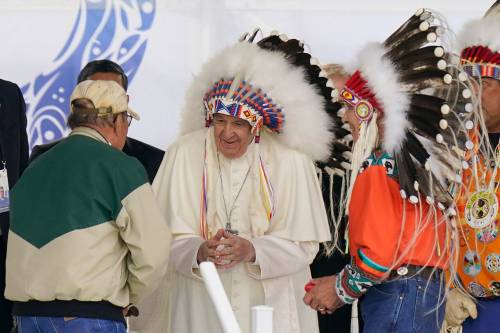
ERIC GAY / ASSOCIATED PRESS PHOTO
Pope Francis dons a headdress during a visit with Indigenous peoples at Maskwaci, the former Ermineskin Residential School in Maskwacis, Alberta. Pope Francis traveled to Canada to apologize to Indigenous peoples for the abuses committed by Catholic missionaries in the country’s notorious residential schools.
But for some, hearing the Pope say sorry also prompted feelings of hope that things could maybe now get better. That they could heal.
As a reporter from the Free Press, I was invited to come along to hear their stories and share their experience at Maskwacis, where Pope Francis issued his historic apology, and at Lac Ste. Anne, site of ancient pilgrimage for Indigenous people in Canada.
For me, it was a privilege to hear survivors tell their stories and learn what the papal apology meant to those who have suffered so much.
There’s no sugar coating it; it was hard to hear the stories. There was so much pain. At times I offered to let them stop sharing; I didn’t want to be responsible for opening up old wounds.
But the survivors wanted to talk. It meant a lot that someone wanted to listen. For some, it was part of their healing.
While often overwhelmed by the depth of their sorrow, I was also impressed again and again by their strength and resilience; they have overcome so much.
I also enjoyed hearing them laugh — there was much laughter. Whether it was telling jokes or entertaining with funny stories, humour was as much a hallmark of the trip as the sadness.
It was also moving to hear some say they are now prepared to grant the Pope, and the Roman Catholic Church, the forgiveness he asked for and look for ways to move on.
There’s no denying the path ahead will be hard. It will take time. Indigenous people in Canada are divided over whether the apology said enough or went far enough — or if it will ever even be enough to make up for the pain they endured in the schools.

JOHN LONGHURST / WINNIPEG FREE PRESS
Verna Prince was sent to a residential school at age six. She was there for seven years.
Yet, as some noted, they have to do it — they have to forgive in order to break the cycle of anger and blame for the sake of younger generations, so they will have a better future.
As for me, I also need time to process what I saw and heard. The stories below are glimpses from the trip, snippets of lives broken and torn apart by a cruel church-supported residential school system that, in the end, failed in its goal of breaking the spirit of a proud and noble people.
Now it is our turn, as non-Indigenous Canadians, to take time to listen and find ways to support our Indigenous neighbours as they seek to use the papal apology as a starting point for a new path forward for them, and for all of us.
So, “meegwetch” to the survivors who welcomed me aboard their bus, who shared their hurt and their hope.
I am a better person today because of it.
Humanity taken away
“They took us from our homes, cut our hair, strapped us,” said Verna Prince, 81, of Sagkeeng First Nation.
Prince was sent to a residential school at age six. She was there for seven years.
“Our humanity was taken away. It hurts us still. I’m still mourning,” she said.

JOHN LONGHURST / WINNIPEG FREE PRESS
Rose Klippenstein, who has stayed with the Catholic Church, went to residential high schools as a teen in the late 1970s.
For Prince, going on the trip was a way to honour those who have died and couldn’t hear the apology.
“Most of those my age who went to residential school are gone,” she said, adding she asked Creator what she could do now that she is older.
“Creator told me I have to stand up and tell the story,” she said.
She appreciated the Pope’s apology and his request for forgiveness. But it will take awhile to process it.
“Those who weren’t at residential school can’t know how hard it was,” she said. “It’s going to take awhile to forgive. I need time to think about it.”
Break the cycle of anger
For Rose Klippenstein of Poplar River, the trip was something she could do to honour her mother and older siblings, all of whom went to residential schools.
“They didn’t talk about it,” said Klippenstein, 64, noting they, too, have all passed away.
Klippenstein, who has stayed with the Catholic Church, went to residential high schools as a teen in the late 1970s.

JOHN LONGHURST / WINNIPEG FREE PRESS
Stafford Bruce broke down when he talked about his time in residential school.
When she went things were better, she said. Her main memory is “the loneliness.”
For her, hearing the apology prompted a sense of relief. “Finally, he apologized,” she said.
Forgiving the Church “will be hard,” she said, noting many Indigenous people are deeply angry about what happened at the schools.
“We need to break that cycle of anger,” she said. “We can’t get stuck in the past. If we stay there, we won’t get anywhere.”
At the same time, younger Indigenous people need to know the history of the schools and what they did to First Nations people.
“It’s our responsibility to educate them about it,” she said.
“I saw things”
Stafford Bruce, a quiet, dignified man, broke down when he talked about his time in residential school.
“I saw things,” said the sixty-eight-year-old from Poplar River.

JOHN LONGHURST / WINNIPEG FREE PRESS
Cynthia Bunn, who attended a residential school for four years, was glad she went to hear the Pope’s apology in person.
One of those things was watching a teenage boy being beaten by supervisors in the dorm at the school.
“I was only 15 at the time,” he said, wiping his eyes. “It still brings tears to my eyes.”
He appreciated the papal apology, but all he could think of when the Pope was speaking was that boy.
It was “not enough” for that boy, he said. “It will never be enough.”
Attacking from a place of pain
Cynthia Bunn of Sagkeeng First Nation believed “God had a reason” for everyone who was on the bus, even if some had doubts about going — including her.
“I told the Archbishop I didn’t want to go because of my osteoarthritis,” she said. “I worried it would be too hard on me.”
But Bunn, who attended a residential school for four years, was glad she went to hear the Pope’s apology in person.

JOHN LONGHURST / WINNIPEG FREE PRESS
Susan Daniels was just six years old when she and her two older siblings were taken to a residential school.
“I felt his sincerity,” she said, pointing to her heart. “I believe he wants to walk with us.”
It hurt to see some Indigenous people criticize the papal visit, including the gift of the headdress. But she said she understood where it was coming from.
“They are attacking from a place of pain,” she said. “Many have had a hard life, been beaten down.”
Pope’s words “help me in my healing”
Susan Daniels, 68, was just six years old when she and her two older siblings were taken to a residential school.
Originally from Fairford, Manitoba, and now living at Sagkeeng First Nation, she remembers a black car coming to her house and being driven more than four hours to the school.
“It was very scary,” she said. “We cried all the way.”
She spent seven years in residential school.
“It was a bad experience,” she said. “I have bad memories.”

JOHN LONGHURST / WINNIPEG FREE PRESS
Norman Meade and granddaughter Everlee Meade. “We need to create a better future for our children,” Norman said.
Her siblings — a brother and sister — are both deceased. “I’m here for them,” she said.
When the Pope apologized, “I cried,” she said. “It was very emotional.”
Of her own journey, she said the Pope’s words “helps me in my healing. I have forgiven my abusers. I have learned to put it behind me so I can move forward. But I will never forget.”
She gets her strength to forgive and move on from Creator, she said.
“We have to learn to be a forgiving people, so we don’t pass the anger down to the next generations,” she added.
A better world for the children
Norman Meade, 78, saw the trip as a way to pass on hope to younger generations. That’s why he brought his eight-year-old granddaughter, Everlee, with him.
“We need to create a better future for our children,” he said. “That’s why I went on the trip.”
Meade didn’t attend a residential school but his wife, Thelma, did. “Everlee is a second-generation survivor,” he said.

JOHN LONGHURST / WINNIPEG FREE PRESS
Bradley Bushie attended a day school. But he lived with the effects of residential school through his alcoholic father.
It will take time, but Indigenous people need to use the apology as a way to start the work of making the world “a better place for our young ones that it was for us,” he said.
A “hard time growing up”
Bradley Bushie, 60, attended a day school. But he lived with the effects of residential school through his alcoholic father.
“I had a hard time growing up,” said Bushie, originally from Bloodvein but now living in Poplar River.
When his father was drinking, he would often hit and “slap around” his children.
“He treated me the way he was treated as a boy,” Bushie said. “Drinking was the way he coped.”
When he heard the Pope apologize, “I was thinking about my dad,” he said, noting he died in 2000.
“I had mixed feelings. I was thinking how my dad would have felt to have heard it.”
“An honour to have your friendship”

JOHN LONGHURST / WINNIPEG FREE PRESS
“Now we can find a new way of walking together. May it be so,” said Archbishop Albert LeGatt.

In his final address to the group before arriving in Winnipeg, Archbishop Albert LeGatt, who had arranged for the trip to Alberta, told the group how wonderful it had been for him to be with them to witness the Pope’s apology.
“It shows us a way forward,” he said, adding “I have hope that will happen.”
“Thank you for coming with your memories,” he said, going on to thank residential school survivors for coming on the trip. “It is an honour to have your friendship.”
“Now we can find a new way of walking together. May it be so.”
faith@freepress.mb.ca
The Free Press is committed to covering faith in Manitoba through our Religion in the News project. This reporting continues because readers like you step forward to fund it.
Donate now to support our reporting on religion.
Your donation is eligible for a charitable tax receipt.
BECOME A FAITH JOURNALISM SUPPORTER
Our newsroom depends on a growing audience of readers to power our journalism. If you are not a paid reader, please consider becoming a subscriber.
Our newsroom depends on its audience of readers to power our journalism. Thank you for your support.
The Free Press is committed to covering faith in Manitoba through our Religion in the News project. This reporting continues because readers like you step forward to fund it.
Donate now to support our reporting on religion.
Your donation is eligible for a charitable tax receipt.
BECOME A FAITH JOURNALISM SUPPORTER
Our newsroom depends on a growing audience of readers to power our journalism. If you are not a paid reader, please consider becoming a subscriber.
Our newsroom depends on its audience of readers to power our journalism. Thank you for your support.
Advertisement Advertise With Us
Advertisement Advertise With Us
The Free Press acknowledges the financial support it receives from members of the city’s faith community, which makes our coverage of religion possible.