Activists’ network in Mexico helps U.S. women get abortions
Advertisement
Read this article for free:
or
Already have an account? Log in here »
To continue reading, please subscribe:

Digital Subscription
One year of digital access for only $205*
- Enjoy unlimited reading on winnipegfreepress.com
- Read the E-Edition, our digital replica newspaper
- Access News Break, our award-winning app
- Play interactive puzzles
*First annual payment billed as $205.00 + GST for one year. This annual subscription will automatically renew at $233.00 + GST every 52 weeks (10% off the regular annual price of $259.35). Offer available to new and qualified returning subscribers only. Cancel any time.
To continue reading, please subscribe:
Add Free Press access to your Brandon Sun subscription for only an additional
$1 for the first 4 weeks*
- Enjoy unlimited reading on winnipegfreepress.com
- Read the E-Edition, our digital replica newspaper
- Access News Break, our award-winning app
- Play interactive puzzles
*Your next Brandon Sun subscription payment will increase by $1.00 and you will be charged $17.95 plus GST for four weeks. After four weeks, your payment will increase to $24.95 plus GST every four weeks.
Read unlimited articles for free today:
or
Already have an account? Log in here »
Hey there, time traveller!
This article was published 02/04/2023 (1283 days ago), so information in it may no longer be current.
CHIHUAHUA, Mexico (AP) — Marcela Castro’s office in Chihuahua is more than 100 miles from the U.S.-Mexico border, yet the distance doesn’t prevent her from assisting women in the United States in circumventing recently imposed bans on abortion.
From the headquarters of Marea Verde Chihuahua, an organization that has supported reproductive rights in northern Mexico since 2018, Castro and her colleagues provide virtual guidance, as well as shipments of abortion pills for women who want to terminate a pregnancy on their own.
This abortion model, in which no travel, clinics or prescriptions are needed, sparked interest in the U.S. — and a surge of requests for help — as the Supreme Court moved to eliminate the constitutional right to abortion last year. But the model was developed by Mexican activists through decades of facing abortion bans and restrictions in most of Mexico’s 32 states.
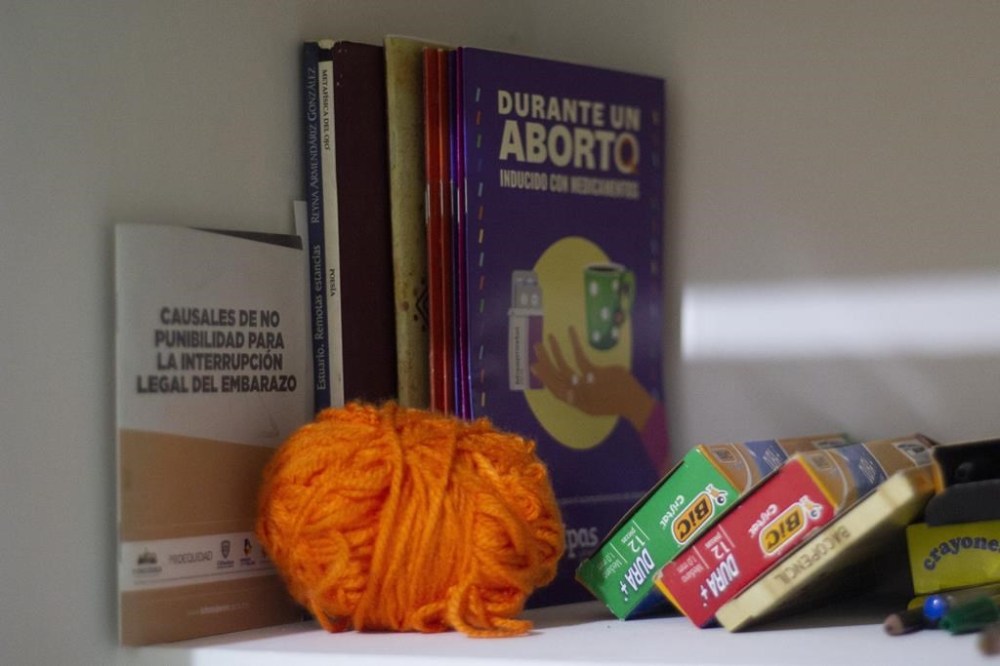
“We don’t offer medical attention because we are not doctors,” Castro said. “Part of our work, though, is to remove the stigma toward abortion. Although it is a medical procedure, it does not require hospital measures.”
To safely advise women on self-managed medical abortions, Castro and her colleagues were trained to become “acompañantes” — capable of serving as a guide and partner, whether in person or from long distance. They have carefully studied national abortion guidelines and they know by heart some protocols established by the World Health Organization.
Since they do not charge for the help they provide, most “acompañantes” need jobs outside the organizations where they volunteer. Among them are lawyers, psychologists and other professionals. Over the years, they have created a nationwide network that has secured abortion access for Mexican and foreign women, whether or not abortion is legal where they live.
“We are ordinary women working for reproductive justice,” Castro said. “We seek what the State has denied us out of prohibition.”
Mexican women face a scenario that resembles the U.S., where more than a dozen states – including Texas — have imposed sweeping abortion bans. Unless it’s justified under certain exceptions, abortion is considered a crime in two-thirds of Mexico’s states.
Chihuahua, where Castro lives, is ruled by a conservative governor and its penal code criminalizes most abortions.
Among all other Mexican border states where “acompañantes” support Mexican or American women, abortion is only legal in Baja California. Additionally, a 2021 ruling by Mexico’s Supreme Court held that those who get the procedure shouldn’t be punished in Coahuila, a state south of Texas.
More than 30 women collaborate with Castro in Marea Verde Chihuahua. They are part of what she calls a binational network, bringing together several Mexican collectives willing to facilitate self-managed abortions in the U.S.
Most women from the U.S. contact Marea Verde Chihuahua through social media or by someone’s referral. Most communicate in Spanish, though the acompañantes are able to assist English speakers as well.
After an initial contact, members of the team check their availability and an “acompañante” is assigned to each case. Further communications usually proceed via WhatsApp.
The accompaniment starts with some basic questions to determine the gestational age, how the pregnancy was confirmed, and the woman’s overall health. Once the information is evaluated, the “acompañante” proposes how to proceed.
In most cases, medication is advised and the “acompañante” is able to provide a combination of two abortion pills, misoprostol and mifepristone, both considered safe by the World Health Organization and the U.S. Food and Drug Administration.
Although both medications require a prescription in the U.S., misoprostol can be acquired without a prescription in Mexican pharmacies — though some vendors refuse to sell pills to women. Mifepristone can be obtained through some abortion rights organizations.
The work of the “acompañantes” troubles anti-abortion activists in Mexico. One of them, Jahel Torres of a national group called Pasos por la Vida, suggested there were health risks because abortion pills were being distributed by non-medical personnel.
However, the WHO has depicted self-managed abortion as a safe option.
Castro and her colleagues usually send pills by mail and provide virtual follow-up until the abortion is completed. But depending on its personnel and resources, each Mexican abortion collective has its own logistics.
Aborto Seguro Chihuahua, which is part of the binational network, provides long-distance guidance to women in the U.S. but medication is not mailed from Mexico. Instead, the “acompañantes” collaborate with volunteers who transport the pills from Ciudad Juárez, in Chihuahua, to El Paso, Texas, where the packages are delivered either in person or through mailing services.
Laura Dorado works alongside 20 people in Aborto Seguro Chihuahua and says her team handles around 120 abortions per month. Some requests come from Mexico; others from Texas, Arizona and Colorado.
When she receives a message from a woman who is able to travel from the U.S. to Mexico, Dorado can offer some advice. “We have identified some pharmacies in which buying the pills is not a struggle or we suggest staying at a hotel and request the medication by delivery, to keep a low profile.”
Dorado said Aborto Seguro Chihuahua mostly receives mifepristone pills from Las Libres, an organization founded 20 years ago in the conservative state of Guanajuato, in central Mexico, where abortion is still banned.
Led by activist Veronica Cruz, Las Libres pioneered in training “acompañantes” to provide virtual guidance for self-managed medical abortions in Mexico and, since 2019, in the U.S. as well.
“In January 2022, we had an average of 10 cases every day. When Roe was overturned, in June, we had up to a hundred,” Cruz said.
She said the numbers kept rising until they reached 300 requests per day, all from the U.S. The workload was immense for her team of 10 people, so she created new networks to help.
“In one year we have created more than 20 networks. We are about 200 people helping only the United States,” Cruz said.
As with Marea Verde and Aborto Seguro in Chihuahua, Las Libres usually receives requests from Texas, Arizona and Colorado. Occasionally, women also reach out from Florida, Mississippi, Oklahoma, Georgia, California, New Jersey and New York.
Though abortion is legal in some of those states, “acompañantes” believe many of these women are of Hispanic origin and either want to avoid going to an abortion clinic or can’t afford to pay up to $600 to get an abortion where they live.
According to Cruz, many of these women are wary of self-managed abortions, and fighting that stigma has become part of their work.
“Most people think pills aren’t safe, so changing all of that so quickly has been a challenge,” Cruz said.
John Seago, president of Texas Right to Life, said there has yet to be any intensive effort to prosecute people involved in supplying abortion pills to Texas residents.

“Texas simply does not have enough policy tools to efficiently stop these practices,” Seago said. His organization is pushing for new legislation, he added “so that those breaking Texas law by aiding and abetting abortion digitally or physically will be held accountable.”
Nathan Cortez, a professor at Southern Methodist University in Dallas specializing in health law, said he considered it inevitable that women in states with abortion bans would consider options outside the U.S.
“This demonstrates the limits of a state’s jurisdiction — the more onerous and unreasonable your state laws are, the more likely you are to push prohibited activities elsewhere.” Cortez said.
——
Associated Press religion coverage receives support through the AP’s collaboration with The Conversation US, with funding from Lilly Endowment Inc. The AP is solely responsible for this content.
Related Articles
Some US states stock abortion medications after court ruling
Advertisement Advertise With Us
Advertisement Advertise With Us
The Free Press acknowledges the financial support it receives from members of the city’s faith community, which makes our coverage of religion possible.