‘It has become a cycle’: Muslim Canadians more vigilant during Ramadan

Advertisement

Advertise with us

TORONTO - Mosques across Canada have increasingly had to ask congregants to stay vigilant against potential attacks and harassment during the holy month of Ramadan, Muslim advocacy groups say, noting that the normalization of such security conversations is a concern.

Read this article for free:


or

Already have an account? Log in here »

To continue reading, please subscribe:

Subscribe and receive a limited-edition Free Press branded hat or tote.

Digital Subscription

One year of digital access for only $205*

  • Enjoy unlimited reading on winnipegfreepress.com
  • Read the E-Edition, our digital replica newspaper
  • Access News Break, our award-winning app
  • Play interactive puzzles

*First annual payment billed as $205.00 + GST for one year. This annual subscription will automatically renew at $233.00 + GST every 52 weeks (10% off the regular annual price of $259.35). Offer available to new and qualified returning subscribers only. Cancel any time.

To continue reading, please subscribe:

Add Free Press access to your Brandon Sun subscription for only an additional

$1 for the first 4 weeks*

  • Enjoy unlimited reading on winnipegfreepress.com
  • Read the E-Edition, our digital replica newspaper
  • Access News Break, our award-winning app
  • Play interactive puzzles
Start now

*Your next Brandon Sun subscription payment will increase by $1.00 and you will be charged $17.95 plus GST for four weeks. After four weeks, your payment will increase to $24.95 plus GST every four weeks.

Hey there, time traveller!
This article was published 13/04/2023 (1264 days ago), so information in it may no longer be current.

TORONTO – Mosques across Canada have increasingly had to ask congregants to stay vigilant against potential attacks and harassment during the holy month of Ramadan, Muslim advocacy groups say, noting that the normalization of such security conversations is a concern.

Two mosques in a city north of Toronto and one in Montreal were the subject of security incidents this month. With two weeks of Ramadan still left in the leadup to Eid, the Muslim Association of Canada said mosques have been advising worshippers on ways to stay safe while also looking at measures to boost security on-site.

“We need to ensure that our community is safe, but the fact that that’s becoming a requirement, and that’s becoming a normalized practice because it’s a real fear, is a problem,” association director Memona Hossain said in an interview.
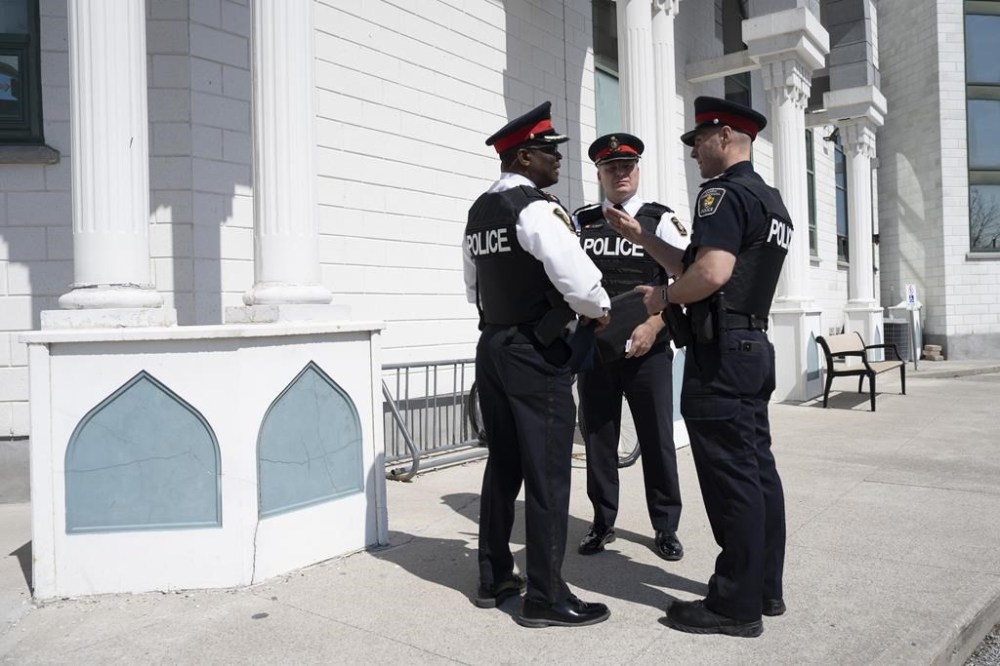
Deputy Chief Robertson Rouse of the York Regional Police (left) and Insp. Charles Byham (centre) speak with a colleague outside the Islamic Society of Markham following a news conference about an alleged hate incident in Markham, Ont. on Monday, April 10, 2023. Mosques across Canada have increasingly had to ask congregants to stay vigilant against potential attacks and harassment during the holy month of Ramadan, Muslim advocacy groups say, noting that the normalization of such security conversations is a concern. THE CANADIAN PRESS/Chris Young

A spokesperson for the National Council of Canadian Muslims said Ramadan in recent years has brought with it an increase in reports from community members of confrontations.

“It has become almost a cycle,” said Steven Zhou, adding the increase might be related to the increased visibility of Muslims during the holy month.

Mosques are bustling during Ramadan as people gather to pray multiple times a day while fasting and sometimes prayers last into the night, Zhou said. He added, however, that attacks against Muslims take place year-round.

Last week, mosque leaders allegeda man brought his car to a Markham, Ont., mosque around prayer time at dawn, uttered Islamophobic slurs, made threats to burn down the place of worship and tried to ram into congregants. Police are investigating.

In a separate case, also in Markham, a man is facing criminal charges after allegedly blocking the entrance to a mosque, yelling derogatory slurs at worshippers and assaulting several people.

In Montreal, surveillance videos showed a man trying to strike a young worshipper at a mosque last week before using a rock to break through the building’s front door.

The National Council of Canadian Muslims and the Muslim Association of Canada said it has become increasingly common for imams to tell congregants how they should react if an active shooter enters a mosque.

Those conversations started happening more frequently after a gunman entered a Quebec mosque in 2017 and killed six worshippers, and they continued after June 2021, when four members of a Muslim family were killed while out for an evening walk in London, Ont. A man is facing terror-related murder charges in their deaths.

“These are very surreal conversations,” Zhou said.

“Such as, ‘Where are the appropriate exits for when a shooting happens?’ When people are lining up, if somebody has a car, (they’re) wondering, ‘Will it be easier for that person to ram us?’ … A large number of people are afraid and just tired of having to look over their shoulders all the time.”

Abu Noman Tarek, an imam in Brantford, Ont., and director of the Canadian Council of Imams, said his mosque recently had a conversation with the local police chief about “how could we make sure that mosque is ready to face such situations.”

“No Canadian should leave their home with their religious identity or to go to the religious place with fear that they could be under attack, and they might not come back to their family members,” Tarek said.

All three national advocacy groups said the Muslim community in Canada is strong and members will continue to gather at mosques despite a fear of attacks.

They said Canada has come a long way in addressing Islamophobia but there is still a lot more work that needs to be done.

“We hear our leadership saying that it’s a priority for them and we hear resources being put into place, but something isn’t lining up great because we’re still seeing a consistent increase in these issues,” Hossain, of the Muslim Association of Canada,said.

Zhou added that the National Council of Canadian Muslims was happy to see increased funding for the Security Infrastructure Program in the recent federal budget so places of worship can access more money for security upgrades. But he criticized the government for taking too long to process the funding.

Public Safety Canada did not immediately respond to requests for comment on that.

Zhou said discussion of the safety concerns of Muslims was important.

“This has been a long-standing set of issues,” he said.

Last month, figures released by Statistics Canada showed hate crimes reported to police continued to spike across the country in the second year of the pandemic as people were targeted by race, religion and sexual orientation. The report said police-reported hate crimes targeting Muslim Canadians increased by 71 per cent.

This report by The Canadian Press was first published April 13, 2023.

Report Error Submit a Tip

The Free Press acknowledges the financial support it receives from members of the city’s faith community, which makes our coverage of religion possible.

More Stories

Restaurants ‘under pressure’

Gabrielle Piché 5 minute read Preview

Restaurants ‘under pressure’

Gabrielle Piché 5 minute read Friday, Sep. 25, 2026

Happy hour outings are on Jackie Piggott’s calendar — but even those are fewer.

She and her husband might visit a restaurant once a month. It’s a change over the past year: earlier, they may go twice, thrice or weekly.

“It’s something that we’ve talked about, my husband and myself, just because the pricing is so expensive,” Piggott said, stopping during a grocery run in St. Vital. “It’s also better for our health.”

She’s in the majority: a new Restaurants Canada report found 80 per cent of Canadians are eating out less frequently because of higher living costs, up from 75 per cent in 2025.

Read
Friday, Sep. 25, 2026

Special teams woes hurt Bombers in loss to Argos

Ken Wiebe 7 minute read Preview

Special teams woes hurt Bombers in loss to Argos

Ken Wiebe 7 minute read Saturday, Sep. 26, 2026

THEY’VE been the most consistent of the three phases in the Winnipeg Blue Bombers arsenal this season.

A port in the proverbial storm, throughout this topsy-turvy campaign of ups-and-downs, the special-teams units have been supplying strength to a group that is still searching for consistency with only four games left in the regular season.

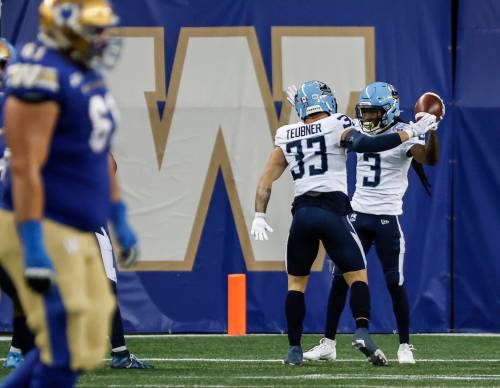
That’s what made this momentary lapse so costly in a 30-28 loss to the Toronto Argonauts on Friday at Princess Auto Stadium.

“We didn’t keep up our end of the bargain. And that hurts our football team, hurts our chances of winning games,” said Blue Bombers special teams ace Tanner Cadwallader. “And if we want to win close games. we’ve got to be a whole lot better than that. And we will. We’re going to come in (on Saturday for the film session) and go through it with a fine-tooth comb and just work a little bit harder.”

Read
Saturday, Sep. 26, 2026

Winnipeg Police Service recognizes, honours residential school survivors as Orange Shirt Day approaches

Malak Abas 3 minute read Preview

Winnipeg Police Service recognizes, honours residential school survivors as Orange Shirt Day approaches

Malak Abas 3 minute read Yesterday at 7:27 PM CDT

Winnipeg Police Service members lit a sacred fire outside of their North District Station in recognition of residential school survivors ahead of the upcoming Orange Shirt Day.

“We know that the relationship between policing and Indigenous communities has not always been one of trust,” WPS Chief Gene Bowers told visitors at a gathering outside of the station Sunday afternoon.

“We cannot change that history, but we can acknowledge it, we can learn from it, and we can take responsibility for how we move forward.”

The sacred fire, guided by elder Mike Calder, will burn for 24 hours at the Sinclair Street station, and then be allowed to extinguish naturally. It’s the second year the WPS has lit a sacred fire in recognition of residential school survivors — last year, the fire was lit outside of WPS headquarters on Smith Street.

Read
Yesterday at 7:27 PM CDT

Wab Kinew as ‘communicator in chief’

Paul G. Thomas 6 minute read Preview

Wab Kinew as ‘communicator in chief’

Paul G. Thomas 6 minute read 2:00 AM CDT

Premier Wab Kinew and his party have been riding high in the polls longer than normal for a government one year or less away from its first re-election contest. One reason is his ubiquitous, dominating communications presence as NDP leader and premier.

The argument here is that Kinew has supplemented his prerogatives as premier and party leader (such as appointing cabinet ministers and approving party nominations) with the skilful use of communications to advance his policy agenda, boost his personal popularity and maintain the competitive advantage of his party over the opposition Progressive Conservatives.

Communications has always been a significant part of politics and policy making. However, in the contemporary political and media environments, communications considerations have moved from the background to the foreground of decision-making by political parties, including when they are performing in the role of government. Campaigning and governing now overlap in what has been described as a permanent election campaign.

Political parties use communications strategies for several purposes: to establish an image of the leader which makes a positive emotional connection with voters; to promote a coherent message and to keep party members on message; and to gain favourable media coverage for its policies and other actions on almost a daily basis.

Read
2:00 AM CDT

Positive anticipation is growing about major housing developments underway in Winnipeg’s downtown

Gabrielle Piché 10 minute read Preview

Positive anticipation is growing about major housing developments underway in Winnipeg’s downtown

Gabrielle Piché 10 minute read Friday, Sep. 25, 2026

If traffic is light and the wind is down, Somia Sadiq is able to hear the roar of Winnipeg Jets fans twice: first through her window, then on TV.

From her apartment view high above downtown, she can look out at Graham Avenue’s painted pedestrian landscape, see construction cranes and hear the heavy equipment at work as massive housing projects take shape at The Forks, at what used to be Portage Place shopping centre and at the former Hudson’s Bay building.

Sadiq has lived at 300 Main for 2 1/2 years, a few steps from the city’s famous, windy and reopened-to-pedestrians Portage Avenue intersection. At 42 storeys, it’s the tallest building in Winnipeg.

She is among 18,000 downtown residents who will soon be joined by thousands of others attracted to the city’s core by the new wave of major construction projects.

Read
Friday, Sep. 25, 2026

Canada resorting to its tried and true playbook

Niigaan Sinclair 5 minute read Preview

Canada resorting to its tried and true playbook

Niigaan Sinclair 5 minute read 6:00 AM CDT

In 1846, Britain faced an emergency influenced by the Irish famine, so leaders repealed the country’s “Corn Laws” and restrictions on imported food and grain, transitioning to a system of free trade.

This created a crisis in the then Province of Canada, which had relied on British “preferential” status to prop up its agricultural and resource industries.

As a result, Canada looked south for new markets and eventually negotiated a free trade agreement with the United States.

This required land to be acquired and converted for industrial use quickly, so Canada quickly dispatched Commissioner William Robinson to negotiate with Indigenous communities along Lake Huron and Lake Superior for land.

Read
6:00 AM CDT