Churches, temples and monasteries regularly hit by airstrikes in Myanmar, activists say
Advertisement
Read this article for free:
or
Already have an account? Log in here »
To continue reading, please subscribe:

Digital Subscription
One year of digital access for only $205*
- Enjoy unlimited reading on winnipegfreepress.com
- Read the E-Edition, our digital replica newspaper
- Access News Break, our award-winning app
- Play interactive puzzles
*First annual payment billed as $205.00 + GST for one year. This annual subscription will automatically renew at $233.00 + GST every 52 weeks (10% off the regular annual price of $259.35). Offer available to new and qualified returning subscribers only. Cancel any time.
To continue reading, please subscribe:
Add Free Press access to your Brandon Sun subscription for only an additional
$1 for the first 4 weeks*
- Enjoy unlimited reading on winnipegfreepress.com
- Read the E-Edition, our digital replica newspaper
- Access News Break, our award-winning app
- Play interactive puzzles
*Your next Brandon Sun subscription payment will increase by $1.00 and you will be charged $17.95 plus GST for four weeks. After four weeks, your payment will increase to $24.95 plus GST every four weeks.
Read unlimited articles for free today:
or
Already have an account? Log in here »
Hey there, time traveller!
This article was published 23/01/2024 (986 days ago), so information in it may no longer be current.
BANGKOK (AP) — A study issued Tuesday by researchers collecting evidence of war crimes in Myanmar supported reports that air strikes by the military government damaged churches in the Buddhist-dominated country’s sole Christian-majority state.
The 10 reported attacks on churches in the western state of Chin examined by the researchers are part of a broader assault on religious communities across the war-torn nation, other religious and human rights workers said.
Myanmar sank into civil war after the army seized power from the elected government of Aung San Suu Kyi in February 2021. Since then, resistance fighters from the Buddhist Burman ethnic majority have joined forces with long-oppressed ethnic minorities, some with substantial Christian populations.
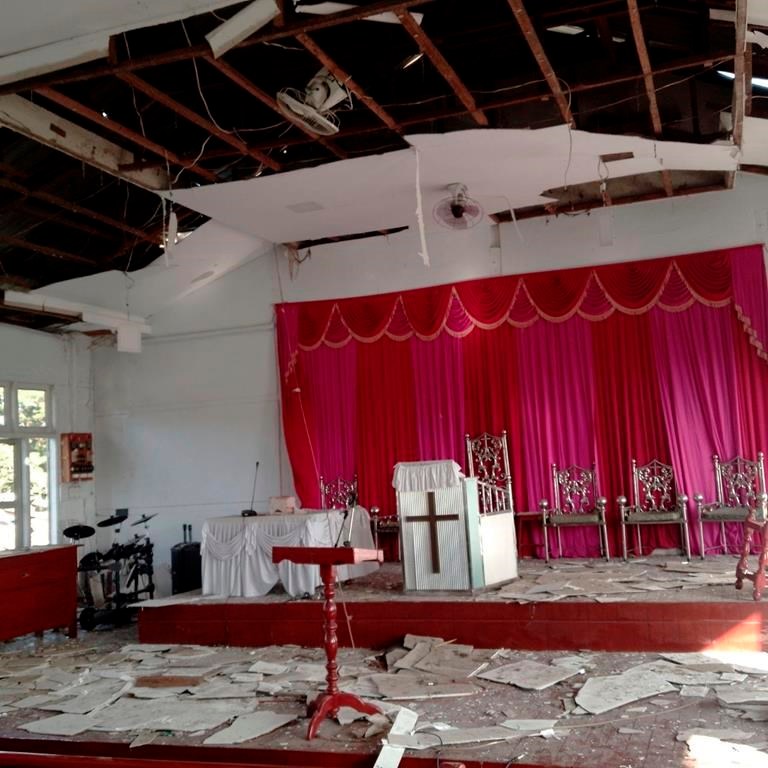
Human rights agencies and United Nations investigators have found evidence that security forces indiscriminately and disproportionately targeted civilians with bombs, mass executions of people detained during operations and large-scale burning of civilian houses.
According to the Assistance Association for Political Prisoners, which tallies political arrests and attacks, at least 4,416 people have been killed by security forces since the 2021 takeover.
Tuesday’s report, compiled by the Myanmar Witness project of the United Kingdom-based Centre for Information Resilience, analyzed in depth five claims of airstrikes causing major physical damage to churches in Chin state over several months in 2023 and concluded that all five could be verified.
Religious buildings are accorded special protected status under international law.
At least 107 religious buildings — including 67 churches and five Buddhist monasteries — have been destroyed by the military since the 2021 takeover in Chin state alone, the Chin Human Rights Organization said. A 2023 report by the International Commission of Jurists, covering the period through April, counted 94 major Buddhist religious sites and 87 Christian ones destroyed or damaged nationwide.
Myanmar Witness cross-checks evidence such as photos, videos and witness accounts found on social media with satellite photo analysis and other methods to try to verify human rights abuses. The ultimate aim, said project director Matt Lawrence, is “providing material to international mechanisms that can hold perpetrators of atrocities to account.”
The report did not address whether the strikes were deliberate, but wrote that the Myanmar Air Force’s “overwhelming air superiority” makes it likely that they were conducted by the government.
Many human rights activists believe that the military aims for religious buildings.
“Bombing churches is much more than just collateral damage,” wrote Benedict Rogers, former East Asia team leader for the human rights organization Christian Solidarity Worldwide and author of three books on Myanmar, wrote in an email interview. “Targeting them is part of a deliberate strategy,” he said.
The military regime is intolerant of non-Burman ethnic and non-Buddhist religious minorities, he said. in 2017, the military carried out a brutal counterinsurgency campaign in the western state of Rakhine that drove about 740,000 members of the Muslim Rohingya minority to flee to neighboring Bangladesh.
“By targeting churches and other places of worship, they are striking directly at the identity of these communities,” he said.
Crucially, churches and other places of worship are also suspected of sympathy with ethnic opposition groups, he added, even though they are much more commonly used as places of refuge for civilians seeking to shelter from fighting.
The military was not available for immediate comment on the report, but in the past has repeatedly said it attacks only legitimate targets of war, accusing the resistance forces of being terrorists.
Salai Mang Hre Lian of the Chin Human Rights Organization said that previous governments also discriminated against religious minorities, but “the attacks and direct violations and discrimination against Christian minorities are more significant and increasing” since the army’s 2021 takeover.
“Buddhist monasteries suspected of providing shelter or assistance to resistance groups have also been attacked,” he noted.
Attacks on religious buildings “send a powerful signal to all civilians that even in places protected by international humanitarian laws, if they support non-junta groups, they will be targets,” Lian said.
“Not only Christians, but all the religious minorities are being persecuted,” said Ngun Thawng Lian, a well-known Christian pastor who now lives in Australia.

His hometown of Thantlang was virtually leveled in September 2021, in some of the war’s most brutal early fighting. With four Myanmar nationals, he filed a criminal complaint in the Philippines against the junta generals, under a 2009 Philippine law claiming universal jurisdiction.
More reports of attacks on churches were made by Christian humanitarian assistance group Free Burma Rangers, which runs missions bringing medical aid and evangelical activities to villagers in Kayah, also known as Karenni state, and elsewhere in eastern Myanmar.
“Since the coup, many churches have been bombed and destroyed in Chin state — not just Chin, but in Karen and Karenni,” said Dave Eubank, a former member of the U.S. Special Forces who is the group’s founder and director.
He said that around Demoso, a contested township in Karenni, most of the churches have been bombed and completely destroyed or damaged.
“I can think of 10 that I’ve already seen in ruins or big holes in them, direct airstrikes,” Eubank said. One of the biggest churches in Demoso was hit in 2022, with helicopter gunships directly firing rockets and heavy machine guns into the church steeple.”
The Free Press acknowledges the financial support it receives from members of the city’s faith community, which makes our coverage of religion possible.