Abducted as babies in the 1970s, these Argentines found a way toward their true identity
Advertisement
Read this article for free:
or
Already have an account? Log in here »
To continue reading, please subscribe:
Digital Subscription
One year of digital access for only $1.44 a week*
- Enjoy unlimited reading on winnipegfreepress.com
- Read the E-Edition, our digital replica newspaper
- Access News Break, our award-winning app
- Play interactive puzzles
*Billed as $5.77 plus GST every four weeks. After 52 weeks, price increases to the regular rate of $19.95 plus GST every four weeks. Offer available to new and qualified returning subscribers only. Cancel any time.
To continue reading, please subscribe:
Add Free Press access to your Brandon Sun subscription for only an additional
$1 for the first 4 weeks*
- Enjoy unlimited reading on winnipegfreepress.com
- Read the E-Edition, our digital replica newspaper
- Access News Break, our award-winning app
- Play interactive puzzles
*Your next Brandon Sun subscription payment will increase by $1.00 and you will be charged $17.95 plus GST for four weeks. After four weeks, your payment will increase to $24.95 plus GST every four weeks.
Read unlimited articles for free today:
or
Already have an account? Log in here »
Hey there, time traveller!
This article was published 25/03/2024 (940 days ago), so information in it may no longer be current.
BUENOS AIRES, Argentina (AP) — Claudia Poblete can’t help it. On certain days, as she passes in front of a church, she automatically crosses herself while her children gaze at her with confusion.
She didn’t raise them as Catholics — as she was — because her spirituality has shifted.
In 2000, Poblete didn’t go by her current name. She was called Mercedes Landa, and before a judge showed her a DNA test result that confirmed her true identity, she was unaware that she was among hundreds of babies who were abducted during the Argentine dictatorship.

Poblete is one of the 133 “recovered grandchildren” of Argentina. Now adults, they were found by their biological families years after their parents went missing when the military took power on March 24, 1976.
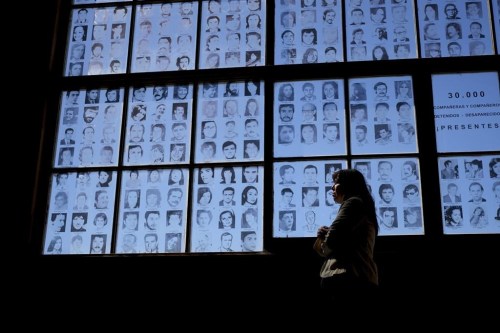
Until democracy was restored in 1983, at least 30,000 people had disappeared. Many of them were militants whose mothers started gathering at Buenos Aires’ main square and later became known as the Mothers of Plaza de Mayo.
Many of the Mothers had children who were detained and tortured inside military facilities that resembled concentration camps. Others were transported on planes from which they were thrown alive into the sea.
Some of the Mothers knew that their daughters or daughters-in-law were pregnant, but dozens more found out through survivors’ testimonies. And so, under the impression that their children were killed but their grandchildren survived, they started searching for them and created a human rights organization called Grandmothers of Plaza de Mayo.
Poblete knew of their existence, but the lieutenant colonel who she thought was her father told her that they were “crazy” women who wanted revenge on the military. And Poblete, who called him “dad” for half her life, never suspected he lied.
“I didn’t know about the abducted children,” Poblete said.
She was eight months old when her family was taken to an illegal detention center in November 1978. Once there, she was abducted from her mother and handed to a military doctor who looked for a family willing to keep her. Soon after, Ceferino Landa and his wife registered Poblete as their biological daughter and called her Mercedes.
“For almost 21 years, they never even told me that I could be adopted,” the now 46-year-old Poblete said. “They always maintained the lie.”
To prevent her from finding the truth, “Merceditas” — as they called her — was not allowed to walk by herself on the streets. She could not travel alone, read books of her choice or watch TV shows that were not approved by Landa. She attended a Catholic school without suspecting that the church was complicit with the military who broke her biological family apart.
“It has been investigated and proven that members of the Catholic Church participated in torture sessions and took confessions from people in clandestine centers,” said Mayki Gorosito, executive director of a museum founded in the former Navy School of Mechanics. Known as ESMA, it housed the most infamous illegal detention center during the dictatorship.
Inside these detention centers, several priests and nuns were aware of the illegal adoptions. Outside, at Catholic schools where irregularities of birth certificates were easy to spot, the personnel didn’t raise any flags.
“My grandfather told me that, when he was looking for me and my mother, he approached the chaplain of my school to ask for information,” Poblete said. But the priest remained silent. “That complicity is impossible to reconcile with a supposedly Christian vision.”
It took her years to share her story publicly and to let go of the guilt that many recovered grandchildren share.
“I carried a lot of responsibilities I was not supposed to,” said Pedro Alejandro Sandoval, who the Grandmothers found in 2004.
He, like Poblete, kept in touch with his “appropriators” — the couples who pretended to be their parents — for years and didn’t embrace his biological relatives immediately. “It was not until the trial that I started to feel free,” Sandoval said.
The searches of the Grandmothers began in different ways. In the late 1970s, with no resources at hand, they used to wait outside kindergartens in the hope of finding resemblances between the infants and their disappeared children. But then, in 1987, the Argentine government took up their cause.
Through the National Commission for the Right to Identity (known for its Spanish initials, CONADI) and the National Genetic Data Bank — both of which were specifically created to aid the Grandmothers — the search was institutionalized.
At least 1,000 Argentines approach these organizations annually, said Manuel Goncalves Granada, a recovered grandchild who recovered his identity in 1997 and currently works at CONADI.
The commission addresses requests from Argentines suspecting they could have been abducted as babies, but also looks into reports from people who report suspicious behavior. Sandoval, for instance, was found through an investigation that was launched after a neighbor reported that something was not right with his adoptive family.
Once a judge has a case of illegal appropriation and a DNA test confirms identity theft, the appropriators of the abducted babies could be imprisoned and a trial might take place.
Sandoval learned about the detention of the military officer who said he was his father through a newspaper article. “Former commander Víctor Rei arrested for falsification, concealment and the theft of a minor,” the headline read.
“The people who raised me, whom I called ‘mom’ and ‘dad’ for over 26 years, suddenly became my appropriators,” Sandoval said. “The process to assimilate — that took time.”
For decades, he said, he felt like Dr. Jekyll and Mr. Hyde: one person with two identities fighting each other. “I was the same person, but I unfolded myself all the time,” Sandoval said.
Unlike Poblete, who was registered by her parents after she was born, Sandoval was born at ESMA and therefore was not named by his family. So, when the time came to choose a new name, he picked Pedro, to honor his mother — who he learned wanted to call him that — and kept Alejandro, because that’s who he was for half his life.
For the recuperated grandchildren of Argentina, their names are deeply linked to the reconstruction of their identity. Many want to assume the names of their biological families — last names included — as if their parents lived on through the names they so proudly bear.
“I will never listen to their voices, but I’m getting to know them through different ways,” Sandoval said.
He refers to his parents as “my old man” or “my old woman,” as if he could chat with them every day.

“I can tell you stories about my parents,” he said. “There is something magical. DNA is much bigger than we all believe.”
Both Sandoval and Poblete encourage all Argentines who doubt their upbringings to approach the Grandmothers because, if abducted as babies, the deceit orchestrated by the military in the 1970s could pass on to future generations.
“One is not really free if there’s a lie in between,” Poblete said. “Freedom starts when you know the truth and, once knowing it, you can choose.”
____
Associated Press religion coverage receives support through the AP’s collaboration with The Conversation US, with funding from Lilly Endowment Inc. The AP is solely responsible for this content.
The Free Press acknowledges the financial support it receives from members of the city’s faith community, which makes our coverage of religion possible.