A mass circumcision is marketed to tourists in a remote area of Uganda. Some are angrily objecting
Advertisement
Read this article for free:
or
Already have an account? Log in here »
To continue reading, please subscribe:
Digital Subscription
One year of digital access for only $1.44 a week*
- Enjoy unlimited reading on winnipegfreepress.com
- Read the E-Edition, our digital replica newspaper
- Access News Break, our award-winning app
- Play interactive puzzles
*Billed as $5.77 plus GST every four weeks. After 52 weeks, price increases to the regular rate of $19.95 plus GST every four weeks. Offer available to new and qualified returning subscribers only. Cancel any time.
To continue reading, please subscribe:
Add Free Press access to your Brandon Sun subscription for only an additional
$1 for the first 4 weeks*
- Enjoy unlimited reading on winnipegfreepress.com
- Read the E-Edition, our digital replica newspaper
- Access News Break, our award-winning app
- Play interactive puzzles
*Your next Brandon Sun subscription payment will increase by $1.00 and you will be charged $17.95 plus GST for four weeks. After four weeks, your payment will increase to $24.95 plus GST every four weeks.
Read unlimited articles for free today:
or
Already have an account? Log in here »
Hey there, time traveller!
This article was published 11/08/2024 (802 days ago), so information in it may no longer be current.
NEAR MOUNT ELGON, Uganda (AP) — The dancers shook their hips to the beat of drummers who led the way, anticipating the start of mass circumcision among the Bamasaaba people of Uganda’s mountainous east.
Yet the frolicking in the streets belied a dispute brewing behind the scenes as some locals questioned their king over the very public presentation of Imbalu, the ritualized circumcision of thousands of boys every other year in this remote community near Uganda’s border with Kenya.
Could it be turned into a carnival, put on for the gaze of foreigners? Or should it remain a sacred ceremony in which families quietly prepare their sons to face the knife with courage?
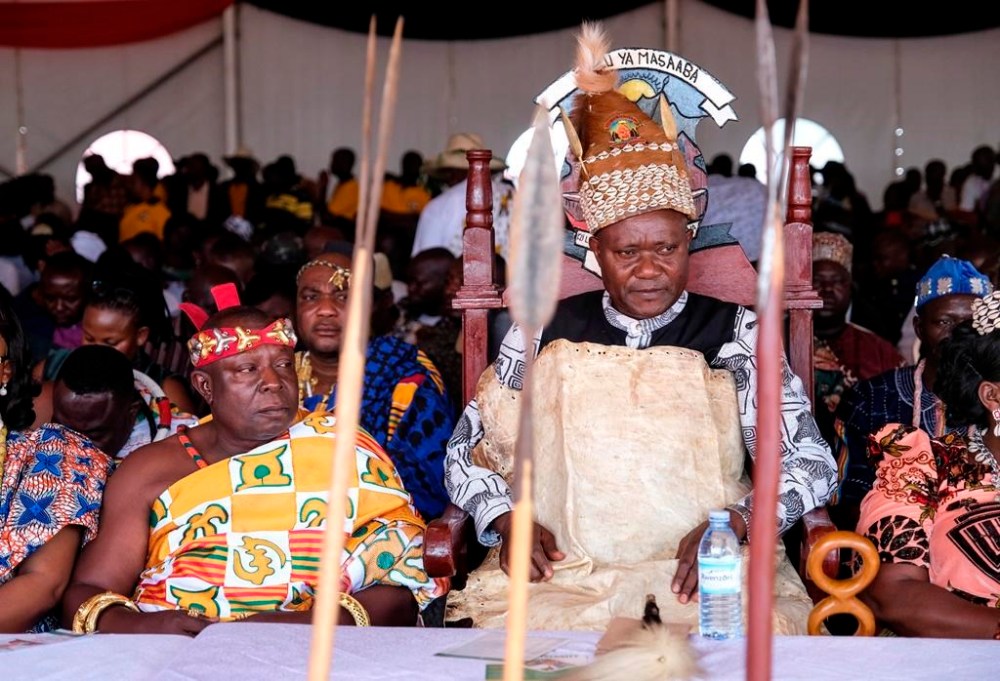
The king, known as the Umukuuka, had his way ahead of the Aug. 3 ceremonial inauguration at a park in the town of Mbale, arguing for a traditional festival that also looked attractive to visitors. The organizers of Imbalu received over $120,000 in financial support from the Ugandan government and a corporate sponsor.
In an interview with the AP, the Umukuuka asserted that organizing a modern Imbalu was challenging and defended his decision to market the ritual as a tourist event in line with Uganda’s national development plan.
“Everything is changing as the population expands. People may not manage to follow the cultural processes,” he said, citing the economic hardship and commercialization he said were diluting the communal aspect of Imbalu. “But we are fighting through the clan system that (Imbalu) remains intact.”
But the Ugandan government’s intervention has raised eyebrows among many Bamasaaba and underscored angst over the most important ceremony for this ethnic group of four million Ugandans. Some who spoke to the AP said they felt the Umukuuka, in his first year in office, was trivializing Imbalu by exposing it to outside interests.
“Our leadership is being hijacked by” national political leaders, said Wasukira Mashate, an elder who is a custodian of Bamasaaba cultural property, charging that the Umukuuka was missing the counsel of clan leaders with real spiritual authority.
“I don’t think they are having any role” in Imbalu, he said, speaking of clan leaders. “It was for our own benefit culturally, but now it is becoming a national event because the government of Uganda has captured it.”
At the ceremonial inauguration, an angry crowd gathered outside the totemic shrine of the clan that historically has launched Imbalu by cutting the first candidates. Clan members pointed to the young mixed-breed bull tethered to the grass as offensive, saying only a local breed would suffice as an appropriate sacrifice to the gods.
“This cow is exotic. We are Bamasaaba, and he brought us a white animal,” said Kareem Masaba, speaking of the Umukuuka. “He has insulted us. His predecessors used to come into the shrine and participate in the rituals, but this man will not come here. He is disrespecting us.”
The dispute over the sacrificial animal delayed the inauguration into the late afternoon as anger grew among men wielding machetes, sharp sticks and other crude weapons. The Umukuuka, seated not far away in a tent among dignitaries from elsewhere in Africa, did not budge. Clan members retaliated by refusing to present the first group of initiates before the Umukuuka, a former forestry officer whose real name is Jude Mudoma.
The mass circumcisions will last until the end of 2024.
The tribal initiation of boys into adulthood has long been controversial in African countries such as South Africa, where incidents of botched, deadly circumcisions among Xhosa-speaking people have inspired campaigns for safe clinical circumcision. Among the Bamasaaba, whose cutting method is just as violent, there have been no calls to end the practice. The strongest adherents see Imbalu as more important than ever amid widespread infant circumcision in hospital settings. They say those boys who are not initiated in the tribal way risk suffering lifelong social delinquency.
Tribal circumcision is performed by a traditional surgeon wielding a knife usually fashioned from melted nails. Bamasaaba hundreds of kilometers away in the Ugandan capital of Kampala are known to hunt down Imbalu dodgers they then cut by force. The bodies of uncircumcised men can be violated before burial.
Circumcision “helps us to be strong,” said Peter Gusolo, a traditional surgeon, gesticulating to express his people’s purported sex prowess. Those who resist circumcision will be cut “even if (they) are dying,” he said. “We circumcise you at night. We bury you in the morning.”
He added, “We cannot bury you in the land of the Bamasaaba without (being circumcised). No, no, no. It is in the constitution of the culture of the Bamasaaba. … It is a curse if you bury into the land people who are not circumcised.”
Gusolo, whose family lives in a house on the side of a hill planted with arabica coffee plants, spent days isolating himself in a cave and postponing intimacy with his wife so that he could be possessed by the spirit of Imbalu. Even though men like Gusolo wield certificates issued by local health authorities to prove their skill, the title is hereditary. The surgeons say they cannot afford to be flippant with their work because the wounds they inflict will not heal if they are not spiritually strong.
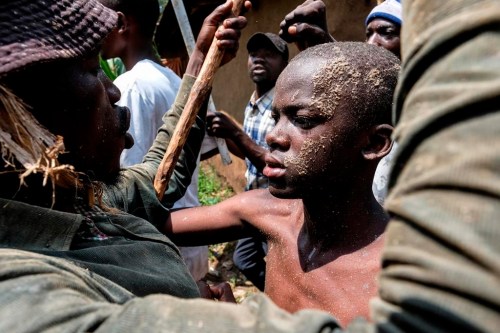
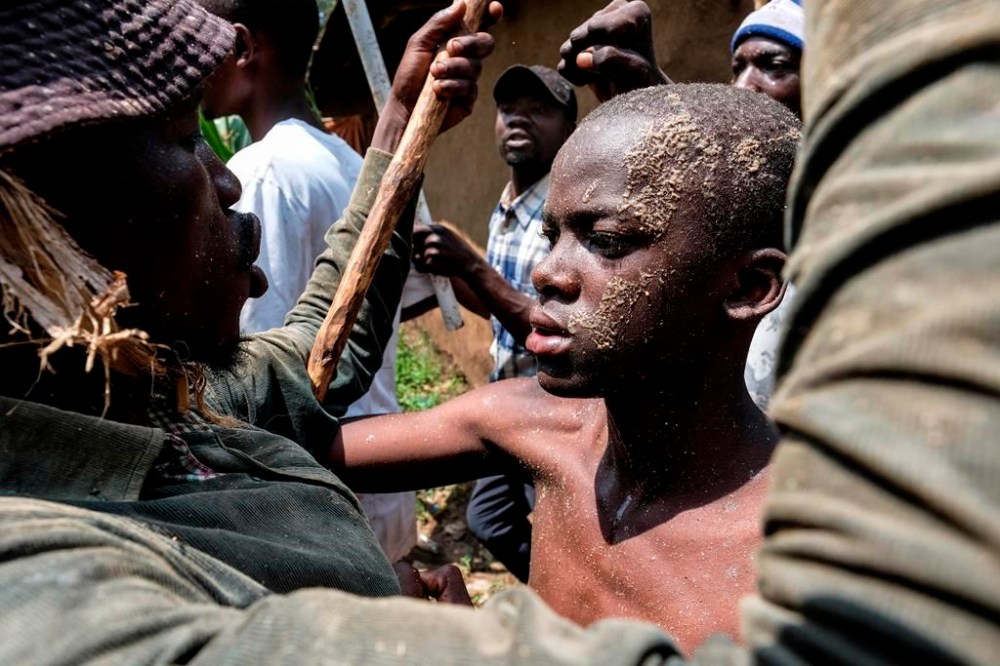
The first candidate for initiation this year was a teenager whose face had been smeared with mud and the dregs of homemade beer. He spread his legs and unblinkingly stared at the sky while a swarm of frenzied people around him pushed and shoved, demanding courage. The surgeon, applying no anesthetic, took hold of the boy and skinned him with a swift movement of his hands. A member of the boy’s family, aiming to protect the boy from the threat of witchcraft, collected the skin and took it home.
Emmanuel Watundu, the father of a 17-year-old boy who was among the first to be cut, said he stood by Imbalu, describing it as the life-changing event his son asked for. But he criticized what he saw as a carnival atmosphere by “peer groups (who) normally behave differently than we used to.”
Outside Watundu’s house, where a crowd had gathered, drunken people of all ages danced wildly, and one woman briefly exposed her breasts. A politician seeking a seat in the national assembly had a procession marching in the dirt road. Boys fondled girls and swung legs at them.
Watundu said the street dancers he saw were “from different areas” and that most people attending Imbalu came “to do business.” He said of the Ugandan government’s involvement that it had “given some bad picture” about the Umukuuka’s role as the chief organizer of Imbalu.
Wilson Watira, who chaired the Imbalu organizing committee, defended the government’s role as a supporter of Bamasaaba tradition. The exuberant street processions left people feeling joyful, he said.

“When it comes to performance of culture, of culture itself … it remains culture. We only want to show the world that even when we are performing this culture, it can also attract other people,” he said.
In the past, people thought the ritual was barbaric and brutal, Watira said.
“It’s the reason why we said, ‘No, we are not barbaric. We can make this thing very attractive, and you will enjoy it.’”
___
Associated Press religion coverage receives support through the AP’s collaboration with The Conversation US, with funding from Lilly Endowment Inc. The AP is solely responsible for this content.
The Free Press acknowledges the financial support it receives from members of the city’s faith community, which makes our coverage of religion possible.