United Church of Canada marks 100 years
A century ago, Canadian Methodists, Congregationalists and Presbyterians came together to form a new denomination

Advertisement
Read this article for free:
or
Already have an account? Log in here »
To continue reading, please subscribe:

Digital Subscription
One year of digital access for only $205*
- Enjoy unlimited reading on winnipegfreepress.com
- Read the E-Edition, our digital replica newspaper
- Access News Break, our award-winning app
- Play interactive puzzles
*First annual payment billed as $205.00 + GST for one year. This annual subscription will automatically renew at $233.00 + GST every 52 weeks (10% off the regular annual price of $259.35). Offer available to new and qualified returning subscribers only. Cancel any time.
To continue reading, please subscribe:
Add Free Press access to your Brandon Sun subscription for only an additional
$1 for the first 4 weeks*
- Enjoy unlimited reading on winnipegfreepress.com
- Read the E-Edition, our digital replica newspaper
- Access News Break, our award-winning app
- Play interactive puzzles
*Your next Brandon Sun subscription payment will increase by $1.00 and you will be charged $17.95 plus GST for four weeks. After four weeks, your payment will increase to $24.95 plus GST every four weeks.
Read unlimited articles for free today:
or
Already have an account? Log in here »
Hey there, time traveller!
This article was published 28/06/2025 (466 days ago), so information in it may no longer be current.
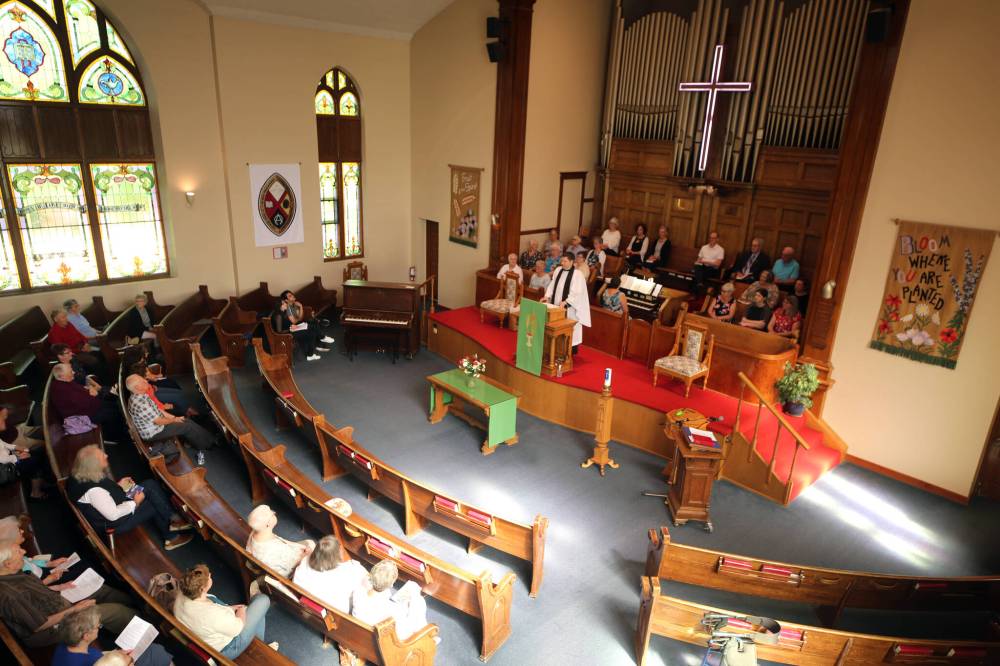
Turning 100 is a significant milestone for people — and for denominations. That’s what the United Church of Canada did on June 10, this year.
It was on that date a century ago that Canadian Methodists, Congregationalists and the Presbyterians came together to form the new denomination.
A big reason for the merger was to reduce duplication of effort and resources; so many little towns and villages across the country had multiple churches from different denominations. There was also a desire for greater Christian unity and collaboration.
It was a bold move that required each of the three groups to give something up to create the new entity.
As Jocelyn Bell, editor of Broadview magazine put it: “The United Church of Canada would never have existed unless each of the founding denominations agreed to let go of some cherished tradition, some notion of how things ought to be done. And it would never have taken root if each group hadn’t believed that diverse approaches to faith strengthen the whole body of Christ.”
Until the end of the 1960s, the new denomination enjoyed the fruits of that amalgamation through packed churches and Sunday schools. But by the end of that decade, as the idea of a Christian Canada began to wane and many baby boomers grew up and left the church, things began to shift for the United Church — as it did for other denominations.
For the United Church, that meant going from a high of about one million members in the mid-1960s to just over 325,000 today. On any given Sunday, about 110,000 are at a church service. And along with the drop in membership came a wave of church closings. It has averaged about 54 a year of late, according to one estimate. If that rate continues, by 2070 there will be no United Church churches left in Canada.
While many get stuck focusing on those grim statistics, it’s easy to overlook how the United Church impacted Christianity in this country, paving the way for significant changes.
For example, it was a leader when it came to involving women in pastoral ministry, ordaining Lydia Gruchy in 1936. In 1962 it adopted a more compassionate stance on divorce by noting it was sometimes a better choice than remaining unhappily married. It also was a leader in promoting peace when it welcomed U.S. draft dodgers during the Vietnam War.
Other ways it showed leadership was by condemning apartheid in South Africa in the 1980s. Also in that decade, it was the first denomination to welcome LGBTTQ+ people into membership and as clergy — a decision that was widely criticized by many other church groups.
The United Church was also a leader in responding to the terrible legacy of residential schools; it established a healing fund and, in 1998 and apologized for its role in the schools.
The denomination also was a leader in responding to the HIV AIDs crisis, addressing climate change, and was active in ecumenical and interfaith dialogue.
In these and other ways, such as addressing social justice issues like poverty, hunger and homelessness, Christians in Canada can be grateful for the United Church, and join it in celebrating its anniversary — and maybe they can also learn something from that denomination’s experience 100 years ago.
Things are different today than back then, of course; Canada is a much more diverse and secular country. But that same vision for increased cooperation, collaboration and unity may well be worth exploring as denominations and churches struggle with falling attendance and giving.

Maybe like those pioneers 100 years ago, denominational leaders can ask if we need five churches within 10 minutes driving distance of each other in most Canadian cities and towns. Do we need so many places of worship, seminaries and church-related social assistance and aid organizations?
And not only that; do we even need so many denominations? Writing in the Canadian Society of Church History in 2020, Bruce Guenther noted there are over 300 Christian denominations in Canada today. There are historical, cultural and theological reasons for why each one came into being. But at a time when many are struggling to stay afloat, would it make sense to explore more collaboration or even mergers?
Some will point to theological stances as a reason for why their denomination is unique or distinct and needs to continue in its present form. But the same objections were raised by some Methodists, Congregationalists and Presbyterians 100 years ago before the United Church was created. But they still did it. They still decided it was worth it to merge, and Canada was forever changed.
Who are the new visionaries who will explore new ways to be the church in Canada, just like what happened 100 years ago? Maybe the United Church of Canada can once again lead the way.
faith@freepress.mb.ca
The Free Press is committed to covering faith in Manitoba through our Religion in the News project. This reporting continues because readers like you step forward to fund it.
Donate now to support our reporting on religion.
Your donation is eligible for a charitable tax receipt.
BECOME A FAITH JOURNALISM SUPPORTER
Our newsroom depends on a growing audience of readers to power our journalism. If you are not a paid reader, please consider becoming a subscriber.
Our newsroom depends on its audience of readers to power our journalism. Thank you for your support.
The Free Press is committed to covering faith in Manitoba through our Religion in the News project. This reporting continues because readers like you step forward to fund it.
Donate now to support our reporting on religion.
Your donation is eligible for a charitable tax receipt.
BECOME A FAITH JOURNALISM SUPPORTER
Our newsroom depends on a growing audience of readers to power our journalism. If you are not a paid reader, please consider becoming a subscriber.
Our newsroom depends on its audience of readers to power our journalism. Thank you for your support.
Advertisement Advertise With Us
Advertisement Advertise With Us
The Free Press acknowledges the financial support it receives from members of the city’s faith community, which makes our coverage of religion possible.