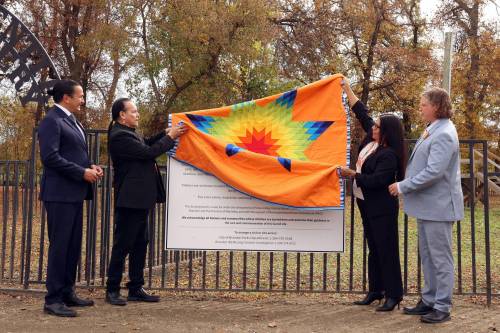
A moving tribute to the past
New book tells the story of the Manitoba Buddhist Temple, built by survivors of Japanese Canadian internment

Advertisement
Read this article for free:
or
Already have an account? Log in here »
To continue reading, please subscribe:

Digital Subscription
One year of digital access for only $205*
- Enjoy unlimited reading on winnipegfreepress.com
- Read the E-Edition, our digital replica newspaper
- Access News Break, our award-winning app
- Play interactive puzzles
*First annual payment billed as $205.00 + GST for one year. This annual subscription will automatically renew at $233.00 + GST every 52 weeks (10% off the regular annual price of $259.35). Offer available to new and qualified returning subscribers only. Cancel any time.
To continue reading, please subscribe:
Add Free Press access to your Brandon Sun subscription for only an additional
$1 for the first 4 weeks*
- Enjoy unlimited reading on winnipegfreepress.com
- Read the E-Edition, our digital replica newspaper
- Access News Break, our award-winning app
- Play interactive puzzles
*Your next Brandon Sun subscription payment will increase by $1.00 and you will be charged $17.95 plus GST for four weeks. After four weeks, your payment will increase to $24.95 plus GST every four weeks.
Read unlimited articles for free today:
or
Already have an account? Log in here »
Hey there, time traveller!
This article was published 22/11/2025 (312 days ago), so information in it may no longer be current.
In 1942, shortly after the Dec. 7, 1941 Japanese attack on Pearl Harbor, over 22,000 Japanese Canadians in British Columbia — men, women and children — were forcibly removed from their homes in that province.
They were labelled as “enemy aliens” by a Canadian government that was fearful of additional attacks, even though around 60 per cent were born and raised in Canada and the majority were Canadian citizens.
They were sent to internment camps in the interior of the province, where men were separated from their wives and children to do remote logging and other work. Due to labour shortages on farms in Alberta and Manitoba, families were given a choice to go to the prairies where they could stay together.
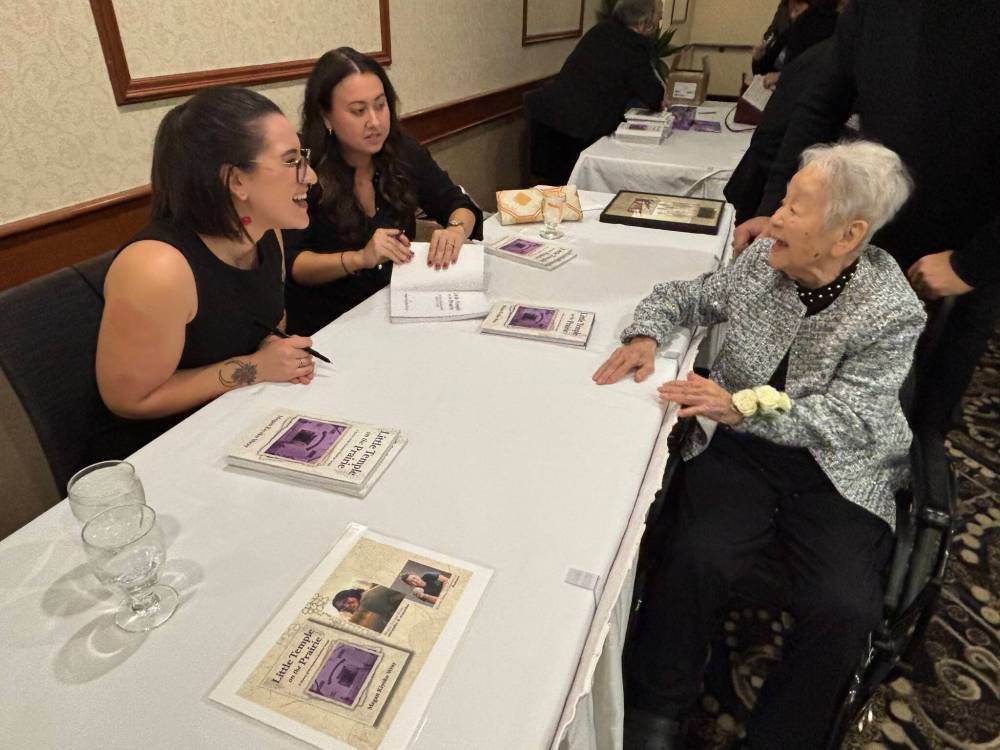
Submitted
Sally Takeuchi, a survivor of that 1942 forced relocation to Manitoba. Takeuchi was 12 when she came here with her parents and siblings to live on a farm in rural Manitoba.
Approximately 1,000 people chose to come to Manitoba to work on sugar beet farms near places like Steinbach, Portage la Prairie, Morris, Dugald, Elm Creek, Altona and Gretna.
The federal government promised they would have good homes and receive fair wages in the province. For most, that didn’t turn out to be true. Instead, wages were low and the living conditions were harsh — homes were often nothing more than sheds, barns or converted granaries and chicken coops, often with no insulation to keep out the cold, dirt or rough plank floors, and no plumbing or proper kitchens.
At the same time, they had to contend with racism and suspicion from some Manitobans who saw them as the “enemy.” Since they lived in rural locations far from other Japanese Canadian families, they struggled with isolation and loneliness.
When the war ended in 1945, many of the Japanese Canadian families chose to remain in Manitoba. This was mostly because they had nothing to return to. The government had promised to hold their homes, farms, fishing boats and businesses back in B.C. in trust for when they came back, but in fact had sold them off, usually at fire-sale prices.
Most of the Japanese Canadian families moved to Winnipeg to find work. Once there, one of the first things they did was to make plans for a place of worship, culture and community: the Manitoba Buddhist Temple.
On Nov. 15, a few survivors from that forcible relocation to Manitoba, together with their descendants, met for a gala to celebrate the launch of the book Little Temple on the Prairie (Friesen Press).
The book, by author Megan Kiyoko Wray and illustrator Brynne Takeuchi Monterrosa, details the mass expulsion of the Japanese Canadian community from B.C. and the move to Manitoba.
It tells the story of how most were given only 24 hours-notice to leave, and allowed only one suitcase per person — forcing them to make agonizing decisions about what to take and what to leave behind.
The book also details the planning that went into the creation of the Temple. It was seen as a way to enable that once scattered and isolated Japanese Canadian community as a way to come together in order to preserve their faith, customs, language and culture.
Construction of the Temple started in 1951, using volunteer labour. It was completed in 1952. It quickly became the centre of Japanese Canadian life in the province, providing a place for worship, educational and cultural events, networking, cooking classes and other community activities.
As Kiyoko Wray put it at the launch, it is “hard to imagine the community without the temple,” a place “to belong and be connected.” Without it, she added, “we are not who we are right now.”
Harvey Kaita is president of the temple. The forced relocation was traumatic for the Japanese Canadians, including his own parents, who lost their home and properties in what is now Maple Ridge, B.C. But the temple made life easier when the war ended.
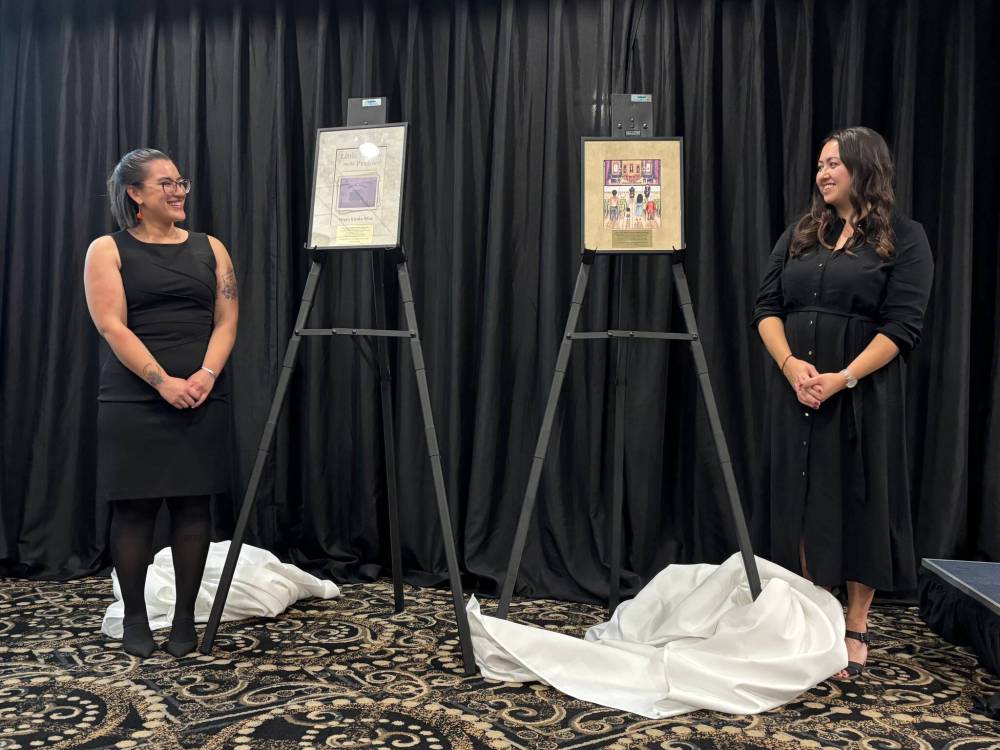
Submitted
Author Megan Kiyoko Wray and illustrator Brynne Takeuchi Monterrosa at the gala and launch.
“It provided them with community, a gathering place, a focus, a place where they could speak their language and be themselves,” he said.
It was also where they could practice their Jodo Shinshu Buddhism, also known as Pure Land Buddhism, brought to Canada by Japanese immigrants in the early 20th century. That 800-year-old tradition, known as a path for everyday people, encourages humility, sincerity, and living responsibly in society.
Today, the temple isn’t the same busy place it used to be. Services were once packed, and what they called “Sunday School” was filled with children. But today there are only 68 members, most of them older. “Very few young people attend today,” said Kaita, adding that for cultural activities the community now turns to the Japanese Canadian Cultural Centre.
For Kiyoko Wray, the book is more than a history; it’s a “moving tribute” to the previous generation who endured the hardship of relocation and created the temple. “I see the community as co-authors,” she said.

Through her illustrations in the book, Takeuchi Monterrosa said she wanted to “capture the lively bustle of the temple,” honouring the past while “looking to the future.”
One of her illustrations features the Amida Buddha, a central figure in Pure Land Buddhism, in a sugar beet field. For Takeuchi Monterrosa, it signifies how the community has survived that harsh beginning in Manitoba in the 1940s to flower and thrive in the “guiding light of the Dharma,” that is, in the light of the teachings of the Buddha about the right way of living.
Altogether, she said, “it was humbling and a true honour to be part of bringing the story to life.”
Little Temple on the Prairie is available at McNally Robinson booksellers.
faith@freepress.mb.ca
The Free Press is committed to covering faith in Manitoba through our Religion in the News project. This reporting continues because readers like you step forward to fund it.
Donate now to support our reporting on religion.
Your donation is eligible for a charitable tax receipt.
BECOME A FAITH JOURNALISM SUPPORTER
Our newsroom depends on a growing audience of readers to power our journalism. If you are not a paid reader, please consider becoming a subscriber.
Our newsroom depends on its audience of readers to power our journalism. Thank you for your support.
The Free Press is committed to covering faith in Manitoba through our Religion in the News project. This reporting continues because readers like you step forward to fund it.
Donate now to support our reporting on religion.
Your donation is eligible for a charitable tax receipt.
BECOME A FAITH JOURNALISM SUPPORTER
Our newsroom depends on a growing audience of readers to power our journalism. If you are not a paid reader, please consider becoming a subscriber.
Our newsroom depends on its audience of readers to power our journalism. Thank you for your support.
Advertisement Advertise With Us
Advertisement Advertise With Us
The Free Press acknowledges the financial support it receives from members of the city’s faith community, which makes our coverage of religion possible.