MAID decision could have national impact
People involved in faith-based health care in Manitoba are closely watching B.C. Supreme Court case

Advertisement
Read this article for free:
or
Already have an account? Log in here »
To continue reading, please subscribe:

Digital Subscription
One year of digital access for only $205*
- Enjoy unlimited reading on winnipegfreepress.com
- Read the E-Edition, our digital replica newspaper
- Access News Break, our award-winning app
- Play interactive puzzles
*First annual payment billed as $205.00 + GST for one year. This annual subscription will automatically renew at $233.00 + GST every 52 weeks (10% off the regular annual price of $259.35). Offer available to new and qualified returning subscribers only. Cancel any time.
To continue reading, please subscribe:
Add Free Press access to your Brandon Sun subscription for only an additional
$1 for the first 4 weeks*
- Enjoy unlimited reading on winnipegfreepress.com
- Read the E-Edition, our digital replica newspaper
- Access News Break, our award-winning app
- Play interactive puzzles
*Your next Brandon Sun subscription payment will increase by $1.00 and you will be charged $17.95 plus GST for four weeks. After four weeks, your payment will increase to $24.95 plus GST every four weeks.
Read unlimited articles for free today:
or
Already have an account? Log in here »
Hey there, time traveller!
This article was published 24/01/2026 (238 days ago), so information in it may no longer be current.
The B.C. Supreme Court is hearing a case that asks if publicly funded faith-based hospitals should be allowed to deny patients onsite Medical Assistance In Dying (MAID).
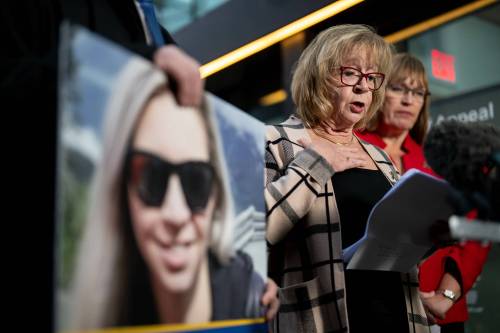
The case involves Samantha O’Neill, who was a patient with terminal cancer at St. Paul’s hospital in Vancouver.
When O’Neill, 34, asked for MAID, she was told she couldn’t do it at St. Paul’s. Due to its religious beliefs, that Catholic hospital doesn’t permit it on its premises.

Ethan Cairns / The Canadian Press files
Gaye O’Neill, mother of Samantha O’Neill, speaks before the start of the B.C. Supreme Court trial in Vancouver on Jan. 12.
To access the procedure, O’Neill was told she would have to be transferred to another facility. On the day of the transfer, she was heavily sedated for her comfort. She never awoke again. As a result, her parents were unable to say goodbye.
In the court case, O’Neill’s parents argue that the hospital, which receives public funding, should not be allowed to use religious beliefs to deny a procedure that is legal in Canada.
Reading about this case took me back seven years, to when my friend John Regehr opted for MAID.
At that time, Regehr, 93, was a patient at Concordia Hospital, a faith-based hospital in Winnipeg that was started by Mennonites in 1928. Like St. Paul’s, it doesn’t permit MAID on its premises.
At the age of 90, Regehr had life-saving heart surgery. A few months later, he fell in his apartment and broke his hip. He recovered, but over the next few years there were more falls and more trips to emergency.
In October of 2019, he was admitted to Concordia Hospital with severe pain in his hip. It was clear to him he would never be able to go back home again.
According to his son, Rennie, he didn’t want to lie in bed for the rest of his life, “waiting for death to come.”
When Regehr learned he was eligible for MAID, “his face lit up,” Rennie said.
Since Concordia doesn’t allow the procedure, due to its beliefs, Regehr was moved by ambulance to Health Sciences Centre on Nov. 7. There, in the presence of this family, he died.
Looking back on that experience, Rennie said the experience of being transferred “was hurtful” to his father on two levels.
First, because he had committed so much of his time and energy to the Mennonite church in Canada, only to feel they had turned, as he was abandoned by them in his greatest moment of need.
Requiring him to leave Concordia for MAID felt “like his own people were kicking him out to the street,” Rennie said. “It would have been wonderful if he could have done it there. It represented his spiritual home.”
The other level of hurt was physical; the ambulance ride to Health Science Centre was extremely uncomfortable. “The ambulance bounced around, and it was cold,” Rennie said. “It still sticks with me … it was not a good last hour.”
For Rennie, Concordia’s decision felt like dogma and doctrine were more important than his father, and for others who find themselves in similar situations.
“Can those doctrines and dogmas be set aside to tend to the person?” he asked. “I wish for more pastoral responses.”
In Winnipeg, faith-based hospitals like Concordia and St. Boniface can opt out of providing MAID. But they must work with health authorities to ensure patients can access it elsewhere. A spokesperson from the Winnipeg Regional Health Authority (WHRA) said when a patient requires or requests a service that is not provided at a particular site — whether it’s various kinds of surgeries or MAID — they will work with their health care partners to provide those services.
When it comes to faith-based personal care homes, they have what is called an “abstaining policy” when it comes to MAID, said Gladys Hrabi, CEO of the Catholic Health Association of Manitoba and of the Interfaith Health Care Association of Manitoba.
The policy states that while the homes are funded by the WRHA, they are not owned or operated by them. As a result, the individual homes are allowed to opt-out of having to permit MAID on their premises, according to their beliefs.
Many personal care homes, like the Bethania Group and Donwood, which are Mennonite, don’t allow MAID on their premises — something they make clear to potential residents. But they don’t prevent residents from accessing information about it, said Bethania CEO Gary Ledoux.

“We would provide information and all necessary records to the MAID team,” he said, adding they also provide spiritual support. “We journey with our residents, whether we agree with their decision or not,” added Donwood CEO Paul Nyhof.
For Catholic care homes, MAID is not permitted on site. “All Catholic faith-based organizations have policies and procedures in place to that effect,” said Dominique Philibert of the Réseau Compassion Network, which brings together 15 Catholic health and social service-related organizations, including St. Boniface Hospital.
One care home that does permit MAID on site is Luther Home, which is sponsored by Christ Lutheran Church, an Evangelical Lutheran Church in Canada congregation. “While we do not endorse the actual process, we respect our resident’s right to choose that path and support those that do as we would any of our residents going through the dying process,” said CEO Keith Bytheway.
When it comes to the court case in B.C., people involved in faith-based health care in Manitoba are watching closely. Whatever happens could have considerable impact here — and perhaps across the country.
faith@freepress.mb.ca
The Free Press is committed to covering faith in Manitoba through our Religion in the News project. This reporting continues because readers like you step forward to fund it.
Donate now to support our reporting on religion.
Your donation is eligible for a charitable tax receipt.
BECOME A FAITH JOURNALISM SUPPORTER
Our newsroom depends on a growing audience of readers to power our journalism. If you are not a paid reader, please consider becoming a subscriber.
Our newsroom depends on its audience of readers to power our journalism. Thank you for your support.
The Free Press is committed to covering faith in Manitoba through our Religion in the News project. This reporting continues because readers like you step forward to fund it.
Donate now to support our reporting on religion.
Your donation is eligible for a charitable tax receipt.
BECOME A FAITH JOURNALISM SUPPORTER
Our newsroom depends on a growing audience of readers to power our journalism. If you are not a paid reader, please consider becoming a subscriber.
Our newsroom depends on its audience of readers to power our journalism. Thank you for your support.
Advertisement Advertise With Us
Advertisement Advertise With Us
The Free Press acknowledges the financial support it receives from members of the city’s faith community, which makes our coverage of religion possible.