Olympics visitors are invited beyond the Duomo to Milan’s other stunning churches

Advertisement

Advertise with us

MILAN (AP) — Away from the crowds swarming Milan’s Duomo during the Winter Olympics, young volunteers have been steering visitors toward the city’s lesser-known churches, inviting them to discover their sacred heritage.

Read this article for free:


or

Already have an account? Log in here »

To continue reading, please subscribe:

Subscribe and receive a limited-edition Free Press branded hat or tote.

Digital Subscription

One year of digital access for only $205*

  • Enjoy unlimited reading on winnipegfreepress.com
  • Read the E-Edition, our digital replica newspaper
  • Access News Break, our award-winning app
  • Play interactive puzzles

*First annual payment billed as $205.00 + GST for one year. This annual subscription will automatically renew at $233.00 + GST every 52 weeks (10% off the regular annual price of $259.35). Offer available to new and qualified returning subscribers only. Cancel any time.

To continue reading, please subscribe:

Add Free Press access to your Brandon Sun subscription for only an additional

$1 for the first 4 weeks*

  • Enjoy unlimited reading on winnipegfreepress.com
  • Read the E-Edition, our digital replica newspaper
  • Access News Break, our award-winning app
  • Play interactive puzzles
Start now

*Your next Brandon Sun subscription payment will increase by $1.00 and you will be charged $17.95 plus GST for four weeks. After four weeks, your payment will increase to $24.95 plus GST every four weeks.

Hey there, time traveller!
This article was published 20/02/2026 (228 days ago), so information in it may no longer be current.

MILAN (AP) — Away from the crowds swarming Milan’s Duomo during the Winter Olympics, young volunteers have been steering visitors toward the city’s lesser-known churches, inviting them to discover their sacred heritage.

Known as “The Path of Beauty” (“La Via della Bellezza” in Italian), the initiative began in 2020 as a project of the archdiocese’s youth ministry office. It typically offers visits on weekends, but the schedule extends to weekdays during the Games and runs through March 15.

“The idea is to welcome visitors inside these churches and invite them to rediscover an artistic beauty that we inherit from the past, but that still speaks today,” Sara Cainarca, who coordinates the team hosting the visits, told The Associated Press on Wednesday.
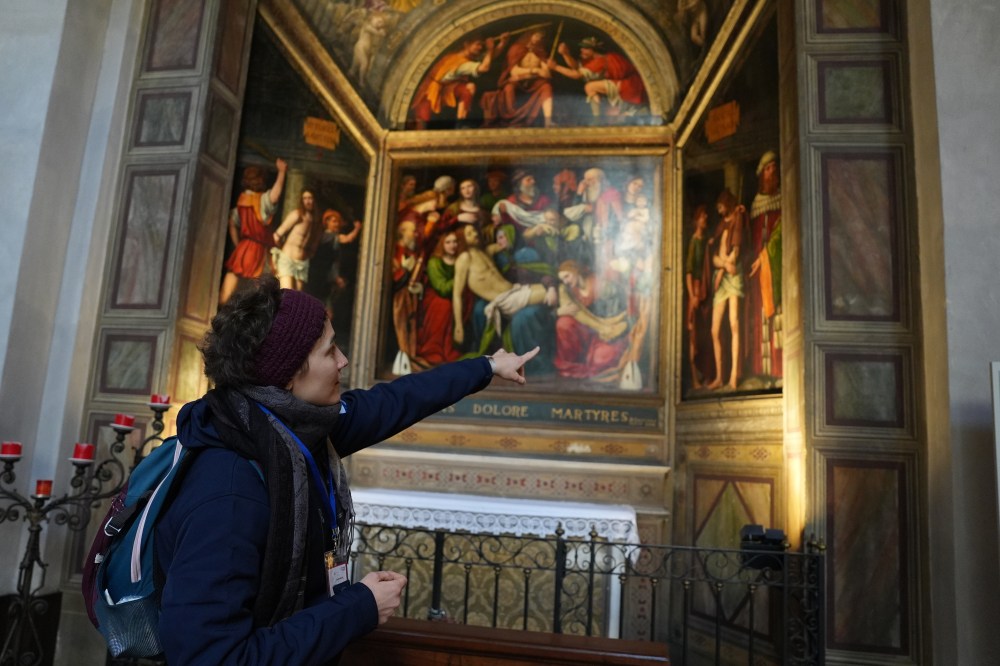
Sara Cainarca, a volunteer with the “La Via della Bellezza,” or “The Path of Beauty,” initiative, gestures toward a fresco inside the Basilica of San Lorenzo Maggiore in Milan, Italy, Wednesday, Feb. 18, 2026. (AP Photo/María Teresa Hernández)

Faith through art

Between 15 and 20 people are involved in the archdiocese’s project, each specializing in one or two churches in Milan. The short visits are offered to a dozen Catholic sanctuaries across the city.

Volunteers wait for visitors inside their assigned church. Emphasizing they are not certified tour guides, they offer a free introduction to the history and sacred art of each building.

During the Olympic weeks, volunteers say they have welcomed visitors from the United States, France, Germany and Spain, some drawn to the city for the Games and others simply curious to explore beyond its best-known landmarks.

Giovanna Giuditta Mazza is an art history student who joined the initiative two years ago. She offers visits in English, French and Italian and is mostly based in the Basilica of San Lorenzo Maggiore, which dates back to the late 4th and early 5th centuries, making it one of the city’s oldest churches.

“When people enter the church, they often do not know what to expect,” said Mazza, 22. “But when they leave, I see a sparkle in their eyes and that is precious to me.”

For her and other volunteers, these encounters become an opportunity to speak about their faith.

“Beauty is not just about art,” said Víctor Ortíz, a 22-year-old student of cultural heritage. “It is also about the Word of God.”
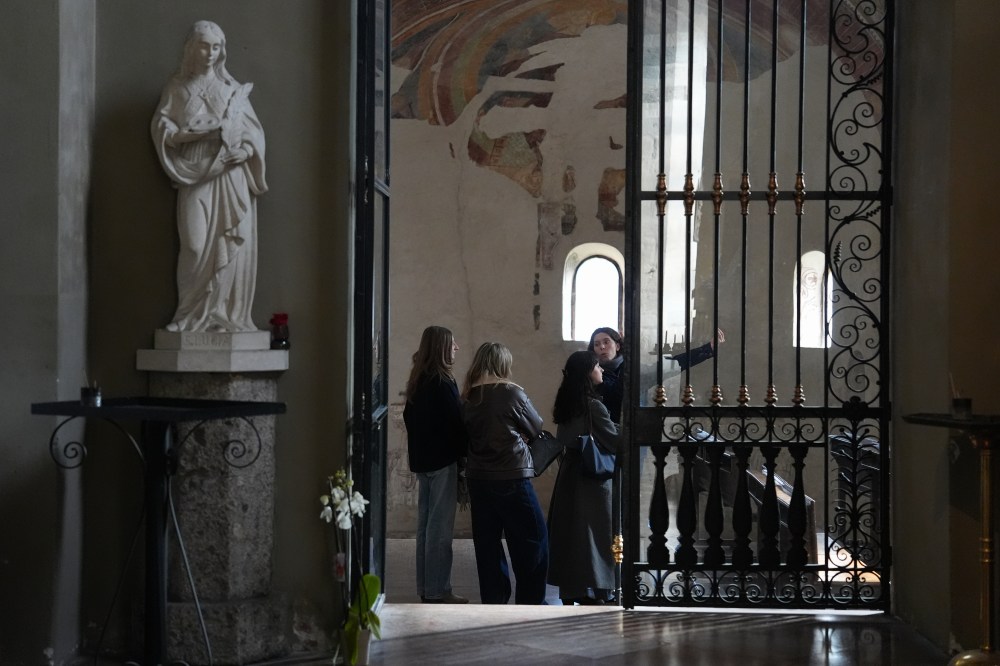
Giovanna Giuditta Mazza, right, leads a small group of visitors inside the Basilica of San Lorenzo Maggiore as part of the “La Via della Bellezza,” or “The Path of Beauty,” initiative in Milan, Italy, Wednesday, Feb. 18, 2026. Volunteers with the archdiocese’s youth ministry office offer free visits highlighting the artistic and spiritual heritage of the churches. (AP Photo/María Teresa Hernández)

The church of Santa Maria presso San Satiro is best known for the illusion created by Renaissance architect Donato Bramante, who designed a trompe-l’oeil apse to compensate for limited space. 

Ortiz, who often gives guides there, explains to visitors how the site had also been linked to a 13th-century miracle, in which an image of the Virgin Mary was said to have bled after being stabbed.

“The growing devotion surrounding that event eventually led to the construction of the church in the 16th century,” he said.

Training and tradition

“La Via della Bellezza” began as training sessions in which university students from the Lombardy region explored the relationship between art and spirituality. Volunteers then spread to cities like Brescia or Bergamo, where churches and basilicas are known for their rich Romanesque and Baroque art.

“The idea is to accompany visitors so they move from being tourists to becoming pilgrims who discover a deeper desire within themselves,” said Cainarca, 26.

Volunteers meet at least once a month with experts who provide additional training in art history and other topics. Additionally, the group travels to nearby places to deepen their understanding of both artistic heritage and the spiritual traditions behind it. They will soon head to Ravenna, home to a series of Christian monuments famed for their mosaics that has been recognized as a World Heritage by the U.N. cultural agency UNESCO.

Milan, though, is Cainarca’s favorite city to work in. She says its churches are part of the city’s identity and that its patron, Saint Ambrose, shaped a vision of community and collaboration.
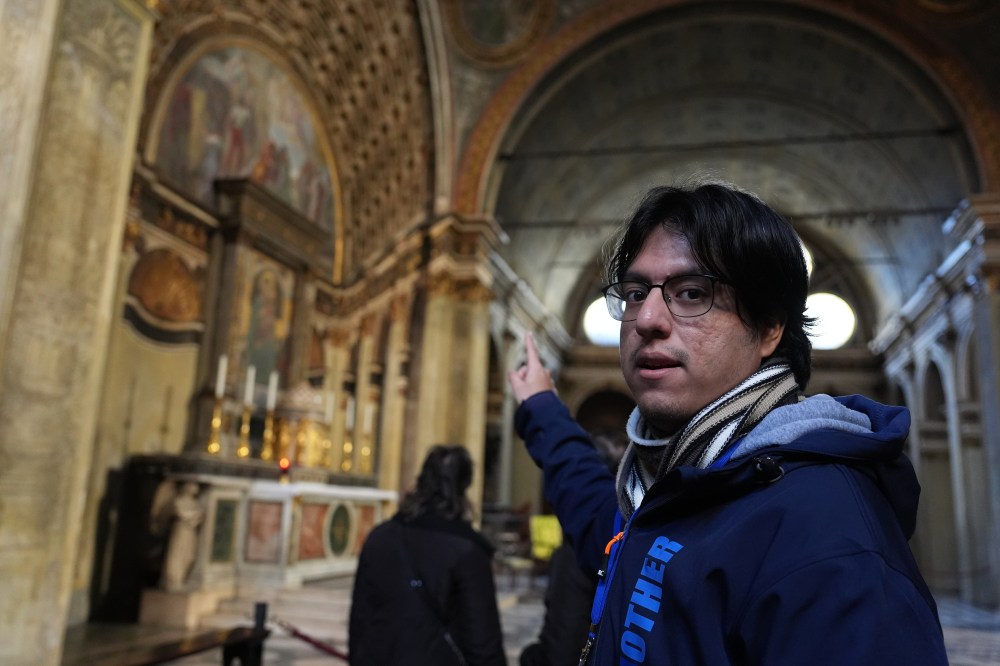
Víctor Ortiz, a volunteer with the “La Via della Bellezza,” or “The Path of Beauty,” initiative, gestures toward artwork inside the church of Santa Maria presso San Satiro in Milan, Italy, Wednesday, Feb. 18, 2026. (AP Photo/María Teresa Hernández)

“Today, Milan is known for fashion, shopping, finance and skyscrapers,” she said. “These churches offer a moment of pause, contemplation and discovery.”

___

AP Winter Olympics coverage: https://apnews.com/hub/milan-cortina-2026-winter-olympics

___

Associated Press religion coverage receives support through the AP’s collaboration with The Conversation US, with funding from Lilly Endowment Inc. The AP is solely responsible for this content.

Report Error Submit a Tip

The Free Press acknowledges the financial support it receives from members of the city’s faith community, which makes our coverage of religion possible.
More Stories

Real journalists matter in an AI world

Paul Deegan 4 minute read Preview

Real journalists matter in an AI world

Paul Deegan 4 minute read 2:00 AM CDT

An algorithm can decide what you see, but it doesn’t report the news. Nunatsiaq News, an award-winning newspaper in Nunavut, recently reported that a so-called “news” website was posting AI-generated articles about the north by stealing real news stories produced by real journalists.

The articles were supposedly written by Nunavut correspondent Leah Qammaniq — a fake journalist, with a fake photo and a fake bio.

Governor General Louise Arbour warned us of fake news in her installation speech in June. She said, “We must continue to protect the public space in which our national debates take place: from schools and universities to the media, political parties, unions and civil society organizations …With instant access to vast amounts of information, it is very tempting to pay little attention to the reliability of sources. The lines between knowledge and belief, between truth and falsehood, between facts and assumptions, are increasingly blurred. AI could be threatening not only the way we live and work, but also the control we exercise over our own destiny.”

The Government of Canada has recognized the problem as well. Its recent discussion paper, Enhancing trust in artificial intelligence through increased transparency, stated, “Canadians encounter news reporting, product reviews, and audio-visual content across the internet, often without any indication of whether it was written by a person, generated by an AI system, or produced through some combination of both … A particular concern within this broader landscape is that generative AI greatly enables the creation and dissemination of deceptive or misleading content.”

Read
2:00 AM CDT

Hydro Québec faces issue we should avoid

Editorial 4 minute read Preview

Hydro Québec faces issue we should avoid

Editorial 4 minute read Yesterday at 2:01 AM CDT

You might be tempted to call it a canary in an electric power generation coal mine.

Read
Yesterday at 2:01 AM CDT

The election of our discontent: City at a crumbling crossroads, grumbling residents say in poll

Matthew Frank 7 minute read Preview

The election of our discontent: City at a crumbling crossroads, grumbling residents say in poll

Matthew Frank 7 minute read Updated: Yesterday at 3:16 PM CDT

There’s an undercurrent of unhappiness running through the Winnipeg electorate as the municipal election day approaches.

One-half of Winnipeggers believe the city is heading in the wrong direction, according to a new Abacus Data poll, with nearly one-third unsure if Winnipeg is regressing or progressing.

Only 21 per cent of residents believe the city is on the right track, the Free Press-commissioned poll found.

That discontentment extends to how the city spends its tax dollars, with four in 10 Winnipeggers believing they receive poor value for what they pay in property taxes.

Read
Updated: Yesterday at 3:16 PM CDT

Puzzles Palace

1 minute read Monday, Jul. 27, 2026

To solve our puzzles, please subscribe with this special offer: |

Mayoral candidates Klein, Vogiatzakis continue to snipe over inducement allegations

Chris Kitching and Joyanne Pursaga 6 minute read Preview

Mayoral candidates Klein, Vogiatzakis continue to snipe over inducement allegations

Chris Kitching and Joyanne Pursaga 6 minute read Updated: Yesterday at 5:50 PM CDT

Winnipeg mayoral candidate Mike Vogiatzakis told reporters Monday he will contact the city clerk to report his allegation that rival Kevin Klein offered him a job to drop out of the race.

Vogiatzakis and Klein both doubled down a day after accusing each other of offering the other a position at city hall, if they were victorious in the Oct. 28 election, in exchange for a withdrawal.

“Do I want to get him charged? Not really. I don’t want to destroy anybody’s life,” Vogiatzakis told reporters.

“Kevin’s a good guy. I thought he was a friend of mine, but he’s not. Kevin uses leverage to get ahead, and he tried to use me as leverage.”

Read
Updated: Yesterday at 5:50 PM CDT

Essential workers ruling raises questions

Editorial 4 minute read Preview

Essential workers ruling raises questions

Editorial 4 minute read 2:00 AM CDT

Ever been to a Dynacare clinic? Most of us have been. It’s an amazing demographic and ethnic slice of the city we’ve become. Old patients. Young patients. New arrivals. Long-time Canadians. People who know the ropes — others who are startled by the crowds and the noise and the lockstep forward motion of professionals doing what they have been trained to do. It seems, all at the same time, both chaotic and diagnostic, as names of patients are steadily called out and thousands of tests are performed.

But Dynacare is at the centre of a new kind of test and this time, we’re all in the test tube together.

It’s the first real test for new labour law put in place by the government of Premier Wab Kinew in 2024 — a law that redefined what essential services are for provincially-regulated workplaces. Under this law, companies and their employee and unions must have an agreement of which employees are essential — which ones must stay on the job during a legal strike for the protection of the health and safety of the public.

Dynacare had that kind of essential employee agreement with its staff and union — the company and the union had agreed the employees were not essential.

Read
2:00 AM CDT