Why it could take years to trace the Indigenous artifacts returned by the Vatican
Advertisement
Read this article for free:
or
Already have an account? Log in here »
To continue reading, please subscribe:

Digital Subscription
One year of digital access for only $205*
- Enjoy unlimited reading on winnipegfreepress.com
- Read the E-Edition, our digital replica newspaper
- Access News Break, our award-winning app
- Play interactive puzzles
*First annual payment billed as $205.00 + GST for one year. This annual subscription will automatically renew at $233.00 + GST every 52 weeks (10% off the regular annual price of $259.35). Offer available to new and qualified returning subscribers only. Cancel any time.
To continue reading, please subscribe:
Add Free Press access to your Brandon Sun subscription for only an additional
$1 for the first 4 weeks*
- Enjoy unlimited reading on winnipegfreepress.com
- Read the E-Edition, our digital replica newspaper
- Access News Break, our award-winning app
- Play interactive puzzles
*Your next Brandon Sun subscription payment will increase by $1.00 and you will be charged $17.95 plus GST for four weeks. After four weeks, your payment will increase to $24.95 plus GST every four weeks.
Read unlimited articles for free today:
or
Already have an account? Log in here »
OTTAWA –
More than 60 Indigenous items repatriated from the Vatican are now back on Canadian soil — but their journey home is just getting started.
Experts and elders are now working to trace their origins and return them to the communities that created them.
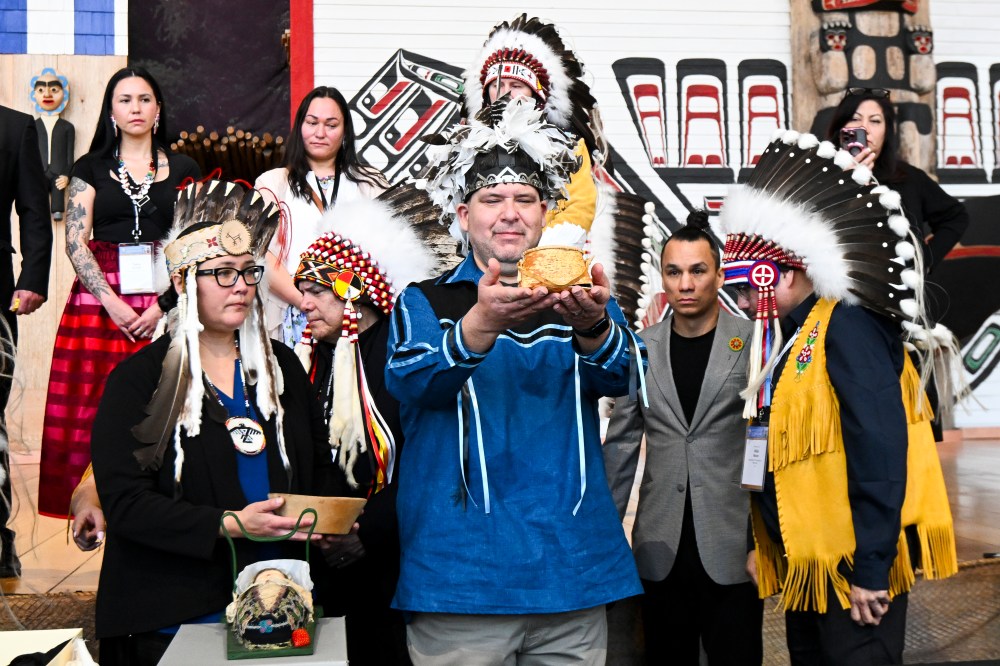
The items — which include baby carriers, embroidered gloves, a bow and arrow, moccasins, a sealskin kayak and a model Métis sled and dog team — are being housed for now at the Canadian Museum of History in Gatineau, Que. They are not being made available for public viewing without the permission of the national Indigenous organizations working to determine their origins.
The Canadian Press was the only media outlet given permission to view all 62 returned items.
In 2022, members of an Indigenous delegation meeting with Pope Francis in Rome were given a private viewing of items held by the church — some of which had not been seen in public in decades. The 62 items were among thousands sent to Rome by missionaries around the world for an exhibit organized by Pope Pius XI in 1925.
In November, Pope Leo XIV said the items would be transferred to the Canadian Conference of Catholic Bishops, which said it would immediately turn them over to Indigenous communities in Canada.
That church-to-church transfer means the Vatican did not set a precedent on repatriating items in their possession — which could make future repatriation efforts more difficult for other Indigenous communities.
Cody Groat, an assistant professor of history and Indigenous studies at Western University and a member of Six Nations of the Grand River, said tracing the items back to their communities or families of origin could take years.
“Part of the reason why we can’t just return these items immediately is because in the Vatican collection they were catalogued so poorly, in some cases generically as ‘Indigenous artifact, Eastern Canada,’ or ‘Indigenous artifact, Western Canada,'” he said.
Two of the items have been traced already. Anishinabek Nation Grand Chief Linda Debassige’s late uncle signed a bowl and spoon that came from Manitoulin Island in Ontario before joining the Vatican collection.
Groat said experts will first study the items’ designs and materials for clues to their origins. A basket made of birch bark, for example, could come from somewhere around the Great Lakes, while a pair of high-top moccasins may have come from somewhere in the Prairies.
The three national Indigenous organizations — the Assembly of First Nations, the Métis National Council and Inuit Tapiriit Kanatami — are developing their own processes for repatriating the items and deciding who will be allowed to study them.
Part of the challenge they face is the lack of national legislation guiding the repatriation of Indigenous artwork and cultural items.
In the United States, the Native American Graves Protection and Repatriation Act requires that federally funded institutions pre-emptively engage with Indigenous nations whose items they may have in their possession, and gives those nations first right of refusal.
As part of its commitment to reconciliation, the federal government is supposed to come up with legislation on repatriating Indigenous cultural belongings and human remains.
In the absence of such a law, Groat said, Canada lacks a straightforward protocol for ensuring Indigenous cultural items end up where they’re supposed to be.
And even once experts trace an archival item back to its original community, Groat said, that won’t mean the community will be in a position to look after it — especially if it’s struggling with repairs to core infrastructure like housing and water systems.
“Many of these nations are fighting for basic human rights like clean drinking water,” he said. “It’s not their priority at this moment.”
Most Indigenous communities do not have access to high-tech methods of museum conservation, like climate-controlled storage and lighting.
And not all of the items were meant to be seen by just anyone at any time, Groat added.
Some can only be used, viewed or depicted in certain seasonal or ceremonial contexts and are not to be shared with people outside the community, he said. Others, including those made of animal materials, could be considered living beings by their home communities and could be expected to decompose over time, he said.
That means the average Canadian should not expect to see these items in a museum exhibition — unless that’s something community members decide to do.
“They’re going to be utilized by elders, knowledge keepers and youth to revitalize culture, and maybe these cultural items will fall apart and break down over time, but that’s part of their life cycle,” Groat said.
Repatriation could get political as well, if chiefs under the Indian Act and hereditary leaders disagree over how the items are to be handled.
Groat said the passage of time also makes repatriation more difficult. Indigenous communities historically have overlapping territories that extend beyond the reserve system the federal government created under the Indian Act — meaning more than one community could lay claim to a piece.
“It’s going to be incredibly complex,” he said. “It’s going to be years-long, and I don’t think it’s going to be an easy process by any means.”

The Vatican still holds some items collected by the church from Indigenous communities in Canada. Asked what the Assembly of First Nations is doing to bring the rest of those items home, National Chief Cindy Woodhouse Nepinak said she will meet with Pope Leo later this year and plans to discuss the issue with him.
Inuit Tapiriit Kanatami President Natan Obed has floated the idea of bringing the sealskin kayak on a tour of the Arctic. Victoria Pruden, president of the Métis National Council, said the organization has yet to decide how the model dog sled will be handled.
Groat said he’s been surprised at how much attention news of the artifacts is getting across the country.
“We can look now across the country and ask not just questions of reconciliation, but also of cultural heritage and heritage preservation,” he said.
This report by The Canadian Press was first published March 16, 2026.
The Free Press acknowledges the financial support it receives from members of the city’s faith community, which makes our coverage of religion possible.