Syrian Kurds return home to celebrate Nowruz for the first time since exile
Advertisement
Read this article for free:
or
Already have an account? Log in here »
To continue reading, please subscribe:

Digital Subscription
One year of digital access for only $205*
- Enjoy unlimited reading on winnipegfreepress.com
- Read the E-Edition, our digital replica newspaper
- Access News Break, our award-winning app
- Play interactive puzzles
*First annual payment billed as $205.00 + GST for one year. This annual subscription will automatically renew at $233.00 + GST every 52 weeks (10% off the regular annual price of $259.35). Offer available to new and qualified returning subscribers only. Cancel any time.
To continue reading, please subscribe:
Add Free Press access to your Brandon Sun subscription for only an additional
$1 for the first 4 weeks*
- Enjoy unlimited reading on winnipegfreepress.com
- Read the E-Edition, our digital replica newspaper
- Access News Break, our award-winning app
- Play interactive puzzles
*Your next Brandon Sun subscription payment will increase by $1.00 and you will be charged $17.95 plus GST for four weeks. After four weeks, your payment will increase to $24.95 plus GST every four weeks.
Read unlimited articles for free today:
or
Already have an account? Log in here »
Hey there, time traveller!
This article was published 21/03/2026 (203 days ago), so information in it may no longer be current.
AL BASOUTA, Syria (AP) — Abdul Rahman Omar fled his village in the Afrin district in northern Syria eight years ago as a Turkish offensive against Kurdish fighters swept across the area.
Now he is among hundreds of Kurds who have recently returned to Afrin. He joined neighbors in celebrating the spring festival of Nowruz for the first time since their return from exile, and for the first time after the government declared the celebration a national holiday.
Nowruz, the Farsi-language word for “new year,” is an ancient Persian festival that is also celebrated by Kurds in Syria, Turkey and Iraq as well as Iran. It is characterized by colorful street festivals and torch-bearing processions winding their way into the mountains. The 3,000-year-old festival is rooted in the ancient religion of Zoroastrianism and is marked by people across faiths including Zoroastrians, Muslims, Christians, Jews and those of the Baha’i faith as well as by millions in the diaspora.
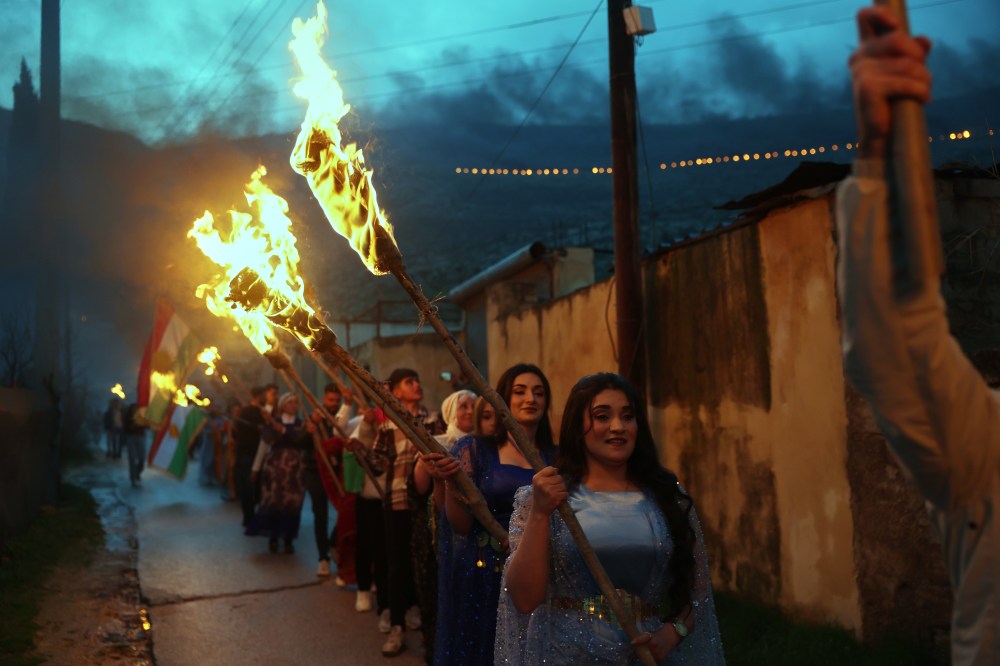
Omar joined a row of young men and women in a line dance to a pounding beat Friday evening and then processed up into the hills above the village of al-Basouta. They hoisted torches and Kurdish flags and spelled out the word “raperin,” meaning “uprising” in Kurdish, with flames.
The initially peaceful holiday celebration was marred by tensions between Arabs and Kurds in some areas Saturday after images circulated on social media of a man taking down the Syrian flag during Nowruz festivities in the northeastern city of Kobani.
The return follows a deal to integrate Kurds into the army
Afrin was seized by Turkish forces and allied Syrian opposition fighters in 2018, following a Turkey-backed military operation that pushed fighters with the Kurdish-led Syrian Democratic Forces and thousands of Kurdish civilians from the area.
Turkey considers the SDF to be a terrorist organization because of its ties to the Kurdistan Workers’ Party, or PKK, a separatist group that staged a decades-long insurgency in Turkey. A peace process is now underway.
Kurds who remained in Afrin complained of discrimination and human rights violations. Many who left were afraid or unable to return because Arab Syrians displaced from other areas by the country’s civil war had taken up residence in their homes.
Omar spent his years in exile in the Sheikh Maqsoud neighborhood of Aleppo city. The neighborhood became a flash point in January in fighting between government forces and the SDF, which had built up a de facto autonomous region in northeast Syria during the civil war that began in 2011.
The battle in Aleppo, followed by a government offensive that seized much of the territory formerly held by the SDF, resulted in an agreement to merge the Kurdish-led forces into the national army and bring key institutions in northeast Syria back under the control of the central government.
The government also agreed to facilitate the return of displaced Kurds to Afrin, including a convoy of 400 families who left the SDF-controlled Hassakeh province earlier this month.
Syria’s new leader recognizes Kurdish identity
For Omar, the homecoming was bittersweet.
“When a person is away from his home for eight years, of course he misses and longs for it,” he said. But the home he came back to was not the one he remembered. Many of his old friends and neighbors who left Syria have not returned.
“There’s a feeling of emptiness, but at the same time, you’ve returned to your own house, you’ve seen the atmosphere of your own village and your memories come back,” he said.
Angelia Hajima, a young Kurdish woman who joined the group processing into the hills, credited Masoud Barzani, the head of the Kurdistan Democratic Party — the dominant Kurdish party in neighboring Iraq — with brokering the SDF-Damascus deal that led to the return of the displaced.
“I hope that everyone can go back to their homeland now,” she said.
During ceasefire negotiations with the SDF in January, interim Syrian President Ahmad al-Sharaa issued a decree strengthening Kurdish rights. The move was seen as an attempt to appeal to the country’s Kurdish minority, many of whom are wary of his government.
The decree made Kurdish an official language along with Arabic, and adopted Nowruz as a national holiday. It also restored the citizenship of tens of thousands of Kurds in northeastern Hassakeh province after they were stripped of it during the 1962 census.
Under the 50-year rule of the Assad dynasty in Syria, which ended with the ouster of former President Bashar Assad in December 2024, Kurds were marginalized and public celebrations of Nowruz were banned.
Omar recalled that Kurds used to light Nowruz torches clandestinely and were sometimes pursued by security forces because of it.
“This is the first time I go to the mountain and light the flame and I’m not afraid,” he said. “Of course it’s a feeling of joy that I, as a Kurd, am celebrating my holiday and speaking in my own tongue without being afraid.”
Celebrations marred by outbreaks of violence
While Friday night’s festivities went forward peacefully, some areas saw outbursts of violence on Saturday after images circulated of a man climbing a flagpole and tearing down the Syrian flag in the Kurdish town of Kobani, which had been under siege during January’s fighting.

In some areas of Afrin, mobs descended on Kurdish areas and vandalized cars and shops. The security directorate in Afrin announced a curfew starting at 8 p.m. There were no immediate reports of casualties.
In the SDF-controlled city of Qamishli, residents attacked a post of the Damascus-affiliated Internal Security force and vandalized vehicles.
The Internal Security force in Aleppo said in a statement that it was seeking to identify the person who ripped down the flag and would take “necessary measures” against him “within the legal framework.”
Sipan Hamo, an SDF commander recently appointed deputy minister of defense as part of the integration deal, in a post on X urged calm.
“Those who lowered the Syrian flag in Kobani and those who insult the Kurdish people and their symbols share the same mentality that aims to create division and discord,” he said.
The Free Press acknowledges the financial support it receives from members of the city’s faith community, which makes our coverage of religion possible.