Syrian authorities’ new limits on alcohol sales in Damascus spark backlash

Advertisement

Advertise with us

DAMASCUS, Syria (AP) — Crowds of Syrians rallied Sunday to protest authorities' efforts to limit the sale and consumption of alcohol in Damascus, reflecting rising anxiety in the cosmopolitan capital that Syria’s new Islamist government may threaten long-held secular freedoms.

Read this article for free:


or

Already have an account? Log in here »

To continue reading, please subscribe:

Subscribe and receive a limited-edition Free Press branded hat or tote.

Digital Subscription

One year of digital access for only $205*

  • Enjoy unlimited reading on winnipegfreepress.com
  • Read the E-Edition, our digital replica newspaper
  • Access News Break, our award-winning app
  • Play interactive puzzles

*First annual payment billed as $205.00 + GST for one year. This annual subscription will automatically renew at $233.00 + GST every 52 weeks (10% off the regular annual price of $259.35). Offer available to new and qualified returning subscribers only. Cancel any time.

To continue reading, please subscribe:

Add Free Press access to your Brandon Sun subscription for only an additional

$1 for the first 4 weeks*

  • Enjoy unlimited reading on winnipegfreepress.com
  • Read the E-Edition, our digital replica newspaper
  • Access News Break, our award-winning app
  • Play interactive puzzles
Start now

*Your next Brandon Sun subscription payment will increase by $1.00 and you will be charged $17.95 plus GST for four weeks. After four weeks, your payment will increase to $24.95 plus GST every four weeks.

Hey there, time traveller!
This article was published 22/03/2026 (192 days ago), so information in it may no longer be current.

DAMASCUS, Syria (AP) — Crowds of Syrians rallied Sunday to protest authorities’ efforts to limit the sale and consumption of alcohol in Damascus, reflecting rising anxiety in the cosmopolitan capital that Syria’s new Islamist government may threaten long-held secular freedoms.

Hundreds of residents from a range of religious sects poured into a grassy square in Bab Touma, a Christian neighborhood in Damascus, chanting “Syrians are united!” and brandishing signs that urged the government to safeguard personal liberties and religious minorities.

“This is not about whether we want to drink alcohol, this is about personal freedom,” said Isa Qazah, a 45-year-old sculptor from the area who joined the protest along the medieval stone lanes near Damascus’ Old City. “We have come here to defend an idea.”
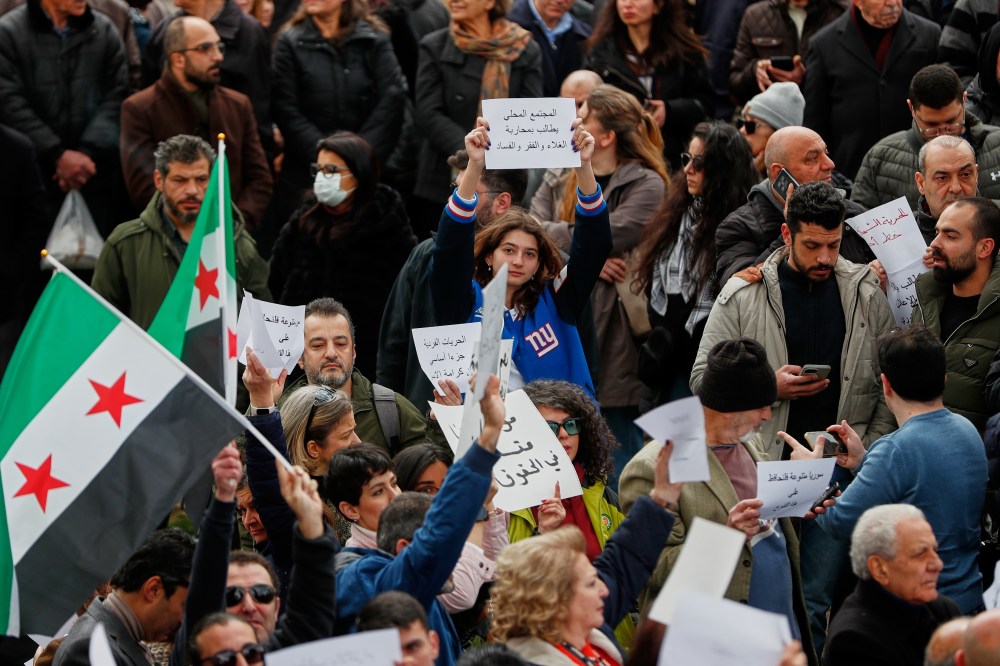
Protesters hold signs during a demonstration against against new alcohol restrictions that limit sales largely to Christian areas in Damascus, Syria, Sunday, March 22, 2026.(AP Photo/Omar Sanadiki)

Heavily armed security forces surrounded the protesters. The demonstration passed without incident.

The controversy erupted last week, when the governor of Damascus issued a decree banning “the provision of alcoholic beverages of all kinds in restaurants and nightclubs” across the capital. Within three months, it says, restaurants must have tossed out their wine lists and bar and club owners must have traded their licenses for cafe permits.

The decision, which authorities said was made “at the request of the local community,” came as the interim government of former Islamist rebel and now President Ahmed al-Sharaa faces growing pressure from hard-liners to impose more conservative religious values. Al-Sharaa has not publicly weighed in on the alcohol debate.

More than a year after his movement ousted former President Bashar Assad, Syria is still reeling from 14 years of civil war and five decades of dictatorship as it struggles to define its future.

A member of the Alawite religious minority, Assad espoused a secular ideology to retain the support of fellow minorities in the Sunni-majority nation. Under his family dynasty, Syrians had little in the way of civic or political freedoms. But they could drink alcohol, party at nightclubs and dress how they pleased.

After being named the interim president, al-Sharaa vowed to unite the country and respect pluralism. He has so far tread lightly when it comes to imposing social restrictions. Yet Syria’s many religious and ethnic groups remain on edge.

Sectarian attacks by pro-government Sunni fighters have killed hundreds of Alawites and Druze over the past year.

Concerns over fresh violence

Protesters on Sunday said they feared the latest alcohol restrictions could further fuel those tensions, as the decree allows alcohol to be sold in three predominantly Christian neighborhoods.

Still, establishments in Bab Touma, al-Qassaa and Bab Sharqi can’t serve booze on site, and shops in those three areas can sell alcohol only in sealed take-away bottles. Vendors also must keep at least 75 meters (246 feet) away from mosques and schools, and 20 meters (65 feet) away from police stations and government offices.

Some said that in singling out Christians, authorities are framing them as responsible for what the decree describes as “violations of public morals.” Although Islamic law prohibits the consumption of alcohol, Damascus is full of secular Muslims.

“How our are neighborhoods are violating public etiquette? The division this creates is unfair and irresponsible,” said Fawaz Bahauddin Khawja, a Christian lawyer at the rally. “This is the real face of Damascus. The only flag we raise is the Syrian flag.”

As criticism flared ahead of the protest, Damascus authorities issued a statement late Saturday apologizing to the city’s Christian population “for any misunderstanding or misinterpretation of the decision.” It also clarified that hotels will be spared the booze restrictions.

“This decision does not interfere with citizens’ personal freedoms,” the statement read. “The regulation of alcohol sales exists in all countries, with differences in how it’s applied and enforced.”

___

Associated Press writer Isabel DeBre in Beirut contributed to this report.

Report Error Submit a Tip

The Free Press acknowledges the financial support it receives from members of the city’s faith community, which makes our coverage of religion possible.

More Stories

Hydro reports $446-M loss in 2025-26, points to fourth drought year in past five

Scott Billeck 3 minute read Preview

Hydro reports $446-M loss in 2025-26, points to fourth drought year in past five

Scott Billeck 3 minute read 6:38 PM CDT

Manitoba Hydro posted a $446-million loss in 2025-26, as drought conditions slashed hydroelectric generation, forcing the Crown corporation to buy more power while leaving it with less electricity to sell outside the province.

The loss was $666 million worse than the $220-million profit Hydro had budgeted. The utility posted a $63-million loss the previous year, according to the utility’s annual report released Tuesday.

Hydro said the 2025-26 fiscal year, which ended on March 31, marked its fourth low-water year in the past five years, among the worst stretches of water-flow conditions in its recorded history.

Hydroelectric generation fell 23 per cent to 24 billion kilowatt-hours from 31 billion the previous year, leaving Hydro a net importer of electricity.

Read
6:38 PM CDT

Jets pick up netminder as relatively new 23-man roster announced

Mike McIntyre 7 minute read Preview

Jets pick up netminder as relatively new 23-man roster announced

Mike McIntyre 7 minute read Updated: Yesterday at 9:25 PM CDT

Let’s get the caveats out of the way: Nothing is set in stone, nor written in permanent ink, and what you see right now could change in the blink of an eye.

With that being said, allow us to introduce you to the 2026-27 Winnipeg Jets — where change is very much in the air.

The 23-man roster submitted to the NHL offices by Monday’s 4 p.m. deadline includes seven players who were not on the team at this time last year. In fact, there could be as many as 10 new faces in the opening-night lineup on Friday against Boston when you factor in three regulars didn’t start the 2025-26 campaign due to injury.

That’s a lot of turnover, which isn’t surprising for a team that finished 26th overall in the standings and was — to most fans and pundits — too old and too slow.

Read
Updated: Yesterday at 9:25 PM CDT

Obsessed stalker who shot, killed young woman at bus stop in 1993 dies behind bars at age 74

Erik Pindera 3 minute read Preview

Obsessed stalker who shot, killed young woman at bus stop in 1993 dies behind bars at age 74

Erik Pindera 3 minute read 5:53 PM CDT

A Winnipeg man who stalked a woman for several years before shooting her dead in the street in 1993 has died in Stony Mountain prison.

On Monday, 74-year-old Ronald Edd Bell died of apparent natural causes at the federal prison just north of Winnipeg, the Correctional Service of Canada said.

Bell had been in prison since May 30, 1994, when he was given a life sentence with no chance of parole for 18 years for killing Terry-Lyn Babb, 25, on Jan. 21, 1993.

Bell walked up behind an unsuspecting Babb, who was waiting at a bus stop at Sherbrook Street and Wolseley Avenue, and shot her in the head with a pistol in front of horrified witnesses, says the Free Press report of his sentencing hearing.

Read
5:53 PM CDT

Jets defenceman spent whole summer working on getting to the next level

Ken Wiebe 8 minute read Preview

Jets defenceman spent whole summer working on getting to the next level

Ken Wiebe 8 minute read Updated: Yesterday at 1:57 PM CDT

Tyrel Bauer makes no apologies for the pugilistic piece of his path.

The Winnipeg Jets defenceman is ready to drop the gloves and throw down when the situation calls for it and he takes great pride in protecting his teammates.

It’s a big part of the reason Bauer will be among the 23 players submitted by the Jets on the opening-day roster on Monday.

“I’ve fought and clawed, both metaphorically and literally and now I just want to show that I can play as well,” Bauer said during a chat with the Free Press during training camp. “(Toughness) is always something that I have, it’s always something in my back pocket and something that I take a lot of pride in doing, for my teammates, for the city and the people who invest in this hockey club. That will never change.

Read
Updated: Yesterday at 1:57 PM CDT

Kinew adds cabinet portfolio to focus on first responders

Carol Sanders and Nicole Buffie 5 minute read Preview

Kinew adds cabinet portfolio to focus on first responders

Carol Sanders and Nicole Buffie 5 minute read Updated: Yesterday at 6:40 PM CDT

Premier Wab Kinew shuffled his cabinet Monday and created a new ministerial position that will oversee first responders in the province.

Kinew appointed David Pankratz, the MLA for Waverley, as minister responsible for first responder initiatives.

Tuxedo MLA Carla Compton was appointed minister responsible for accessibility, taking over the role from Families Minister Nahanni Fontaine.

The new ministers were sworn in at a ceremony at the legislature Monday afternoon.

Read
Updated: Yesterday at 6:40 PM CDT

Wab Kinew as ‘communicator in chief’

Paul G. Thomas 6 minute read Preview

Wab Kinew as ‘communicator in chief’

Paul G. Thomas 6 minute read Yesterday at 2:00 AM CDT

Premier Wab Kinew and his party have been riding high in the polls longer than normal for a government one year or less away from its first re-election contest. One reason is his ubiquitous, dominating communications presence as NDP leader and premier.

The argument here is that Kinew has supplemented his prerogatives as premier and party leader (such as appointing cabinet ministers and approving party nominations) with the skilful use of communications to advance his policy agenda, boost his personal popularity and maintain the competitive advantage of his party over the opposition Progressive Conservatives.

Communications has always been a significant part of politics and policy making. However, in the contemporary political and media environments, communications considerations have moved from the background to the foreground of decision-making by political parties, including when they are performing in the role of government. Campaigning and governing now overlap in what has been described as a permanent election campaign.

Political parties use communications strategies for several purposes: to establish an image of the leader which makes a positive emotional connection with voters; to promote a coherent message and to keep party members on message; and to gain favourable media coverage for its policies and other actions on almost a daily basis.

Read
Yesterday at 2:00 AM CDT