DeSantis signs Florida law to label groups as terrorists and expel student supporters

Advertisement

Advertise with us

TAMPA, Fla. (AP) — Gov. Ron DeSantis signed a measure into law Monday that gives him along with other Florida leaders the ability to label groups as domestic or foreign terrorist organizations and expel state university students who support them.

Read this article for free:


or

Already have an account? Log in here »

To continue reading, please subscribe:

Subscribe and receive a limited-edition Free Press branded hat or tote.

Digital Subscription

One year of digital access for only $205*

  • Enjoy unlimited reading on winnipegfreepress.com
  • Read the E-Edition, our digital replica newspaper
  • Access News Break, our award-winning app
  • Play interactive puzzles

*First annual payment billed as $205.00 + GST for one year. This annual subscription will automatically renew at $233.00 + GST every 52 weeks (10% off the regular annual price of $259.35). Offer available to new and qualified returning subscribers only. Cancel any time.

To continue reading, please subscribe:

Add Free Press access to your Brandon Sun subscription for only an additional

$1 for the first 4 weeks*

  • Enjoy unlimited reading on winnipegfreepress.com
  • Read the E-Edition, our digital replica newspaper
  • Access News Break, our award-winning app
  • Play interactive puzzles
Start now

*Your next Brandon Sun subscription payment will increase by $1.00 and you will be charged $17.95 plus GST for four weeks. After four weeks, your payment will increase to $24.95 plus GST every four weeks.

Hey there, time traveller!
This article was published 06/04/2026 (192 days ago), so information in it may no longer be current.

TAMPA, Fla. (AP) — Gov. Ron DeSantis signed a measure into law Monday that gives him along with other Florida leaders the ability to label groups as domestic or foreign terrorist organizations and expel state university students who support them.

The law, criticized by free speech advocates, allows a top official at the Florida Department of Law Enforcement to designate a group as a domestic or foreign terrorist organization, with the governor and three other members of the Florida Cabinet approving or rejecting the designation. Besides the governor, the Cabinet is made up of the state attorney general, the chief financial officer and the agriculture commissioner, all of whom are elected separately.

Once designated a terrorist organization, a group can be dissolved and it can no longer receive any state funding through school districts or state agencies. Universities also would have to report the status of expelled students attending on visas to U.S. Immigration and Customs Enforcement.
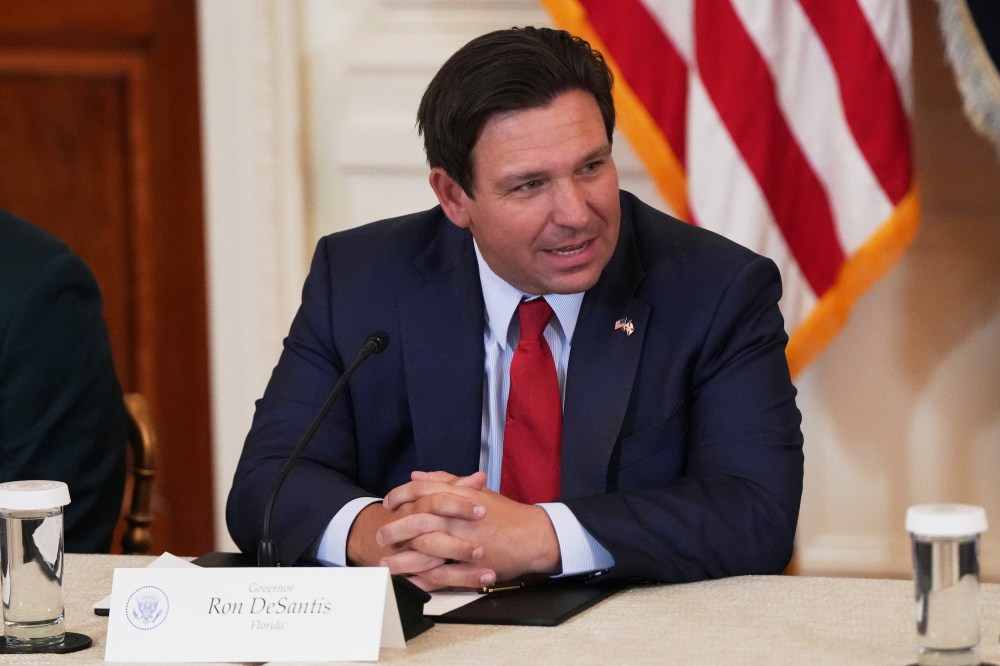
FILE - Florida Gov. Ron DeSantis is seen before a roundtable discussion on college sports in the East Room of the White House, Friday, March 6, 2026, in Washington. (AP Photo/Julia Demaree Nikhinson, File)

“So this will help the state of Florida protect you. It’ll help us protect your tax dollars,” DeSantis said at a news conference in Tampa. “It’ll help us protect things that should not be happening in the United States of America, but certainly shouldn’t be happening in the free state of Florida.”

DeSantis last December designated the Council on American-Islamic Relations and the Muslim Brotherhoods as foreign terrorist organizations. A federal judge last month temporarily blocked the enforcement of DeSantis’ executive order.

PEN America, a free speech advocacy group, said the new law has vague language that could restrict education programs deemed to be “promoting” terrorism and that it could target student protesters who criticize Florida officials.

The new law “could chill education at every level,” said William Johnson, PEN America’s Florida director. “The implications are fraught.”

Report Error Submit a Tip

The Free Press acknowledges the financial support it receives from members of the city’s faith community, which makes our coverage of religion possible.


More Stories

MPI not sleeping on ride-share fraud

Editorial 4 minute read Preview

MPI not sleeping on ride-share fraud

Editorial 4 minute read Yesterday at 2:00 AM CDT

Rust never sleeps. You may remember those words as the title of a Neil Young and Crazy Horse album from 1979. You might even recognize an even older use of the words as an advertising slogan for anti-rust paint Rust-Oleum.

Read
Yesterday at 2:00 AM CDT

Kinew won’t budge on opposition to criminalizing residential school denialism

Chris Kitching 5 minute read Preview

Kinew won’t budge on opposition to criminalizing residential school denialism

Chris Kitching 5 minute read Yesterday at 5:35 PM CDT

Premier Wab Kinew stood by his opposition to the proposed criminalization of residential school denialism Wednesday, after some First Nations leaders criticized his earlier comments and asked him to reconsider.

Kinew said he doesn’t think Canada should make residential school denialism a crime, nor does he think it’s feasible to do, and he’d prefer to see it combated with education.

“When somebody has a question or wants to make a statement from a place of ignorance, the response isn’t to try to criminalize,” he told reporters.

“The response should be to try to heal whatever is going on with them that would cause them to say something hurtful, to try and educate whatever they lack in terms of knowledge about the true history of our country, and ultimately to find a way for us to all live together.”

Read
Yesterday at 5:35 PM CDT

MPI leadership not fooling anyone by forcing PUB’s hand

Dan Lett 5 minute read Preview

MPI leadership not fooling anyone by forcing PUB’s hand

Dan Lett 5 minute read Yesterday at 1:33 PM CDT

It is not a question you will hear raised at Public Utilities Board hearings into Autopac rates, but you can bet it’s the one on most people’s minds.

When will the NDP government step in and repair leadership at Manitoba Public Insurance? For the third year in a row, MPI has limped into PUB hearings like a badly damaged vehicle that should have been written off years ago.

This week, the Crown corporation’s chief actuary admitted the 2.38-per-cent increase requested for the 2027-28 fiscal year was too low, in part because of the impact of last summer’s multiple hailstorms and the premiums MPI pays for re-insurance that protects the public insurer from surges in claims costs.

Chief actuary Cara Low said the rate application was not updated because of “uncertainty.” That is sort of like a firefighter complaining about not being able to do the job because there was too much smoke and flame.

Read
Yesterday at 1:33 PM CDT

A decision with potential for ‘distraction’ and ‘disrespect’ in Transcona

Malak Abas 6 minute read Preview

A decision with potential for ‘distraction’ and ‘disrespect’ in Transcona

Malak Abas 6 minute read Updated: 9:54 AM CDT

Transcona voters acknowledge they have a tough decision to make at the ballot box on election day.

The east Winnipeg working-class ward is replete with lawn signs and posters, but most of the people the Free Press spoke with said they were still undecided.

While Winnipeg is, historically, more likely to elect an incumbent, longtime councillor Russ Wyatt is seeking a sixth term while facing five criminal charges, including sexual assault and administering a noxious substance, after incidents alleged to have occurred in 2023 and 2025.

Residents are not without options. In addition to Wyatt, former councillor Shawn Nason — who occupied the city council seat from 2018-22 — is running for council (Wyatt chose not to run in the 2018 election after taking several months off to undergo addictions treatment), and there are three new faces on the ballot: Lora Meseman, Chris Giesbrecht and Nathine Dagdick.

Read
Updated: 9:54 AM CDT

Puzzles Palace

1 minute read Monday, Jul. 27, 2026

To solve our puzzles, please subscribe with this special offer: |

DeSantis signs Florida law to label groups as terrorists and expel student supporters

The Associated Press 2 minute read Preview

DeSantis signs Florida law to label groups as terrorists and expel student supporters

The Associated Press 2 minute read Monday, Apr. 6, 2026

TAMPA, Fla. (AP) — Gov. Ron DeSantis signed a measure into law Monday that gives him along with other Florida leaders the ability to label groups as domestic or foreign terrorist organizations and expel state university students who support them.

The law, criticized by free speech advocates, allows a top official at the Florida Department of Law Enforcement to designate a group as a domestic or foreign terrorist organization, with the governor and three other members of the Florida Cabinet approving or rejecting the designation. Besides the governor, the Cabinet is made up of the state attorney general, the chief financial officer and the agriculture commissioner, all of whom are elected separately.

Once designated a terrorist organization, a group can be dissolved and it can no longer receive any state funding through school districts or state agencies. Universities also would have to report the status of expelled students attending on visas to U.S. Immigration and Customs Enforcement.

“So this will help the state of Florida protect you. It’ll help us protect your tax dollars,” DeSantis said at a news conference in Tampa. “It’ll help us protect things that should not be happening in the United States of America, but certainly shouldn’t be happening in the free state of Florida.”

Read
Monday, Apr. 6, 2026