A dispatch from inside the Vatican bubble during a remarkable exchange between pope and president
Advertisement
Read this article for free:
or
Already have an account? Log in here »
To continue reading, please subscribe:
Digital Subscription
One year of digital access for only $1.44 a week*
- Enjoy unlimited reading on winnipegfreepress.com
- Read the E-Edition, our digital replica newspaper
- Access News Break, our award-winning app
- Play interactive puzzles
*Billed as $5.77 plus GST every four weeks. After 52 weeks, price increases to the regular rate of $19.95 plus GST every four weeks. Offer available to new and qualified returning subscribers only. Cancel any time.
To continue reading, please subscribe:
Add Free Press access to your Brandon Sun subscription for only an additional
$1 for the first 4 weeks*
- Enjoy unlimited reading on winnipegfreepress.com
- Read the E-Edition, our digital replica newspaper
- Access News Break, our award-winning app
- Play interactive puzzles
*Your next Brandon Sun subscription payment will increase by $1.00 and you will be charged $17.95 plus GST for four weeks. After four weeks, your payment will increase to $24.95 plus GST every four weeks.
Read unlimited articles for free today:
or
Already have an account? Log in here »
Hey there, time traveller!
This article was published 16/04/2026 (193 days ago), so information in it may no longer be current.
ABOARD THE PAPAL PLANE (AP) — There is an odd sense of isolation when you are covering Pope Leo XIV from inside the Vatican’s traveling press pool: Escorted from venue to venue with police motorcades that clear even the most congested of traffic jams, it’s a membership that has many privileges.
But during Leo’s epic four-nation trip to Africa, being inside the Vatican “bubble” has been an almost surreal experience, as an unprecedented back-and-forth plays out between U.S. President Donald Trump and history’s first American pope.
Every morning this week, waking up to developments in Washington from the evening before, the questions have abounded: Will Leo bite? How will he address the latest criticism, if at all, while focusing on the Africa program he has planned?
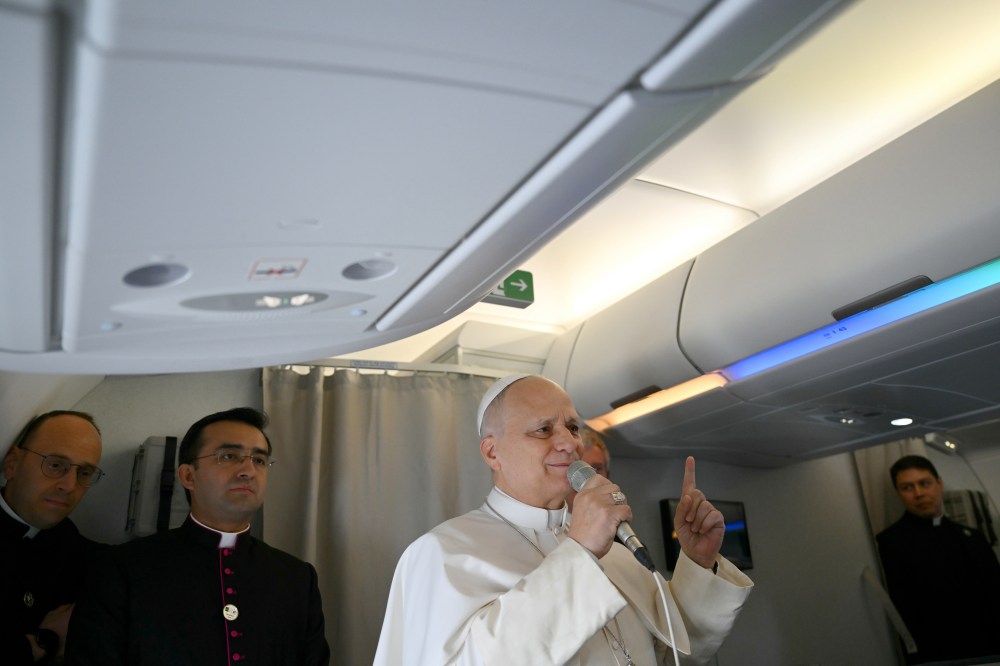
That was certainly the case on Wednesday, as Leo, the Vatican delegation and a pool of around 70 accredited reporters boarded the ITA Airways charter for the second leg of Leo’s 11-day odyssey — the flight from Algiers, Algeria to Yaounde, Cameroon.
Much to the reporters’ delight, Leo had responded head-on to Trump at the start of the trip when he gamely came to the back of the plane and greeted journalists traveling April 13 from Rome to Algiers. He responded to those who asked him about Trump’s Truth Social post a day earlier, in which the U.S. president had accused him of being soft on crime, cozy with the left and owed his papacy to Trump.
Trump was responding to Leo’s calls for peace, in reference to the Iran war, and comments that Trump’s threat to annihilate Iranian civilization were “truly unacceptable.”
Stopping to chat as he made his way from row to row that first day, Leo had told journalists that he was merely preaching the Gospel when he called for peace and criticized war, and that he didn’t fear the Trump administration.
A comment about peace
On Tuesday, on the short flight from Algiers to Annaba, the ancient city of Hippo, Leo stayed in the front of the plane where the Vatican delegation sits, dashing the Vatican pool’s hopes for another Trump vs. Leo news cycle.
On Wednesday, with a five-hour flight ahead of us to Cameroon, excitement grew in economy class when Vatican personnel came to the back of the plane, readied the microphone and did sound checks to make sure the whole cabin could hear.
Emerging from behind the curtain, Leo didn’t take questions from reporters and kept his remarks focused on his just-concluded visit to Algeria, where he honored the legacy of his spiritual inspiration, St. Augustine of Hippo.
In brief remarks standing at the front of the cabin, Leo didn’t refer to war or Trump. But he spoke in terms that could suggest the latest overnight lobs from Washington certainly hadn’t gone unnoticed. Perhaps tellingly, he spoke exclusively in English.
Trump had kept up the criticism on Truth Social, while U.S. Vice President JD Vance, a Catholic convert, said that Leo should “be careful” when speaking about theology.
For starters, Leo noted the sign of “goodness,” “generosity,” and “respect” that the Algerian government showed him in welcoming him on the first-ever papal visit. He said that the Algerian honors had included a full military aerial escort of the papal plane through Algerian airspace.
He also recalled his visit to the Great Mosque in Algiers, which he said was a significant way to show that “although we have different beliefs, we have different ways of worshipping, we have different ways of living, we can live together in peace.”
He said that St. Augustine’s message of searching for God, searching for truth, building bridges and seeking unity and community “is something which the world needs to hear today and that together we can continue to offer in our witness as we continue on this apostolic voyage.”
A papal press pool
Like other heads of state, the pope travels internationally with both his own media team as well as a group of external news organizations that pay, oftentimes handsomely, to have their reporters travel aboard the papal plane and have special access to cover his events. The Associated Press is always on the plane, paying for as many as four journalists per trip.
Being inside the Vatican bubble has journalistic advantages and disadvantages. You get the best access and are traveling under the Vatican’s security umbrella, meaning there’s little or no hassle from local security organizers. The Vatican facilitates visas and local SIM cards in advance, and arranges hotels and local transportation, allowing reporters to focus on the news rather than logistics.
Journalists in the bubble get the pope’s speeches ahead of time and have occasional access to delegation members, as well as other information in real time from the Vatican spokesman.
But the real reason news organizations choose to spend thousands of dollars per journalist, per trip, to be on the papal plane is to be on hand for the pope’s news conferences. The only time a pope holds such briefings with journalists is at an altitude of 35,000 feet (around 10,000 meters)
Who could forget Pope Francis’ famous line on his maiden trip as pope, in 2013 to Rio de Janeiro, when he uttered the line “Who am I to judge,” when he was asked about a purportedly gay priest.
The downside of being in the Vatican bubble is obvious for many of the same reasons it’s helpful: You are removed from local reality, whether in Algeria or Alaska, and rarely have time to do the type of on-the-ground reporting that makes a news report balanced.

Those news organizations that have the resources have teams on the ground producing such content, or journalists within the bubble break away to do their own reporting, so that the end result is a healthy combination of official Vatican information and local input.
But when the real drama involving the pope is occurring thousands of miles and time zones away, being in the Vatican bubble is a somewhat jarring experience. The news everyone wants to know isn’t necessarily what the pope has on his agenda.
But on this trip, the first by an American pope to Africa, being in the Vatican bubble certainly had its advantages. The next stop is Angola. Who knows what Leo will have to say.
___
Associated Press religion coverage receives support through the AP’s collaboration with The Conversation US, with funding from Lilly Endowment Inc. The AP is solely responsible for this content.
Related Articles
Politicians and religion: a bad mix
Advertisement Advertise With Us
Advertisement Advertise With Us
The Free Press acknowledges the financial support it receives from members of the city’s faith community, which makes our coverage of religion possible.