Did the founders create a Christian nation? No, but religion did shape their thinking

Advertisement

Advertise with us

When he talks about the role of religion in the founding of the United States, historian Gregg Frazer does not attract eager audiences.

Read this article for free:


or

Already have an account? Log in here »

To continue reading, please subscribe:

Subscribe and receive a limited-edition Free Press branded hat or tote.

Digital Subscription

One year of digital access for only $205*

  • Enjoy unlimited reading on winnipegfreepress.com
  • Read the E-Edition, our digital replica newspaper
  • Access News Break, our award-winning app
  • Play interactive puzzles

*First annual payment billed as $205.00 + GST for one year. This annual subscription will automatically renew at $233.00 + GST every 52 weeks (10% off the regular annual price of $259.35). Offer available to new and qualified returning subscribers only. Cancel any time.

To continue reading, please subscribe:

Add Free Press access to your Brandon Sun subscription for only an additional

$1 for the first 4 weeks*

  • Enjoy unlimited reading on winnipegfreepress.com
  • Read the E-Edition, our digital replica newspaper
  • Access News Break, our award-winning app
  • Play interactive puzzles
Start now

*Your next Brandon Sun subscription payment will increase by $1.00 and you will be charged $17.95 plus GST for four weeks. After four weeks, your payment will increase to $24.95 plus GST every four weeks.

When he talks about the role of religion in the founding of the United States, historian Gregg Frazer does not attract eager audiences.

“Neither side really wants to hear what I say,” says Frazer, a professor of history and political studies at The Master’s University, a Christian school in Santa Clarita, California.

The founders, Frazer says, did not create a Christian republic. Several key founders either rejected core Christian doctrines or were vague enough to keep historians debating. For Frazer, that often disappoints audiences of his fellow Christians.
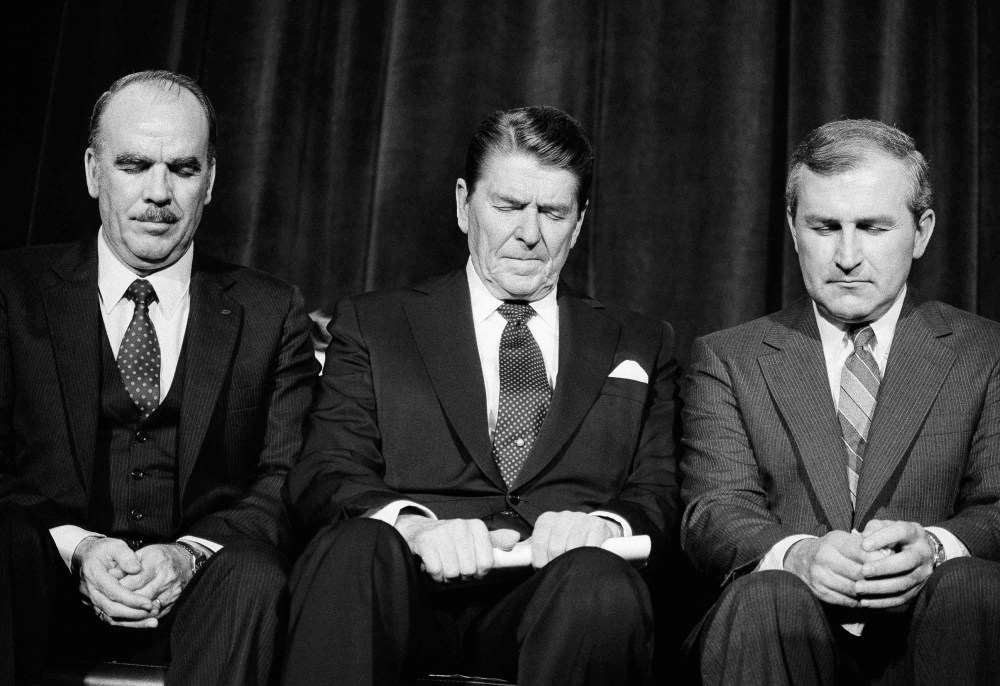
FILE - President Ronald Reagan prays with National Association of Evangelicals President Arthur Gay, left, following his address to the organization's convention asking for help in winning approval of a constitutional amendment permitting prayer in school in Columbus, Ohio, March 7, 1984. (AP Photo/Barry Thumma, File)

But, he says, nor were the founders a cluster of rationalist deists — believers in a God who set the universe in motion like a clockmaker and then left it alone — and anti-religious skeptics, as they are sometimes portrayed. That disappoints audiences who favor a high firewall between church and state. Most of the founders were religious in one form or another.

The long-running debate over the founders’ intentions about religion has been turbocharged with the approaching 250th anniversary of the Declaration of Independence on July 4. Amid the America 250 celebrations, some Christian activists and authors are redoubling claims that the U.S. had a Christian founding.

They have an ally in the White House. President Donald Trump is promoting “America Prays,” culminating in a May 17 gathering on the National Mall in Washington. Cabinet officials are issuing Christian messages in their official capacity. Defense Secretary Pete Hegseth proclaimed that “America was founded as a Christian nation … in our DNA.”

Countering the Christian nation narrative

Critics and advocacy groups are pushing back.

“Most — nearly all — serious historians agree that America was not founded as a Christian nation in any meaningful legal, philosophical, or constitutional sense,” says the group Americans United for Separation of Church and State.

Six in 10 U.S. adults surveyed said they believed the founders originally intended America to be a Christian nation, according to a 2022 Pew Research Center report.

Why do the founders’ beliefs and intentions matter?

“Everyone’s looking for what we historians call a usable past,” says John Fea, author of “Was America Founded as a Christian Nation?”

“We go into the past looking for what we want in order to advance a particular political or cultural agenda,” says Fea, a fellow at the Lumen Center, a Christian research institute and study center in Madison, Wisconsin.

Public officials and others did indeed offer prayers on behalf of the new republic at important historical moments. But he said other issues — such as taxation and representation — were more central to the Revolution.

Church and state in the new nation

Historian Mark David Hall argues that Christianity did strongly impact the founding. While core founders did not hold traditional Christian beliefs, he contends that many other founders did, and this shaped their thinking about how to form the new republic.

“There’s plenty of evidence Christianity had an influence,” says Hall, author of “Did America Have a Christian Founding?”

He says founders’ attention to human dignity harmonizes with the Bible’s teaching of humanity created in God’s image. The system of checks and balances — to prevent the concentration of power — reflects teachings about human sin that would have permeated a largely Protestant culture, he says.

He also notes that some early presidents and Congresses issued proclamations for prayer and thanksgiving, though some drew opposition and controversy. Some states sponsored churches for decades after the Constitution was ratified, indicating that the founders didn’t believe religion should be absent from public life.

The believed that faith was important in forming moral, responsible citizens of the new republic. They promoted “toleration without eliminating the importance of real religious commitment on the part of differing adherents,” Frazer wrote in his book, “The Religious Beliefs of America’s Founders.”

There’s no reference to any specific religion in the Constitution beyond the date — “in the year of our Lord” 1787. It forbids religious tests for officeholders. The First Amendment guarantees religious freedom and forbids “establishment” of a national religion.

Twentieth-century Supreme Court rulings applied the First Amendment to the states on the basis of the Fourteenth Amendment, which prohibits states from denying citizens’ rights.

Frazer argues that the Bible is not cited as a source for any governing principles in the documented proceedings of the Constitutional Convention or in the influential Federalist Papers. He says the founders drew on influences such as Enlightenment thinking for such concepts as human equality, accountable government and freedom of religion. Early critics faulted the Constitution’s lack of religious content.

The Declaration of Independence does have religious language, declaring that rights come from the “Creator.” It appeals to the “Laws of Nature and of Nature’s God.”

Thomas Jefferson and other founders — adroitly, Frazer says — used terms acceptable to Christians as well as followers of other religious and philosophical movements.

The founders’ diverse beliefs

At the time of the Revolution, most colonists were Protestant, though church participation had been in decline.

Rationalistic approaches to religion strongly influenced many college-educated and propertied elite men, such as those who produced the Declaration of Independence and Constitution, Frazer wrote. So did Freemasonry, a fraternal order based on beliefs in a universal God and morals.

Some founders were devout Christians such as John Jay, Samuel Adams and Patrick Henry. Others believed in God but not in Jesus’ divinity, including key founders like Jefferson, John Adams and Benjamin Franklin. The enigmatic Washington kept active in his Episcopal church but avoided sacraments and also was an active Freemason.

Challenging misconceptions about deist founders

But contrary to popular belief, most founders were not deists.

Frazer instead describes many founders as “theistic rationalists.” George Washington believed that divine “Providence” saved his life in battle and intervened on America’s behalf. He was far from alone.

“They did believe in an active God,” Frazer says.

Even the skeptics thought religion was important in forming virtuous citizens. Many scholars believe the First Amendment created a sort of religious free market in which Christianity and other faiths have flourished to this day.

___

Associated Press religion coverage receives support through the AP’s collaboration with The Conversation US, with funding from Lilly Endowment Inc. The AP is solely responsible for this content.

Report Error Submit a Tip

The Free Press acknowledges the financial support it receives from members of the city’s faith community, which makes our coverage of religion possible.

More Stories

A question of public utility

Tom Pearson 5 minute read 2:00 AM CDT

The editorial page of the Free Press often provides perspectives that are thought-provoking and sometimes contradictory. “Keeping the lights on,” (Oct. 5) by Hal Turner and “Wasteful operations should be held accountable,” (Oct. 6) by Barry Prentice are both thought-provoking. They are not contradictory because they cover two quite different topics. Where they differ is in their delivery and the quality of the underlying facts.

Mr. Turner provides what is, in my view, the most cogent rationale for gas-fuelled generation that I have read. He highlights the essential aspect of power supply to Manitobans. He supports the argument for natural gas generation with succinct, relatable facts and anecdotes relating to what other comparable utilities have done. He states that, “Manitoba Hydro’s experts are neither anti-wind nor pro-fossil fuel.” They are simply seeking the best possible solution for Manitobans — a fact many special-interest groups either ignore or sadly, impugn.

Although some would argue the contrary, I believe that Mr. Turner’s position and longevity in the Manitoba Hydro organization lend gravitas to his column. Mr. Turner understands that “keeping the lights on” is a non-negotiable requirement and a public trust.

Before I turn to Mr. Prentice’s column, I should disclose that before I retired (it’s been a while), I was responsible at different times for Winnipeg’s regional water system and subsequently water supply from source to tap. In that context I was also responsible for the operation of the Greater Winnipeg Water District (GWWD) railway. Like Mr. Turner’s perspective on the supply of electricity to Manitobans, I regard the supply of safe drinking water to Winnipeggers as a public trust.

Former Oilers teammates square off for first time

Ken Wiebe 7 minute read Preview

Former Oilers teammates square off for first time

Ken Wiebe 7 minute read Yesterday at 4:41 PM CDT

Calvin Pickard has been many things to Stuart Skinner.

An ally, sounding board, confidante and most importantly, a close friend.

They were a goalie tandem for parts of three seasons with the Edmonton Oilers, making two trips to the Stanley Cup final, combining for 29 playoff wins, but falling just short of achieving the ultimate goal on both of those occasions.

They were opponents just once last season when the Oilers and Pittsburgh Penguins met for the first time since the trade that shipped Skinner to Pennsylvania, but it was Tristan Jarry – the guy he was traded for – standing at the opposite side of the rink.

Read
Yesterday at 4:41 PM CDT

Prime minister’s Thanksgiving message addresses Alberta separation referendum

Anja Karadeglija, The Canadian Press 2 minute read Preview

Prime minister’s Thanksgiving message addresses Alberta separation referendum

Anja Karadeglija, The Canadian Press 2 minute read Updated: Yesterday at 1:49 PM CDT

OTTAWA - Prime Minister Mark Carney focused his Thanksgiving Day message on Alberta’s upcoming separation referendum, saying Canada is "worth fighting for."

"This year, Thanksgiving is a bit different," he said in the video message. "A week from today, Albertans will have the opportunity to make an important decision about their future: whether to remain part of Canada or begin a long and uncertain process through which Alberta could separate from Canada."

Albertans will vote on Oct. 19 on whether the province should stay in Canada or hold a second, binding separation referendum.

In the video posted Monday and filmed in his old high school in Edmonton, Carney noted he grew up in Alberta.

Read
Updated: Yesterday at 1:49 PM CDT

Comparing the Iran and Vietnam Wars

Peter McKenna 5 minute read Preview

Comparing the Iran and Vietnam Wars

Peter McKenna 5 minute read 2:00 AM CDT

The other day I asked my students in U.S. foreign policy to think about the relevance of the Vietnam War in relation to the ongoing war in Iran. More specifically, I wanted them to identify the similarities and differences between the two wars.

What is immediately striking is how domestic politics played such a seminal role in both conflicts. While American public opinion was generally in favour of U.S. military involvement in Vietnam in the early years, things started to turn very sour after U.S. soldiers started arriving stateside in flag-draped coffins and body bags. As for Iran, just about every single poll and TV newscast since the first few weeks of the war have illustrated an overwhelming public repudiation of President Trump’s military adventurism.

The electoral implications were also quite apparent for the two wars. The U.S.-Iran War is clearly having a positive effect on the Democratic Party’s electability, as it looks set to capture both the House of Representatives and the Senate in the Nov. 3 midterm elections. Democratic President Lyndon Johnson, reading the political tea leaves from the Vietnam fallout, opted not to contest the 1968 U.S. presidential election.

Equally interesting, the U.S. press had a crucial, and mostly negative, impact on both the Vietnam and Iran conflicts. Who could forget Gen. William Westmoreland — the commander of U.S. forces in Vietnam (1964-1968) — maintaining that it was the media’s fault the U.S. lost the war in Vietnam. While I take issue with his thesis, I do believe the news coverage and visuals of the first televised war served to raise serious concerns about why the U.S. was at war in Southeast Asia.

Read
2:00 AM CDT

Zelenskyy says Russia strikes energy facilities despite Trump claim of an energy ceasefire

Samya Kullab, The Associated Press 6 minute read Preview

Zelenskyy says Russia strikes energy facilities despite Trump claim of an energy ceasefire

Samya Kullab, The Associated Press 6 minute read Updated: Yesterday at 4:51 PM CDT

KYIV, Ukraine (AP) — Ukrainian President Volodymyr Zelenskyy said Monday that while Ukraine is willing to halt attacks on Russia's energy infrastructure, Moscow has continued to strike his country's energy sites despite U.S. President Donald Trump's announcement that the warring countries had agreed to cease such attacks.

Speaking at the Warsaw Security Forum in Poland, Zelenskyy said Ukraine had been “horribly surprised” that Moscow struck a power plant in the northeastern city of Kharkiv, as well as a gas production facility and a civilian gas station hours after Trump announced the purported “energy ceasefire” in the 4 1/2-year-old war.

Later, during an interview on Fox News Channel’s “America’s Newsroom,” Zelenksyy said his government had refrained from striking Russian energy sites since Trump’s announcement Sunday, and was ready to honor an energy ceasefire as “a good first step” toward closing the war.

But, he said, "I’m not sure that (Russian President Vladimir) Putin is ready."

Read
Updated: Yesterday at 4:51 PM CDT

Today’s horoscope

Georgia Nicols 4 minute read Preview

Today’s horoscope

Georgia Nicols 4 minute read 2:00 AM CDT

MOON ALERT: Caution. Avoid shopping (except food and gas) and important decisions from 3:15 a.m. until 8:15 p.m. After that, the moon moves from Scorpio into Sagittarius.

ARIES (March 21-April 19)

It’s tricky because the moon is in your financial house, which might encourage you to negotiate financial matters and discuss shared property, banking details, insurance issues and inheritances. However, there’s a moon alert. Postpone these discussions.

TAURUS (April 20-May 20)

Read
2:00 AM CDT