A quiet memorial on Berlin sidewalks: German artist lays ‘Stolpersteine’ to honor Holocaust victims

Advertisement

Advertise with us

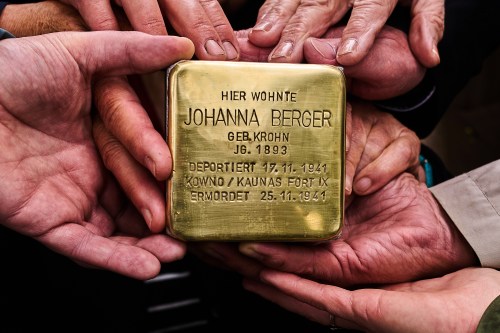
BERLIN (AP) — Artist Gunter Demnig carefully placed a palm-sized Holocaust memorial brass plaque into the sidewalk on a busy street corner of Berlin. It said: “Johanna Berger, born in 1893, lived here; deported on Nov. 17, 1941, murdered on Nov. 25, 1941.”

Read this article for free:


or

Already have an account? Log in here »

To continue reading, please subscribe:

Subscribe and receive a limited-edition Free Press branded hat or tote.

Digital Subscription

One year of digital access for only $205*

  • Enjoy unlimited reading on winnipegfreepress.com
  • Read the E-Edition, our digital replica newspaper
  • Access News Break, our award-winning app
  • Play interactive puzzles

*First annual payment billed as $205.00 + GST for one year. This annual subscription will automatically renew at $233.00 + GST every 52 weeks (10% off the regular annual price of $259.35). Offer available to new and qualified returning subscribers only. Cancel any time.

To continue reading, please subscribe:

Add Free Press access to your Brandon Sun subscription for only an additional

$1 for the first 4 weeks*

  • Enjoy unlimited reading on winnipegfreepress.com
  • Read the E-Edition, our digital replica newspaper
  • Access News Break, our award-winning app
  • Play interactive puzzles
Start now

*Your next Brandon Sun subscription payment will increase by $1.00 and you will be charged $17.95 plus GST for four weeks. After four weeks, your payment will increase to $24.95 plus GST every four weeks.

BERLIN (AP) — Artist Gunter Demnig carefully placed a palm-sized Holocaust memorial brass plaque into the sidewalk on a busy street corner of Berlin. It said: “Johanna Berger, born in 1893, lived here; deported on Nov. 17, 1941, murdered on Nov. 25, 1941.”

After Demnig had swiped the sand off Berger’s memorial stone and those for her husband and two sons, a dozen relatives drew closer around the four plaques, which are called Stolpersteine, or “stumbling blocks,” in German. They put down white roses and recited the Kaddish, the Jewish prayer for the dead, while traffic roared by on a rainy spring day.

Demnig installed the first plaque in the German capital three decades ago. By now, one can find more than 11,000 of his memorial stones all over the city. But Demnig’s decentralized Holocaust memorial goes much further than that — the artist and his teams of supporters have laid 126,000 stones in Germany and 31 other countries across Europe. The first stone was installed in 1992 in the western German city of Cologne.
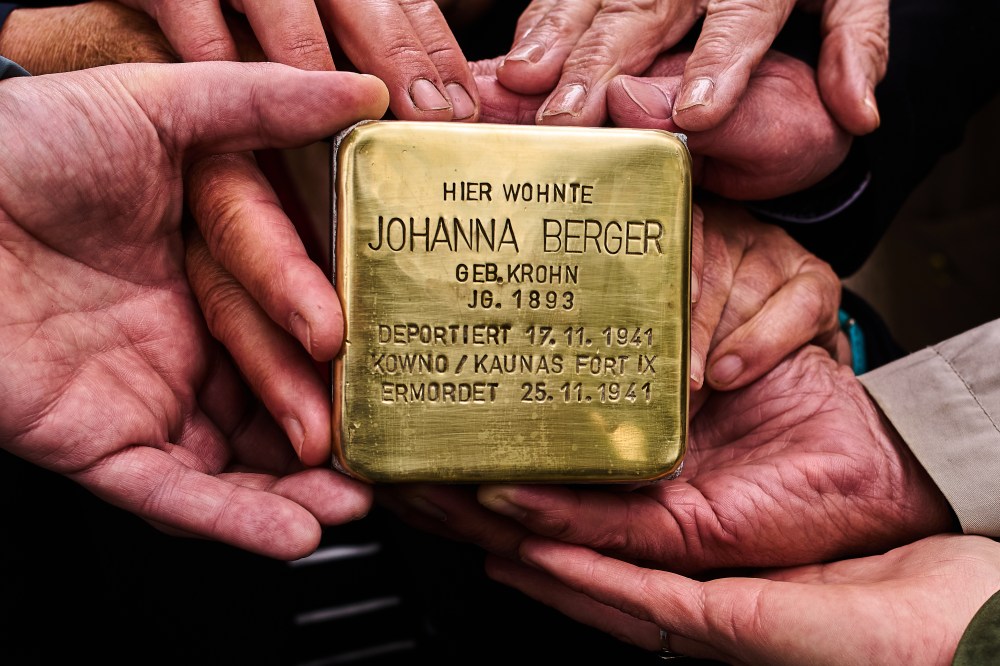
Relatives shows a photo a palm-sized brass Holocaust plaque reading
Relatives shows a photo a palm-sized brass Holocaust plaque reading "Johanna Berger, born in 1893, lived here; deported on Nov. 17, 1941, murdered on Nov. 25, 1941 in Kowno/Kaunas Fort IX" by artist Gunter Demnig prior to the placing of the so called "Stolperstein" or "Stumbling Blocks" in front of her former home in Berlin, Germany, Wednesday, May 6, 2026. (AP Photo/Markus Schreiber)

In a unique way, the shiny brass squares that are embedded in the pavement make passersby stop and interrupt their daily lives for a moment as they bend down to read the names of those who perished. Small children can often be seen as they examine the Stolpersteine closely and demand answers from their parents.

“My basic idea behind this was that wherever in Europe the German Wehrmacht, the SS, the Gestapo, and their local collaborators committed murders or carried out deportations, symbolic stones should be placed there,” the 78-year-old German artist said in an interview with The Associated Press on Wednesday.

The closest thing to a gravestone

Jewish family members oftentimes will travel from all over the world to attend the stonelaying ceremonies, because many of the victims were gassed in the Nazis’ concentration camps and these memorial stones are the closest thing to a grave or a burial.

“The Stolpersteine are some kind of substitute for the missing gravestones,” Michael Tischler said after Wednesday’s ceremony. The 72-year-old Berliner is a grandnephew of Berger who perished in the Holocaust like several other members of Tischler’s family.

“I think this brings the family history to a certain conclusion, or at least a provisional one,” Tischler said.

The memorial stones don’t only bring solace to the families of the victims, but they have also created some kind of grassroots movement that brings together neighborhood initiatives, schools or religious communities to research the history of their city.

Researching Berlin’s Nazi past

Together, old and young browse through archives and check timeworn resident lists to find out if any Jews or others who were persecuted during the Third Reich — such as communists, gays or Roma — used to live in the streets or even homes where they live today.

Once they can confirm a victim’s former place of residence, they arrange for a stonelaying ceremony and make sure the brass plaque is polished periodically, so it won’t lose its shine.

On Wednesday, several 10th graders from the Friedrich-Bergius-Schule attended another Berlin stonelaying ceremony on Stierstraße, where many Jews used to live. Demnig’s three new stones for the Krein family — Michael, his wife Maria and their daughter Dalila — brought the number of Stolpersteine to 62 on this street.

While Maria and Dalila managed to escape to the U.S. and British-controlled Palestinian territory, respectively, Michael, a musician, died in Berlin in 1940 as a forced laborer under the Nazis.

High school student Sibilla Ehrlich, 16, watched as a group of violinists played solemn melodies and some elderly neighbors talked about the lives of the three Jews under Nazi dictatorship.

“It is just so horrible, all this the hatred of others,” she said. “I keep thinking: what if this had been my family.”

Before the Holocaust, Berlin had the biggest Jewish community in Germany. In 1933, the year the Nazis came to power, around 160,500 Jews lived in Berlin. By the time World War II ended and Nazi Germany surrendered on May 8, 1945, their numbers had diminished to about 7,000 through emigration and extermination.

All in all, around 6 million European Jews and others were killed in the Holocaust.

As Germany commemorates the Allied liberation from the Nazis 81 years ago on Friday, many people in Germany fear that the lessons of the Holocaust may be forgotten as the far right is quickly gaining influence in Germany again.

Tischler, too, worries about his country’s future in times of rising antisemitism, but he says the memorial stones offer a glimpse of hope.

“I hope that these Stolpersteine will still give some people pause for thought,” he said.

Report Error Submit a Tip

The Free Press acknowledges the financial support it receives from members of the city’s faith community, which makes our coverage of religion possible.


More Stories

Jets bench boss Arniel talks rebuilding from last season’s struggles

Mike McIntyre and Ken Wiebe 12 minute read Preview

Jets bench boss Arniel talks rebuilding from last season’s struggles

Mike McIntyre and Ken Wiebe 12 minute read Yesterday at 5:42 PM CDT

Scott Arniel has a lot on his plate these days.

But the head coach of the Winnipeg Jets took some time Thursday to sit down with Free Press hockey writers Mike McIntyre and Ken Wiebe to discuss a number of topics on the eve of a new hockey season. This interview has been condensed and edited for clarity.

Wiebe: What was the evaluation of last season like? What did you personally do in an attempt to improve after going from first-overall to 26th-overall?

I just went back and looked at things and made sure my communication was where it needed to be with my players. Was my communication where it needed to be with my boss, with my general manager (Kevin Cheveldayoff)? How our coaching staff worked. How we handled highs and lows. Things I felt I could have done better.

Read
Yesterday at 5:42 PM CDT

J’accuse!: Kinew uses French to fry interim Tory leader over alleged caucus subterfuge

Chris Kitching and Maggie Macintosh 4 minute read Preview

J’accuse!: Kinew uses French to fry interim Tory leader over alleged caucus subterfuge

Chris Kitching and Maggie Macintosh 4 minute read Yesterday at 5:55 PM CDT

NDP Premier Wab Kinew took a dig at the Progressive Conservatives’ leadership change while facing off with Obby Khan’s short-term replacement for the first time in question period Thursday.

Read
Yesterday at 5:55 PM CDT

Jets new backup Stevenson ‘stoked’ to be in tandem with Skinner

Mike McIntyre 6 minute read Preview

Jets new backup Stevenson ‘stoked’ to be in tandem with Skinner

Mike McIntyre 6 minute read Wednesday, Sep. 30, 2026

It didn’t take long to get the dirt on the newest member of the Winnipeg Jets.

Meet Clay Stevenson, who has no problem if you prefer to refer to him by his long-standing nickname of “Mud.”

“You know, Clay is in the mud, and there you go. That’s it, right there,” Stevenson said Wednesday with a laugh. “I got it in juniors when I was playing in Coquitlam, and kind of stuck ever since.”

Stevenson is now hoping to make a name for himself in a city that, quite fittingly, translates to “muddy water” in Cree. The 27-year-old from Alberta was placed on waivers by the Washington Capitals and claimed by the Jets, who were looking to clarify a goaltending situation which was as murky as the Red River.

Read
Wednesday, Sep. 30, 2026

Bombers near must-win territory as Als look to punch post-season ticket

Taylor Allen 7 minute read Preview

Bombers near must-win territory as Als look to punch post-season ticket

Taylor Allen 7 minute read 7:35 PM CDT

The Winnipeg Blue Bombers slayed the beast from the East once already this season — but can they do it again?

The Blue and Gold (7-7) will try to pull off another upset when they take on the Montreal Alouettes (11-3) on Saturday (6 p.m.) at Percival Molson Memorial Stadium.

The two teams last met in Winnipeg on Aug. 28 when the Bombers pulled off an unexpected 44-28 victory.

The stakes are much higher this time around. The Als can clinch the East Division with a win, while the Bombers are clinging to the West’s crossover playoff spot by a thread, with the Calgary Stampeders (7-8) hot on their heels.

Read
7:35 PM CDT

A quiet memorial on Berlin sidewalks: German artist lays ‘Stolpersteine’ to honor Holocaust victims

Kirsten Grieshaber And Markus Schreiber, The Associated Press 5 minute read Preview

A quiet memorial on Berlin sidewalks: German artist lays ‘Stolpersteine’ to honor Holocaust victims

Kirsten Grieshaber And Markus Schreiber, The Associated Press 5 minute read Thursday, May. 7, 2026

BERLIN (AP) — Artist Gunter Demnig carefully placed a palm-sized Holocaust memorial brass plaque into the sidewalk on a busy street corner of Berlin. It said: “Johanna Berger, born in 1893, lived here; deported on Nov. 17, 1941, murdered on Nov. 25, 1941.”

After Demnig had swiped the sand off Berger's memorial stone and those for her husband and two sons, a dozen relatives drew closer around the four plaques, which are called Stolpersteine, or “stumbling blocks,” in German. They put down white roses and recited the Kaddish, the Jewish prayer for the dead, while traffic roared by on a rainy spring day.

Demnig installed the first plaque in the German capital three decades ago. By now, one can find more than 11,000 of his memorial stones all over the city. But Demnig's decentralized Holocaust memorial goes much further than that — the artist and his teams of supporters have laid 126,000 stones in Germany and 31 other countries across Europe. The first stone was installed in 1992 in the western German city of Cologne.

In a unique way, the shiny brass squares that are embedded in the pavement make passersby stop and interrupt their daily lives for a moment as they bend down to read the names of those who perished. Small children can often be seen as they examine the Stolpersteine closely and demand answers from their parents.

Read
Thursday, May. 7, 2026

Klein to double down on derelict homes

Joyanne Pursaga 5 minute read Preview

Klein to double down on derelict homes

Joyanne Pursaga 5 minute read 6:08 PM CDT

Kevin Klein promises to set tight timelines for owners to clean up vacant and derelict homes, if he’s elected to become Winnipeg’s next mayor.

The owner of each building would have six months after it becomes vacant to file an action plan to repair, renovate or remove the structure entirely by the one-year mark.

Those who fail to do so would face heavy fines and possible expropriation, he said.

“Hundreds of empty buildings sit boarded up, waiting to burn, like the one behind me. A vacant house is a fire trap, it’s a crime hub,” said Klein, pointing out the charred remains of a home on Alexander Avenue Friday.

Read
6:08 PM CDT