A Trump commission urges ‘bridges’ between church and state in sweeping draft report
Advertisement
Read this article for free:
or
Already have an account? Log in here »
To continue reading, please subscribe:

Digital Subscription
One year of digital access for only $205*
- Enjoy unlimited reading on winnipegfreepress.com
- Read the E-Edition, our digital replica newspaper
- Access News Break, our award-winning app
- Play interactive puzzles
*First annual payment billed as $205.00 + GST for one year. This annual subscription will automatically renew at $233.00 + GST every 52 weeks (10% off the regular annual price of $259.35). Offer available to new and qualified returning subscribers only. Cancel any time.
To continue reading, please subscribe:
Add Free Press access to your Brandon Sun subscription for only an additional
$1 for the first 4 weeks*
- Enjoy unlimited reading on winnipegfreepress.com
- Read the E-Edition, our digital replica newspaper
- Access News Break, our award-winning app
- Play interactive puzzles
*Your next Brandon Sun subscription payment will increase by $1.00 and you will be charged $17.95 plus GST for four weeks. After four weeks, your payment will increase to $24.95 plus GST every four weeks.
Read unlimited articles for free today:
or
Already have an account? Log in here »
A new report by a Trump administration commission suggests replacing the idea of separating church and state with the idea of building bridges between them.
The assertion — challenging a longstanding concept in American law — comes amid a raft of recommendations in a draft report of the Religious Liberty Commission, released Friday afternoon.
The advisory body was created by President Donald Trump last year and filled almost entirely by conservative Christians. The 224-page draft report — part policy document, part philosophical argument — echoes members’ support for a stronger role for religion and religious expression in government, schools and the public square.
The report applauds recent Supreme Court decisions expanding rights to religious expression in public settings, such as creating opt-outs for religious objections to school lessons.
The report recommends eliminating the “ Johnson Amendment ” that forbids political activities by tax-exempt religious groups — a longstanding goal of Trump. It calls for compensating military service members who were discharged for refusing COVID-19 vaccines.
It calls in general for allowing more religious expression in the public square, greater access to public money for faith-based agencies and broader exemptions for those claiming conscientious objections to policies ranging from vaccine mandates to pronoun usage to classroom lessons.
It recommends that federal agencies publish “Know Your Rights” posters for various settings and establish hotlines to receive complaints about religious liberty violations.
The draft report also calls for the creation of new honors — a Presidential Medal of Religious Liberty and First Freedom Hero Awards. And it calls for exhibits and markers at historic sites paying tribute to the role of religion in American history.
It calls for combatting antisemitism through various legal tools. It also recommends requiring any public official who says an employee engaged in improper religious expression to provide a written explanation.
At a news conference in the Oval Office, commissioners said witnesses who appeared at their hearings had suffered “persecution” at work and elsewhere.
The draft report is now available for public comment over the next 15 days. It is sure to draw opposition.
Some other groups defend the separation of church and state
Critics have said the commission has failed adequately to address issues like anti-Muslim efforts in some states and that, while its hearings spotlighted left-wing antisemitism, it gave less attention to similar right-wing movements.
Some groups, including the progressive Interfaith Alliance, have a pending lawsuit saying the commission lacks ideological diversity as required of federal advisory panels.
The Rev. Paul Raushenbush, president of Interfaith Alliance, said the report represents “a wishlist of divisive, unpopular ideas far-right religious groups have pushed for years,” such as expanding vouchers for religious schools and repealing the Johnson amendment.
At the same time, Raushenbush said in a statement, the commission “couldn’t bring itself to acknowledge the growing threat of Islamophobia” nor Trump’s own criticisms of Pope Leo XIV, Episcopal Bishop Mariann Budde, and other religious critics of “his administration’s inhumane policies.”
The report comes as conservative states such as Texas have worked to incorporate more religion into public spaces such as classrooms, including Bible lessons and Ten Commandments displays.
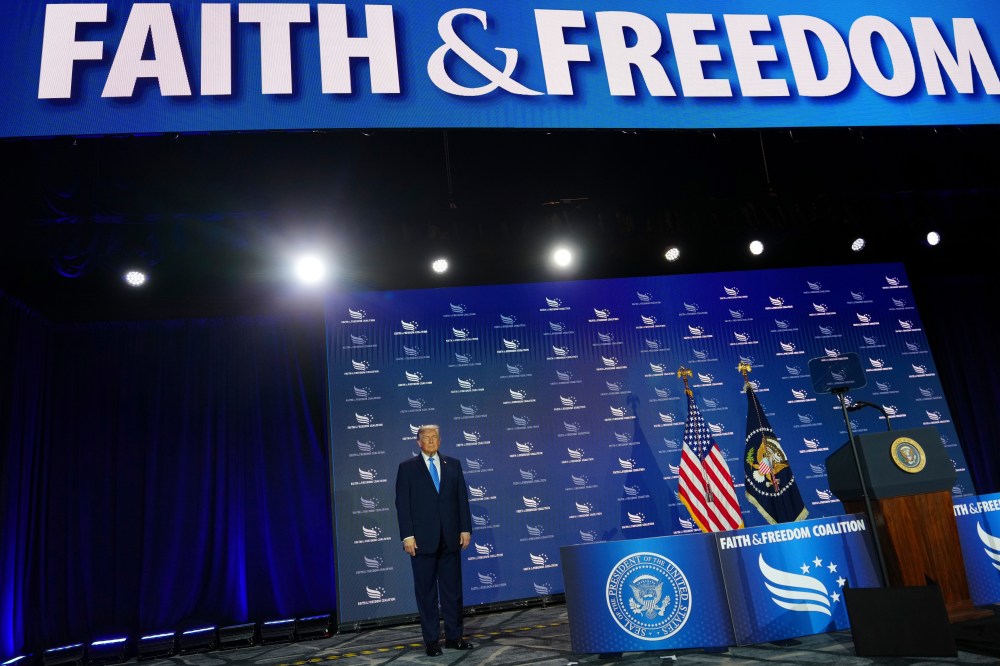
Trump, speaking to supporters at a Faith & Freedom Coalition gathering in Washington on Friday, touted the newly released report.
“We saved religion, it was going down,” he boasted.
Trump contended that the administration of his predecessor, Democrat Joe Biden, had carried out a “reign of persecution.”
While the commission report downplays the separation of church and state, the commission didn’t go so far as to call it a “lie,” as the commission chairman, Texas Lt. Gov. Dan Patrick, did in April.
But it largely took the stance that the idea is misapplied.
“To be clear, this does not involve or require advocating ‘theocracy’ or even the total elimination of any separation between church and state,” the report says. Rather, it calls for honoring a “tension between the relevant clauses of the First Amendment” that guarantee religious freedom but forbid any government-established church.
Still, Patrick pressed the issue at the news conference, saying the phrase separation of church and state was used to “batter and hammer people of faith” for decades.
Americans “cannot be attacked by that phrase any longer,” Patrick said.
Supreme Court rulings on church/state issues have evolved
The phrase, “a wall of separation between church and state” does not appear in the Constitution, but it’s embodied in Supreme Court precedent. Thomas Jefferson used that expression in a letter to Baptists, supporting them in opposing official churches in U.S. states, a practice that soon ended.
Twentieth-century decisions by the high court invoked the “separation” phrase to extend the First Amendment’s prohibition on federal church establishment to state and local governments, citing the 14th Amendment’s ban on states denying citizens’ rights.
That led to bans on official prayers and Ten Commandments displays in public schools. The Supreme Court in recent years has steered a different course, permitting such things as a public school coach’s on-field prayers and a religious opt-out for parents objecting to a lesson on transgender issues.
The draft report contends that even Jefferson didn’t believe in completely banishing religion from public life, but rather in keeping church and state in a kind of balance.
“In reality, the church and state strengthen and support one another,” it says.
The report touts the value of religion to society in terms of providing humanitarian work, anchoring families and acting as “conscience” monitoring government.
“In many cases the law protects the religious expression of Americans, but government officials and employers often use fear tactics to silence individuals into believing that they don’t have the right to publicly express their faith,” it argues.
It argues — citing one of its own members, Catholic media figure Bishop Robert Barron — that notions of strict church-state separation can be traced to a “God is dead” ideology that originated in Europe and saw traditional religion as an opponent to individual autonomy.
“This way of thinking made its way … into the American culture and courtroom,” the report said.
Little recognition for non-religious Americans
The report, while touting the value of religion, appears to give little emphasis on the large population of Americans with no religious affiliation. A key argument of many atheists and secular humanists is that one can be “good without God” — that religion doesn’t have a monopoly on virtue and can do harm as well as good.

The lawsuit challenging the commission alleges that commissioners have asserted that America is specifically a Judeo-Christian or Christian nation, showing a lack of ideological diversity.
The Republican administration is asking a federal court to dismiss the lawsuit.
This draft report comes two months after another entity created by Trump — the Task Force to Eradicate Anti-Christian Bias — issued its own report. It claimed that Christians faced discrimination under the Biden administration. Progressive critics said that the report amounted to advocacy rather than an investigation.
___
Associated Press religion coverage receives support through the AP’s collaboration with The Conversation US, with funding from Lilly Endowment Inc. The AP is solely responsible for this content.
The Free Press acknowledges the financial support it receives from members of the city’s faith community, which makes our coverage of religion possible.