German federal court rejects bid to remove antisemitic relic
Advertisement
Read this article for free:
or
Already have an account? Log in here »
To continue reading, please subscribe:

Digital Subscription
One year of digital access for only $205*
- Enjoy unlimited reading on winnipegfreepress.com
- Read the E-Edition, our digital replica newspaper
- Access News Break, our award-winning app
- Play interactive puzzles
*First annual payment billed as $205.00 + GST for one year. This annual subscription will automatically renew at $233.00 + GST every 52 weeks (10% off the regular annual price of $259.35). Offer available to new and qualified returning subscribers only. Cancel any time.
To continue reading, please subscribe:
Add Free Press access to your Brandon Sun subscription for only an additional
$1 for the first 4 weeks*
- Enjoy unlimited reading on winnipegfreepress.com
- Read the E-Edition, our digital replica newspaper
- Access News Break, our award-winning app
- Play interactive puzzles
*Your next Brandon Sun subscription payment will increase by $1.00 and you will be charged $17.95 plus GST for four weeks. After four weeks, your payment will increase to $24.95 plus GST every four weeks.
Read unlimited articles for free today:
or
Already have an account? Log in here »
Hey there, time traveller!
This article was published 14/06/2022 (1569 days ago), so information in it may no longer be current.
BERLIN (AP) — A German federal court on Tuesday rejected a Jewish man’s bid to have a 700-year-old antisemitic statue removed from a church where Martin Luther once preached.
The Federal Court of Justice upheld rulings by lower courts on the “Judensau,” or “Jew pig,” sculpture on the Town Church in Wittenberg — one of more than 20 such relics from the Middle Ages that still adorn churches across Germany and elsewhere in Europe. As in those rulings, judges pointed to the addition in the 1980s of a memorial at the site.
The case went to federal judges after courts in the eastern state of Saxony-Anhalt ruled in 2019 and 2020 against plaintiff Michael Duellmann. He had argued that the sculpture was “a defamation of and insult to the Jewish people” that has “a terrible effect up to this day,” and has suggested moving it the nearby Luther House museum.
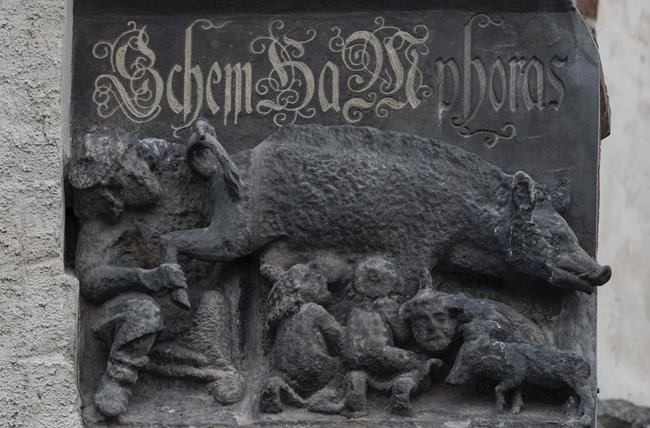
Placed on the church about four meters (13 feet) above ground level, the sculpture depicts people identifiable as Jews suckling the teats of a sow while a rabbi lifts the animal’s tail. In 1570, after the Protestant Reformation, an inscription referring to an anti-Jewish tract by Luther was added.
In 1988, a memorial was set into the ground below, referring to the persecution of Jews and the 6 million people who died during the Holocaust. In addition, a sign gives information about the sculpture in German and English.
The federal court found that, viewed in isolation, the original statue “derides and denigrates Judaism as a whole,” but that the parish remedied the legal situation by adding the memorial explaining its historical background. That, it added, meant that the parish had distanced itself from the “defamatory and antisemitic message” of the statue.
Despite the defamatory nature of the original statue, “the legal system does not demand its removal,” the federal court said. It argued there was more than one way to remedy the problem, and a memorial pointing to the Christian church’s antisemitic mentality over centuries was one such possibility.
Germany’s main Jewish group argued for the memorial to be reworked, and the regional Lutheran bishop signaled that the church will do so.

The head of the Central Council of Jews, Josef Schuster, said the court’s decision to allow the statue to stay was understandable but argued that the memorial and sign don’t contain “an unequivocal condemnation of the antisemitic sculpture.”
“Both the Wittenberg parish and the churches as a whole must find a clear and appropriate solution for handling antisemitic sculptures,” Schuster said. “The defamation of Jews by the churches must belong in the past once and for all.”
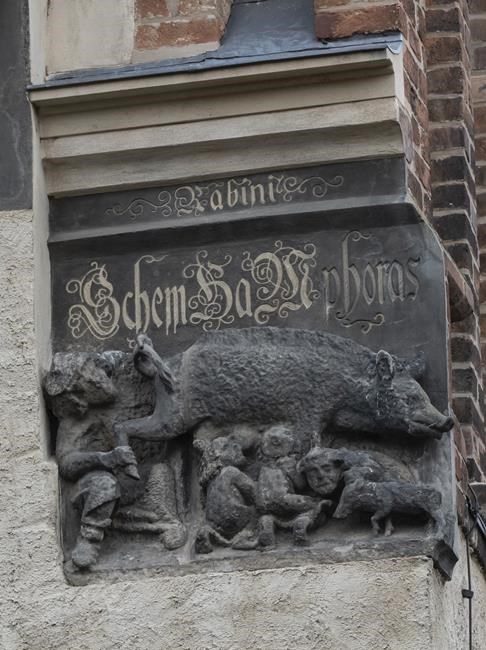
Regional bishop Friedrich Kramer said the church would support the “further development” of the memorial. He said there is a consensus that the memorial and sign “today no longer satisfy the aspiration to break the effect” of the antisemitic statue.
“For us as a church, there can be no question that we face our history with all its misdeeds, and our handling of it,” he said.
Plaintiff Duellmann told German news agency dpa that neither the federal nor the lower courts “really took seriously the propaganda effect, the poisoning effect on society” of the statue. He plans to take the case to Germany’s highest court, the Federal Constitutional Court.
The Free Press acknowledges the financial support it receives from members of the city’s faith community, which makes our coverage of religion possible.