Quebec court upholds most of province’s secularism law, exempts English school boards
Advertisement
Read this article for free:
or
Already have an account? Log in here »
To continue reading, please subscribe:

Digital Subscription
One year of digital access for only $205*
- Enjoy unlimited reading on winnipegfreepress.com
- Read the E-Edition, our digital replica newspaper
- Access News Break, our award-winning app
- Play interactive puzzles
*First annual payment billed as $205.00 + GST for one year. This annual subscription will automatically renew at $233.00 + GST every 52 weeks (10% off the regular annual price of $259.35). Offer available to new and qualified returning subscribers only. Cancel any time.
To continue reading, please subscribe:
Add Free Press access to your Brandon Sun subscription for only an additional
$1 for the first 4 weeks*
- Enjoy unlimited reading on winnipegfreepress.com
- Read the E-Edition, our digital replica newspaper
- Access News Break, our award-winning app
- Play interactive puzzles
*Your next Brandon Sun subscription payment will increase by $1.00 and you will be charged $17.95 plus GST for four weeks. After four weeks, your payment will increase to $24.95 plus GST every four weeks.
Read unlimited articles for free today:
or
Already have an account? Log in here »
Hey there, time traveller!
This article was published 20/04/2021 (1990 days ago), so information in it may no longer be current.
MONTREAL – Quebec’s secularism law is largely legal, a Superior Court judge ruled Tuesday, even as he acknowledged it violates the rights of Muslim women and has cruel and dehumanizing consequences for those who wear religious symbols.
Justice Marc-Andre Blanchard upheld the bulk of the religious symbols law, while striking down clauses pertaining to English-language school boards and a ban on members of the provincial legislature wearing face coverings.
In a 240-page ruling, Blanchard concluded that the law, known as Bill 21 “does not violate the Canadian constitutional architecture.”
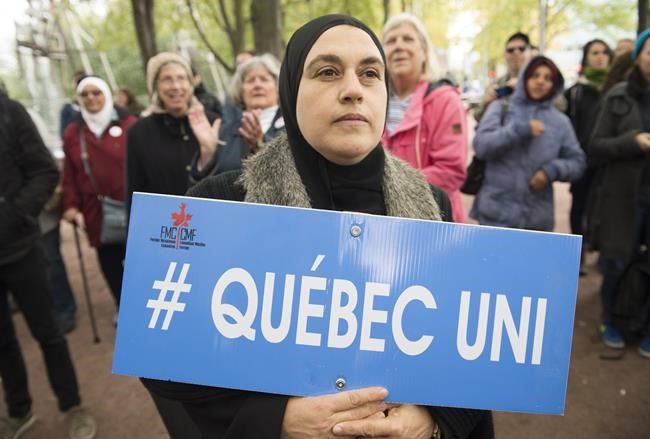
The law was adopted in June 2019, and it prohibits public sector workers who are deemed to be in positions of authority, including teachers, police officers and judges, from wearing symbols such as hijabs, kippas or turbans at work.
It was challenged in court by a number of groups, many of whom argued it was discriminatory and violated the Canadian Charter of Rights and Freedoms.
However, their efforts were complicated by the Quebec government’s decision to make pre-emptive use of the charter’s notwithstanding clause, which shields legislation from most court challenges over violations of fundamental rights.
Blanchard criticized the provincial government’s liberal use of the notwithstanding clause but ruled it was legal to do so.
“The use by the legislator of exemption clauses appears excessive, because it’s too broad, although legally unassailable in the current state of the law,” the decision reads.
Invoking the clause meant the law was largely allowed to stand, despite what the judge described as “serious and negative” impacts on people who wear religious symbols. He noted that people who fall into this category can no longer seek out new jobs in the public service without compromising their beliefs.
“We can easily understand that this is a cruel consequence that dehumanizes those who are targeted,” he wrote.
Blanchard also found that the law violates the rights of Muslim women, and particularly teachers who wear hijabs.
“The court notes that the evidence undoubtedly shows that the effects of Bill 21 will negatively impact Muslim women first and foremost,” the decision reads.
“In one way, by violating their freedom of religion, and in another, in doing the same in regards to their freedom of expression, since clothing constitutes both pure and simple expression, and also the manifestation of a religious belief.”
However, Blanchard rejected the plaintiffs’ claim that the sexual equality guarantees in Section 28 of the charter were not covered by the notwithstanding clause invoked by the Quebec government.
“Section 28 of the Canadian charter, which guarantees equal rights for both sexes, has no scope other than interpretive and it does not independently invalidate laws,” he found.
Blanchard did, however, rule that certain provisions of the law are unconstitutional as they affect English school boards. He ruled that the portions of the law unjustifiably violated Section 23 of the charter, which guarantees minority language education rights and is not on the list of sections covered by the notwithstanding clause.
He noted that previous court decisions have stressed the importance of protecting linguistic minorities’ charter-protected rights to control many aspects of the education they offer, including choosing who to hire and making decisions that will help foster diversity.
The judge also struck down a ban on members of the provincial legislature wearing face coverings, ruling that it violates Section 3 of the charter, which guarantees democratic rights, because it would prevent a person who wears a face-covering garment from sitting in the legislature, even if they were democratically elected.
The trial combined four separate lawsuits that were heard over several weeks at the end of 2020.
During the hearings, the Quebec government repeatedly argued that Bill 21 is moderate and supported by a majority of Quebecers, while critics argued it targets racialized minorities who choose to practice their religion.
Simon Jolin-Barrette, the province’s justice minister, said on Tuesday that the government will appeal Tuesday’s ruling and the exemption established for English school boards. “There are not two Quebecs,” he told reporters in Quebec City. “There is only one. The laws must apply uniformly on Quebec territory.”
Quebec Premier Francois Legault said the decision to uphold most of the law was a “victory for Quebecers.” However, he said he was disappointed with the judgment’s “illogical” conclusion about English schools. “Secularism and Quebec common values have no language barrier,” he wrote on Facebook.
The English Montreal School Board said it was elated with the ruling, with chairman Joe Ortona saying his reading is that English boards can begin hiring qualified teachers, whether they wear a religious symbol or not.
Since it came into force, Ortona said qualified candidates have been refused employment, others have been denied promotions and many simply didn’t bother to apply.
“We have seen the negative impact of Law 21 on our staff and on the culture in our schools and centres,” Ortona said. “The law is forcing individuals to choose between government employment and a desire to wear religious apparel.”
Furheen Ahmed, a teacher at Montreal’s Westmount High School and outspoken critic of the religious symbols law, said more work needs to be done.

“Of course I’m happy, but this is one small victory because we live in a very big province,” Ahmed said.
“My colleagues who work in the French system, they don’t get to celebrate today, and all the other people who aren’t part of English schools, they don’t get to celebrate today.”
Representatives of the Canadian Civil Liberties Association and the National Council of Canadian Muslims, who were parties to the challenge, said their fight wasn’t over but they would study the judgment with their lawyers before deciding on their next steps.
This report by The Canadian Press was first published April 20, 2021.
— With files from Sidhartha Banerjee
The Free Press acknowledges the financial support it receives from members of the city’s faith community, which makes our coverage of religion possible.