Food bloggers bring Africa’s rich cuisines to the world

Advertisement

Advertise with us

NGAPAROU, Senegal - In the quiet hours before lunch, two women worked side by side in an airy kitchen. One, a chef, cleaned fresh red snapper filets with a sharp knife. The other, a filmmaker, pointed her camera into a large pot of simmering vegetables.

Read this article for free:


or

Already have an account? Log in here »

To continue reading, please subscribe:

Subscribe and receive a limited-edition Free Press branded hat or tote.

Digital Subscription

One year of digital access for only $205*

  • Enjoy unlimited reading on winnipegfreepress.com
  • Read the E-Edition, our digital replica newspaper
  • Access News Break, our award-winning app
  • Play interactive puzzles

*First annual payment billed as $205.00 + GST for one year. This annual subscription will automatically renew at $233.00 + GST every 52 weeks (10% off the regular annual price of $259.35). Offer available to new and qualified returning subscribers only. Cancel any time.

To continue reading, please subscribe:

Add Free Press access to your Brandon Sun subscription for only an additional

$1 for the first 4 weeks*

  • Enjoy unlimited reading on winnipegfreepress.com
  • Read the E-Edition, our digital replica newspaper
  • Access News Break, our award-winning app
  • Play interactive puzzles
Start now

*Your next Brandon Sun subscription payment will increase by $1.00 and you will be charged $17.95 plus GST for four weeks. After four weeks, your payment will increase to $24.95 plus GST every four weeks.

Hey there, time traveller!
This article was published 06/01/2019 (2807 days ago), so information in it may no longer be current.

NGAPAROU, Senegal – In the quiet hours before lunch, two women worked side by side in an airy kitchen. One, a chef, cleaned fresh red snapper filets with a sharp knife. The other, a filmmaker, pointed her camera into a large pot of simmering vegetables.

“What would you say this is, low heat or medium?” Tuleka Prah asked, setting the camera aside.

Her pen poised over a lime green notebook, the 37-year-old Prah waited for the next step in the recipe for thiebou dieune, a traditional Senegalese dish of spiced rice, tender vegetables and fish. She came to this West African nation to document its four most popular dishes as part of My African Food Map, a blog and film archive.
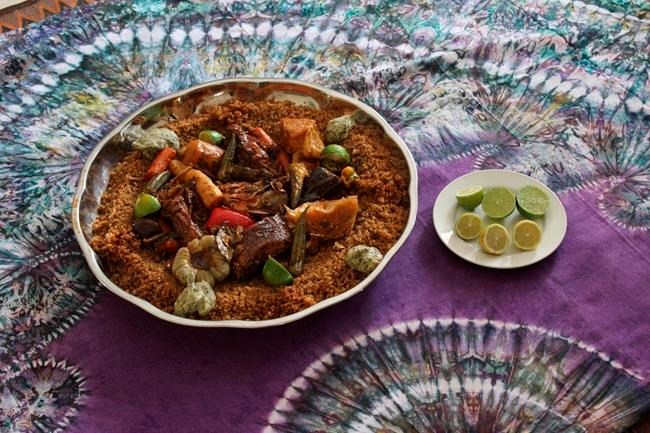
In this Nov. 24, 2018, photo, a platter of thiebou dieune, a traditional Senegalese dish of spiced rice, is serve by Chef Touty Sarr, in Ngaparou, Senegal. In the quiet hours before lunch, two women worked side by side in an airy kitchen. One, a chef, cleaned fresh red snapper filets with a sharp knife. The other, a filmmaker, pointed her camera into a large pot of simmering vegetables. (AP Photo/Amelia Nierenberg)

“Low heat,” said 38-year-old Touty Sarr, who runs the kitchen of a popular cafe in Dakar. She turned to her daughter, who was watching her cook. “This one, if you put it on high, it would all get dry. That’s one of the secrets.”

Senegal was Prah’s fifth destination since her project began in 2012. She hopes to show the care and skill that goes into African dishes, such as South Africa’s fried dough amagwinya and Kenya’s kachumbari, an onion and tomato salad.

“The idea, at its most basic, is to present the food how people who love it would prepare it,” Prah said. “It’s like a database or a digital vault where people can open the drawer, see recipes, see some ingredients.”

Born in England to a Ghanaian father and a South African mother, she lived in six African countries during her childhood including Namibia, Kenya and what is now South Sudan. After finding no reliable recipes online for Ghanaian dishes — and no photos that made the beloved food look appetizing — she started My African Food Map.

She celebrates the cuisines of a continent often marred by negative stereotypes.

“Africa is often associated with poverty, with hunger, with failures of food in a political and nutritional sense,” said James C. McCann, chair of the history department at Boston University and a specialist in African environmental history and cuisine. “It’s an area of the world that has not been covered by the food craze.”

Other culinary historians, chefs, and foodies are fighting such stereotypes. Some, like author and professor Jessica Harris, have studied African and diaspora cuisine, exploring the roots of foods taken far from home by slavery. Others, like Fran Osseo-Asare and her Ghanaian-focused project Betumi, investigate the foods of a single country.

“The internet was the democratization of African food writing,” said Osseo-Asare, who said she has blogged about African food since the 1980s. “When the internet came, you didn’t have publishers as gatekeepers that could stop you from getting your work out.”

Unique among prominent bloggers, Prah takes an almost pan-African approach.

“I always feel like I am from the whole continent,” she said. “I can find myself in different aspects of different countries I visit.”

Her videos often have tens of thousands of views, and she dreams of doing her project full-time like Anthony Bourdain did. She said she has had no luck finding sponsors but intends to keep trying.

“The best outcome is when people say, ‘That is our food, that is our dish,'” she said, remembering her work in Kenya. “I was extremely happy when the first comments I got on YouTube were, ‘Oh, this reminds me of home.'”

To find authentic recipes and skilled chefs, Prah asks everyone she meets in a country – hosts, cab drivers, shop keepers and strangers – about their favourite foods. She met Sarr this way, through friends of friends.
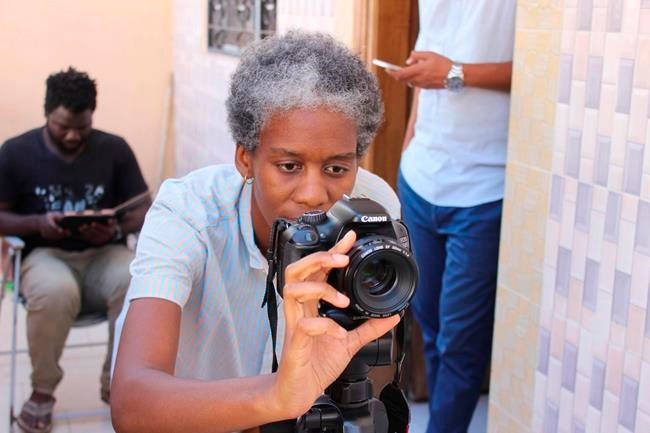
This Nov. 20, 2018, photo shows filmmaker Tuleka Prah, the founder of My African Food Map, at work in Ngaparou, Senegal. In the quiet hours before lunch, two women worked side by side in an airy kitchen. One, a chef, cleaned fresh red snapper filets with a sharp knife. The other, a filmmaker, pointed her camera into a large pot of simmering vegetables. (AP Photo/Amelia Nierenberg)

“I learned from my grandma. I used to follow her everywhere,” said Sarr, who wears her stiff white chef’s uniform every time she cooks, even at home, because it makes her feel more professional. “And our grandmas, they think that taking time with the food gives it more flavour. So I take time, too.”

She said she became a chef after money ran out to pursue her dream of being a doctor.

“There are a lot of similarities between cooking and medicine,” she said, skinning onions. “The feeling of being full after you have eaten is the same sensation as getting better after being sick. It’s something that gives me a lot of pride.”

She dropped garlic into sizzling oil, then stepped back as Prah moved close to the pot to film. The two women orbited each other, artists collaborating over the pot burbling on the stove.

Sarr said she cooks by smell, by sound and by taste, but Prah wrote her steps down in order, recording a recipe for others without the guidance of grandmothers and mothers at their side.

After two hours of chopping and pounding, scraping and whipping, boiling and simmering, Sarr spread red-tinted rice across a platter almost two feet wide. She flattened it and carefully arranged the vegetables and fish in a circle for a communal meal, with some family members eating with spoons and others with their hands.

Prah snapped a picture, and then another, before putting her camera aside to try the dish.

“It’s really good,” she said, her mouth full, smiling at Sarr. “Really, really good.”

___

Follow Africa news at https://twitter.com/AP_Africa

Report Error Submit a Tip

More Stories

Downtown no place to be after dark, huge majority of Winnipeggers say in survey

Joyanne Pursaga 8 minute read Preview

Downtown no place to be after dark, huge majority of Winnipeggers say in survey

Joyanne Pursaga 8 minute read Friday, Sep. 11, 2026

Most Winnipeggers are afraid to walk alone downtown and believe the city needs more police officers, a new survey finds.

Winnipeg Police Service released its 2026 citizen survey Friday.

Downtown safety appears to remain a major concern, with just 44 per cent saying they feel very or reasonably safe walking alone in the area during the day. The number plummets to eight per cent overall at night, down from nine per cent in 2024, the last time the survey was conducted.

This year, 14 per cent of men felt very or reasonably safe walking alone downtown at night, compared to just three per cent of women.

Read
Friday, Sep. 11, 2026

Mayoral candidate denounced for online comments

Morgan Modjeski 3 minute read Preview

Mayoral candidate denounced for online comments

Morgan Modjeski 3 minute read Updated: 2:34 PM CDT

A Winnipeg mayoral candidate is facing criticism after he posted derogatory comments about immigrants and used the word “gay” as an insult online.

Sydney Adams said the response she got from Zac Uminski, who is seeking the city’s top office alongside 12 other individuals, left her baffled. She recently criticized Uminski over his use of artificial intelligence to produce campaign material, to which he replied he can’t afford to hire people to make art or “do whatever gay s—- you think is better than AI.”

“What was going through my head was that this is just unacceptable,” she said.

Adams said Uminski also posted other disparaging remarks about newcomers.

Read
Updated: 2:34 PM CDT

Canadians loving Carney’s decision to stand tall against floundering U.S. bully

Tom Brodbeck 5 minute read Preview

Canadians loving Carney’s decision to stand tall against floundering U.S. bully

Tom Brodbeck 5 minute read Friday, Sep. 11, 2026

It’s hard to imagine a more dramatic political contrast than the one unfolding on opposite sides of the Canada-U.S. border.

Mark Carney is fighting a trade war with Donald Trump, taking the occasional verbal punch from the American president and imposing retaliatory tariffs on U.S. products.

And the prime minister is being rewarded for it politically.

Trump, meanwhile, is fighting pretty much everyone he can find — including some of America’s closest allies — and his own voters are increasingly giving him the political equivalent of a raised middle finger. That’s quite a tale of two leaders.

Read
Friday, Sep. 11, 2026

Tory health critic ‘disappointed’ after being rebuffed by health officials

Carol Sanders 4 minute read Preview

Tory health critic ‘disappointed’ after being rebuffed by health officials

Carol Sanders 4 minute read Yesterday at 11:53 AM CDT

The health critic for the Progressive Conservative party says her ability to get information about the accelerated reopening of Dauphin’s emergency department was stymied by Prairie Mountain Health officials because they refused to meet with her.

“I wanted to meet with PMH staff to discuss the status of the facility and the challenges they’re facing and getting services back online,” Kathleen Cook said Friday.

“I was very disappointed that Prairie Mountain Health declined me that opportunity.”

Cook said she asked for a meeting a few days after the Sept. 7 reopening of a temporary ER at the hospital, that was severely damaged by flooding.

Read
Yesterday at 11:53 AM CDT

Citizen reports help highlight connectivity issues across southwest Manitoba

Nicole Buffie 5 minute read Preview

Citizen reports help highlight connectivity issues across southwest Manitoba

Nicole Buffie 5 minute read Updated: Yesterday at 10:43 AM CDT

A southwestern Manitoba man has created a map to document cell service blackout spots in an effort to push for better access in rural areas.

Mark Custance compiled more than 300 citizen reports over the last few months to document where service in southwest Manitoba is strong, spotty or doesn’t exist at all.

“I’ve heard people complain and say, ‘cell service sucks’ or ‘this is not working.’ But what does the data actually say?” Custance said from his office in Melita, where he has installed a cell-service booster to maintain connectivity with the rest of the world.

Analyzing where service is good and poor, he cross-references it with the location of cellphone towers across the region.

Read
Updated: Yesterday at 10:43 AM CDT

Puzzles Palace

1 minute read Monday, Jul. 27, 2026

To solve our puzzles, please subscribe with this special offer: |