Fighting phosphorus

Citizen scientists gather data to help keep Lake Winnipeg healthy

Advertisement

Advertise with us

Volunteers from across Manitoba are heading to local waterways to help the Lake Winnipeg Foundation (LWF) collect data they hope will help improve the health of the province’s great lake.

Read this article for free:


By clicking the button above, an account will be created and you will begin to receive some of our recommended newsletters. You may opt out of any newsletter by visiting your Email and Communication Preferences page or by clicking "unsubscribe" at the bottom of any email.

or

Already have an account? Log in here »

To continue reading, please subscribe:

Digital Subscription

One year of digital access for only $1.44 a week*

  • Enjoy unlimited reading on winnipegfreepress.com
  • Read the E-Edition, our digital replica newspaper
  • Access News Break, our award-winning app
  • Play interactive puzzles

*Billed as $5.77 plus GST every four weeks. After 52 weeks, price increases to the regular rate of $19.95 plus GST every four weeks. Offer available to new and qualified returning subscribers only. Cancel any time.

To continue reading, please subscribe:

Add Free Press access to your Brandon Sun subscription for only an additional

$1 for the first 4 weeks*

  • Enjoy unlimited reading on winnipegfreepress.com
  • Read the E-Edition, our digital replica newspaper
  • Access News Break, our award-winning app
  • Play interactive puzzles
Start now

*Your next Brandon Sun subscription payment will increase by $1.00 and you will be charged $17.95 plus GST for four weeks. After four weeks, your payment will increase to $24.95 plus GST every four weeks.

Hey there, time traveller!
This article was published 03/08/2019 (2642 days ago), so information in it may no longer be current.

Volunteers from across Manitoba are heading to local waterways to help the Lake Winnipeg Foundation (LWF) collect data they hope will help improve the health of the province’s great lake.

“We all have to do our part,” says Jim Duthie, a Birds Hill resident and LWF citizen scientist. “This is one small thing I am doing, but it’s all part of a bigger picture as we look for bigger strategies to help keep Lake Winnipeg healthy.”

Duthie currently collects water samples at the mouth of Bird Lake near his family cottage. He is one of the more than 100 volunteers currently working as a citizen scientist with the Lake Winnipeg Community-Based Monitoring Network.

Lake Winnipeg Foundation
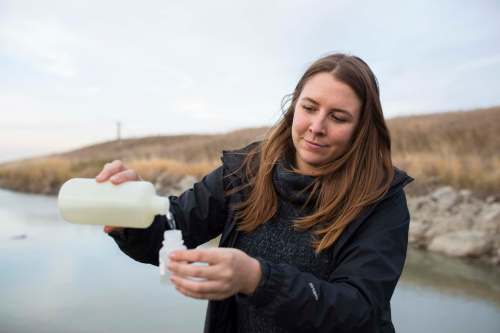
Chelsea Lobson, Lake Winnipeg Community-Based Monitoring Network co-ordinator, takes part in water sampling near Cooks Creek.
Lake Winnipeg Foundation Chelsea Lobson, Lake Winnipeg Community-Based Monitoring Network co-ordinator, takes part in water sampling near Cooks Creek.

The network is helping the foundation collect data about phosphorus levels in Manitoba waterways.

In 2016, LWF started to put together a coalition of citizen scientists, and those volunteers have spent the past three years collecting water samples from bodies of water that make up the Lake Winnipeg watershed.

The samples are then tested to determine phosphorus concentrations, as phosphorus is the nutrient responsible for blue-green algae blooms on Manitoba’s lakes, notably Lake Winnipeg.

With LWF seeking as much data on phosphorus levels as possible, it decided it couldn’t simply rely on environmental scientists or government bodies to do this kind of testing.

“The original idea came from a data deficit in phosphorus data in the watershed, so we saw this as an opportunity to collect more data while also engaging citizens in the process,” says Chelsea Lobson, co-ordinator of the monitoring network.

Volunteers across Manitoba head out during spring, summer and fall to test phosphorus levels.

“With this kind of data, it is really important to collect samples during the spring melt and after big rain events,” Lobson says.

“And citizens allow the network to be nimble and responsive; the volunteers work or live or commute near their samples areas, so they can sample frequently during the spring melt, and also collect samples at a moment’s notice after a big rain event.”

LWF hopes the information it has gathered will lead to solutions to the problem of algae blooms in Lake Winnipeg, Lobson says.

“So we all know that phosphorus causes algae, but in order to reduce that phosphorus, we need to know where it’s coming from, and the network is giving us those answers,” Lobson says.

“They’re collecting phosphorus samples to identify phosphorus hot spots and looking for areas contributing more relative to other areas, and once we know where those hot spots are, we are able to target them.”

With that data now in its hands, executive director Alexis Kanu says, the foundation can work at developing strategies to combat phosphorus in Manitoba waterways.

“It has really been beneficial,” Kanu says. “It is showing us some really interesting stuff, and it is complementary to what we know from government monitoring programs.”

Lake Winnipeg Foundation
Jim Duthie, a citizen scientist with the Lake Winnipeg Community-Based Monitoring Network, takes water samples at Bird Lake.
Lake Winnipeg Foundation Jim Duthie, a citizen scientist with the Lake Winnipeg Community-Based Monitoring Network, takes water samples at Bird Lake.

A number of phosphorus hot spots were detected in Manitoba in 2017, which was a higher-precipitation year, according to Kanu.

“So when we can find those phosphorus hot spots, then we know that is where we need to be doing the work to reduce phosphorus loading,” she says.

“We obviously want to be working in the landscapes that are contributing the most phosphorus, because there is the most to be gained by reducing phosphorus there.”

Phosphorus hot spots that were discovered in 2017 did not reappear in 2018 — a much drier year — and that tells LWF that runoff plays a big factor in phosphorus levels, Kanu says.

“What that tells us is 2018 was a dry year, so when we have low water levels and low water flows, then less phosphorus is getting into the lake, so if we can replicate dry conditions by keeping water back on the land by holding it behind dams or in retention ponds or in natural wetlands, we can replicate the dry conditions that lead to low phosphorus loading,” Kanu says.

“We were expecting the data to show us where to do the work, but now it’s starting to hint at possible solutions, and anything that helps us tackle this problem by narrowing our focus and making sure we are being strategic is going to go a long way.”

Kanu says it has been the hard work but also the passion of their volunteers that has so far made the monitoring program a success.

“It isn’t something that we could do on our own, and it isn’t anything that any of our partners could do on their own,” Kanu says. “It depends on people coming together and deciding they are going to be a part of this larger network and become part of us discovering the bigger picture.

“I can say that I have been completely inspired by how engaged volunteers are and how committed they are to this.”

For more information on volunteering with the Lake Winnipeg Community-Based Monitoring Network, contact Chelsea Lobson at cbm@lakewinnipegfoundation.org, or visit lakewinnipegfoundation.org.

Report Error Submit a Tip

More Stories

Citizen scientists gather data to help keep Lake Winnipeg healthy

Dave Baxter 5 minute read Preview

Citizen scientists gather data to help keep Lake Winnipeg healthy

Dave Baxter 5 minute read Saturday, Aug. 3, 2019

Volunteers from across Manitoba are heading to local waterways to help the Lake Winnipeg Foundation (LWF) collect data they hope will help improve the health of the province’s great lake.

“We all have to do our part,” says Jim Duthie, a Birds Hill resident and LWF citizen scientist. “This is one small thing I am doing, but it’s all part of a bigger picture as we look for bigger strategies to help keep Lake Winnipeg healthy.”

Duthie currently collects water samples at the mouth of Bird Lake near his family cottage. He is one of the more than 100 volunteers currently working as a citizen scientist with the Lake Winnipeg Community-Based Monitoring Network.

The network is helping the foundation collect data about phosphorus levels in Manitoba waterways.

Read
Saturday, Aug. 3, 2019

Jets players glad to have Hellebuyck trade behind them

Mike McIntyre 6 minute read Preview

Jets players glad to have Hellebuyck trade behind them

Mike McIntyre 6 minute read Saturday, Oct. 24, 2026

Relief? Regret? Rage?

How are the Winnipeg Jets feeling following Friday’s Connor Hellebuyck trade — particularly those with deep roots and strong bonds with the franchise goaltender who now finds himself a member of the New Jersey Devils?

“It was a bit of a cloud hanging over our heads,” captain Adam Lowry admitted on Saturday. “It’s nice we can look forward now. We don’t have to keep talking about it. We’ve got guys that want to be here.”

That was a bit of a common theme around the room following an outdoor practice at Princess Auto Stadium ahead of Sunday’s Heritage Classic game against the Montreal Canadiens.

Read
Saturday, Oct. 24, 2026

Today’s horoscope

Georgia Nicols 4 minute read Preview

Today’s horoscope

Georgia Nicols 4 minute read 2:00 AM CDT

MOON ALERT: Caution! Avoid shopping (except food and gas) and important decisions from 9:15 a.m. until 8:30 p.m. today. After that, the moon moves from Taurus into Gemini.

ARIES (March 21-April 19)

Be aware of the limitations of the moon alert as it is taking place in your money house. Guard against temptations to shop and buy things. Be wise and restrict your spending to food and gas until after the moon alert is over. (See above.)

TAURUS (April 20-May 20)

Read
2:00 AM CDT

Setting appropriate boundaries

Editorial 4 minute read Preview

Setting appropriate boundaries

Editorial 4 minute read 2:01 AM CDT

Most Manitoba teachers are responsible, caring professionals who work hard to support their students and would never dream of abusing their positions of trust by sending inappropriate private messages to students.

They understand the importance of maintaining professional boundaries and putting students’ safety first.

But there are some who have crossed that line, with troubling consequences. That is why the provincial government’s decision last week to prohibit teachers and other school staff from texting or using social media to contact students is an important and necessary step to protect children.

The new rules, announced Friday by Education Minister Tracy Schmidt, prohibit school employees from initiating remote communications with students or responding to messages through unauthorized platforms. That includes texting, personal social media accounts and private messaging applications, regardless of whether a teacher is contacting a student during school hours or while coaching a sports team or supervising extracurricular activities.

Read
2:01 AM CDT

Connor Hellebuyck breaks silence after trade from Jets

Mike McIntyre 8 minute read Preview

Connor Hellebuyck breaks silence after trade from Jets

Mike McIntyre 8 minute read Saturday, Oct. 24, 2026

It took until the very end of his introductory news conference Saturday — right around the 15-minute mark — before Connor Hellebuyck was finally asked the question that hockey fans back in Winnipeg were likely waiting for.

“Is there anything you’d like to say to Jets fans?” a reporter who covers Hellebuyck’s new team, the New Jersey Devils, put to him during the session held inside the Prudential Center in Newark.

A short pause followed.

“I mean, there’s a lot. There’s a lot that I need to say,” Hellebuyck began, no doubt raising plenty of eyebrows around here and the hockey world in general.

Read
Saturday, Oct. 24, 2026

Express the merry widow you truly are

Maureen Scurfield 5 minute read 2:00 AM CDT

DEAR MISS LONELYHEARTS: My husband died a while back, and I don’t miss him! He had grown old in a strange and cranky way, and I’m a cheerful person by nature. It was hard to hear him shoot down every idea I had to go out and do things together.

He wasn’t physically ill — just finished with having any fun. He had gotten depressed and wouldn’t take anti-depressants, although he was fine with getting drunk and critical towards me.

He was particularly negative about seeing friends and relatives, and living the active way we used to — always the first to get tickets to concerts and encouraging other friends to go with us for dinners at new restaurants. We also went to a lot of sports games, and visited friends and relatives. We arrive with lots of good food and drink.

So now when people ask me in that pitying voice used for widows, “Poor darling, how are you doing?” I respond, “He was miserable towards the end, and it was a relief when he died.” They look shocked, but it’s the truth, and they know it.