Human rights panel to hear Navajo uranium contamination case

Advertisement

Advertise with us

ALBUQUERQUE, N.M. (AP) — A group representing Navajo communities is presenting its case to an international human rights body, saying U.S. regulators violated the rights of tribal members when they cleared the way for uranium mining in western New Mexico.

Read this article for free:


or

Already have an account? Log in here »

To continue reading, please subscribe:

Subscribe and receive a limited-edition Free Press branded hat or tote.

Digital Subscription

One year of digital access for only $205*

  • Enjoy unlimited reading on winnipegfreepress.com
  • Read the E-Edition, our digital replica newspaper
  • Access News Break, our award-winning app
  • Play interactive puzzles

*First annual payment billed as $205.00 + GST for one year. This annual subscription will automatically renew at $233.00 + GST every 52 weeks (10% off the regular annual price of $259.35). Offer available to new and qualified returning subscribers only. Cancel any time.

To continue reading, please subscribe:

Add Free Press access to your Brandon Sun subscription for only an additional

$1 for the first 4 weeks*

  • Enjoy unlimited reading on winnipegfreepress.com
  • Read the E-Edition, our digital replica newspaper
  • Access News Break, our award-winning app
  • Play interactive puzzles
Start now

*Your next Brandon Sun subscription payment will increase by $1.00 and you will be charged $17.95 plus GST for four weeks. After four weeks, your payment will increase to $24.95 plus GST every four weeks.

Hey there, time traveller!
This article was published 21/10/2021 (1787 days ago), so information in it may no longer be current.

ALBUQUERQUE, N.M. (AP) — A group representing Navajo communities is presenting its case to an international human rights body, saying U.S. regulators violated the rights of tribal members when they cleared the way for uranium mining in western New Mexico.

The Inter-American Commission on Human Rights based in Washington, D.C., decided earlier this year that the petition filed a decade ago by Eastern Navajo Diné Against Uranium Mining was admissible. With additional testimony and exhibits being filed Thursday, the commission is expected to hold a hearing in the spring.

Lawyers for the Navajo group said the commission’s decision to hear the case marks the first time that the panel has found admissible a petition filed on behalf of an Indigenous community. It’s the second time for the panel to consider an environmental justice case against the United States. The first was a petition by Mossville Environmental Action Now regarding high cancer rates within impoverished communities in parts of Louisiana.
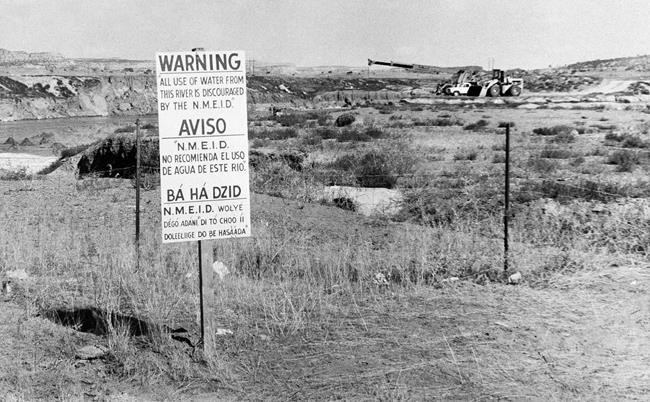
FILE - This Nov. 13, 1975, file photo, shows signs along the Rio Puerco warning residents in three languages to avoid the water in Church Rock, N.M. after a uranium tailings spill. A group representing Navajo communities is presenting its case to an international human rights body, saying U.S. regulators violated the rights of tribal members when they cleared the way for uranium mining in western New Mexico. (AP Photo/SMH,File)

“Our filing today is crucial for the protection of our Diné communities, our people, our homeland, and our culture,” Jonathan Perry, director of the Navajo group, said in a statement. “We will stand for our human rights and not allow our value as Indigenous People to be diminished. The federal government must realize that we are not disposable and that water is life.”

On the Navajo Nation, uranium mining has left a legacy of death, disease and environmental contamination. That includes the largest spill of radioactive material in the United States, when 94 million gallons of tailings and wastewater spewed onto tribal lands in the Church Rock area in western New Mexico in 1979. It happened just three months after the partial meltdown of a nuclear reactor at Three Mile Island in Pennsylvania, which got far more attention at the time.

Hundreds of abandoned uranium mines and radioactive waste still have to be cleaned up across the Navajo Nation. Tribal President Jonathan Nez recently said residents of the nation’s largest Indigenous reservation have been exposed to dangerous levels of radiation for years and have endured a wide range of illnesses as a result, with some dying prematurely.

The Navajo Nation recently signed a joint proclamation in support of the group’s petition. Several individual Navajo chapters have passed their own resolutions, and the Oglala Sioux Tribe in South Dakota submitted a letter of support.

Since 2005, the Navajo Nation has had a ban on uranium mining on its land, which spans parts of New Mexico, Arizona and Utah.

During a legislative session this week, Navajo lawmakers passed a measure that requests Congress host hearings regarding uranium mining, its long-term outcomes and reclamation efforts. The sponsor, Council Delegate Kee Allen Begay Jr., said it will be important for Congress to hear directly from the Navajo people.

“The healing of families can only begin when past wrongs are made right,” he said in a statement.

According to the human rights petition, the U.S. government failed to protect the human rights of Indigenous communities when the Nuclear Regulatory Commission licensed Hydro Resources Inc. to build and operate in situ leach mines — in which chemicals are used to dissolve minerals out of the formation — near Crownpoint and Church Rock.

Hydro Resources is now known as NuFuels, a subsidiary of the Canadian mining company Laramide Resources. The company did not immediately respond to questions about the claims or future plans for mining at the site.

The Navajo group is making several requests, including that the Nuclear Regulatory Commission rescind or not renew the company’s mining license and that the federal government respect Navajo law and prioritize cultural views and practices. The group also is asking that a remediation plan be created and an environmental assessment be conducted of the effects of uranium mining and milling.

Eric Jantz, an attorney with the New Mexico Environmental Law Center, has worked on the case for two decades. He said the legal battle has been emotionally draining particularly for those who live near the site because the threats of uranium mining have been hanging over their heads every day for decades.

Community members Rita Capitan and Christine Smith said they have been speaking out about the dangers of contamination as a way to protect future generations and prevent further damage to natural resources that their communities depend on.

“Water is sacred. Water is life. Water is alive and water has rights and we all as human beings have a right to have good water,” Capitan said during a news conference. “We’ve got to do it for our generations to come.”
Report Error Submit a Tip

More Stories

Human rights panel to hear Navajo uranium contamination case

Susan Montoya Bryan, The Associated Press 5 minute read Preview

Human rights panel to hear Navajo uranium contamination case

Susan Montoya Bryan, The Associated Press 5 minute read Thursday, Oct. 21, 2021

ALBUQUERQUE, N.M. (AP) — A group representing Navajo communities is presenting its case to an international human rights body, saying U.S. regulators violated the rights of tribal members when they cleared the way for uranium mining in western New Mexico.

The Inter-American Commission on Human Rights based in Washington, D.C., decided earlier this year that the petition filed a decade ago by Eastern Navajo Diné Against Uranium Mining was admissible. With additional testimony and exhibits being filed Thursday, the commission is expected to hold a hearing in the spring.

Lawyers for the Navajo group said the commission’s decision to hear the case marks the first time that the panel has found admissible a petition filed on behalf of an Indigenous community. It's the second time for the panel to consider an environmental justice case against the United States. The first was a petition by Mossville Environmental Action Now regarding high cancer rates within impoverished communities in parts of Louisiana.

“Our filing today is crucial for the protection of our Diné communities, our people, our homeland, and our culture,” Jonathan Perry, director of the Navajo group, said in a statement. "We will stand for our human rights and not allow our value as Indigenous People to be diminished. The federal government must realize that we are not disposable and that water is life.”

Read
Thursday, Oct. 21, 2021

Is ‘tornado alley’ moving north?

Editorial 4 minute read Preview

Is ‘tornado alley’ moving north?

Editorial 4 minute read Yesterday at 2:00 AM CDT

There’s a famous fictional story in which a ruby-slippered, tornado-tossed traveller takes a wide-eyed look around and declares, “I’ve a feeling we’re not in Kansas anymore.”

Read
Yesterday at 2:00 AM CDT

Mechanic Susie helps turn jockey standings around at Assiniboia Downs

George Williams 5 minute read Preview

Mechanic Susie helps turn jockey standings around at Assiniboia Downs

George Williams 5 minute read Yesterday at 9:51 PM CDT

Two champions got back up off the mat this week at Assiniboia Downs. One of them was a human.

Antonio Whitehall won four races on Wednesday evening to wrest back the lead in the jockey standings from surging former Hastings Park rider Kerron Khelawan, and he crossed the finish line first in the last five races on the card. Whitehall was disqualified from winning the seventh race aboard Tap the Parlay when that filly caused some unavoidable interference early in the race.

The winners that stood for Whitehall included Neighneigh ($5.50) in the fourth race for trainer Demetris Topouzis; Mechanic Susie ($3.90) in the fifth for trainer Elton Dickey; Betterlucknexttime ($3.80) in the sixth race for trainer Mike Nault; and a nail biter in the seventh aboard Weekendindelmar ($5.00) for trainer Robert Maybin.

No earth-shattering prices in the bunch, but the fact that the three-time ASD riding champion came back with a huge night after being outscored 2-0 by Khelawan and being knocked out of top spot in the standings the night before spoke volumes.

Read
Yesterday at 9:51 PM CDT

Sunday-night auto aficionados work to steer away from unwelcome elements they say aren’t a part of their tradition

Zoe Pierce 12 minute read Preview

Sunday-night auto aficionados work to steer away from unwelcome elements they say aren’t a part of their tradition

Zoe Pierce 12 minute read Yesterday at 1:37 PM CDT

The red 1969 Dodge Coronet Super Bee out for a cruise on Portage Avenue draws admiring eyes from onlookers on a recent Sunday night, many of them seeing a specimen of the now-rare muscle car for the first time on a Winnipeg street. Or any other street, for that matter.

Longtime car enthusiast Bob Sudoma was behind the wheel, participating in the decades-old show-offy summer tradition.

The Sunday night cruise is built around a simple idea: proud car owners take their beloved vehicles for a spin to meet up with others of the same autophile ilk.

Less-fortunate appreciators, or just curious folks, also gather along the route to watch the highly-polished parade. Portage Avenue is one of cruise night’s best-known stretches.

Read
Yesterday at 1:37 PM CDT

Former interim police chief to retire

1 minute read Yesterday at 1:19 PM CDT

After nearly five decades with the Winnipeg Police Service, deputy chief Art Stannard is retiring.

WPS Chief Gene Bowers noted the departure during a Winnipeg Police Board meeting Friday.

“If you ever had a question you went to Art … That’s a long period of time (in) his life that he gave to our members and our city,” said Bowers.

Stannard began working for the WPS in 1978 and spent time in almost every division since that point, most recently in support services.

Winnipeg-produced podcast Careers Under Construction keeps rolling for Pederson Group

Aaron Epp 5 minute read Preview

Winnipeg-produced podcast Careers Under Construction keeps rolling for Pederson Group

Aaron Epp 5 minute read Yesterday at 7:52 PM CDT

It could have been the CEO’s corner office or a boardroom, but instead it’s a media production studio.

Eight storeys above the corner of Portage Avenue and Main Street, the 300-square-foot room in the Pederson Group’s headquarters at 201 Portage Ave. is outfitted with comfortable chairs, a plant and black drapes that block out natural light and control the acoustics.

There are three video cameras, two computers, a few microphones and a variety of portable video lights. All told, the equipment is worth more than $70,000.

It’s here where two of the Winnipeg recruitment firm’s five staff members — Justis Pederson, president and CEO, and Cassie Bezan, director of creative communications — produce Careers Under Construction, a weekly, hour-long podcast featuring interviews Pederson conducts with Manitoba business people.

Read
Yesterday at 7:52 PM CDT