Solar project delays create hurdles for New Mexico utility

Advertisement

Advertise with us

ALBUQUERQUE, N.M. (AP) — A utility in sun-drenched New Mexico is struggling to get enough solar-generated electricity as it prepares to shut down a coal-fired power plant amid supply chain disruptions, one of the problems threatening to delay or cancel projects around the world as pressure mounts to reduce carbon emissions and tackle climate change.

Read this article for free:


or

Already have an account? Log in here »

To continue reading, please subscribe:

Subscribe and receive a limited-edition Free Press branded hat or tote.

Digital Subscription

One year of digital access for only $205*

  • Enjoy unlimited reading on winnipegfreepress.com
  • Read the E-Edition, our digital replica newspaper
  • Access News Break, our award-winning app
  • Play interactive puzzles

*First annual payment billed as $205.00 + GST for one year. This annual subscription will automatically renew at $233.00 + GST every 52 weeks (10% off the regular annual price of $259.35). Offer available to new and qualified returning subscribers only. Cancel any time.

To continue reading, please subscribe:

Add Free Press access to your Brandon Sun subscription for only an additional

$1 for the first 4 weeks*

  • Enjoy unlimited reading on winnipegfreepress.com
  • Read the E-Edition, our digital replica newspaper
  • Access News Break, our award-winning app
  • Play interactive puzzles
Start now

*Your next Brandon Sun subscription payment will increase by $1.00 and you will be charged $17.95 plus GST for four weeks. After four weeks, your payment will increase to $24.95 plus GST every four weeks.

Hey there, time traveller!
This article was published 17/02/2022 (1673 days ago), so information in it may no longer be current.

ALBUQUERQUE, N.M. (AP) — A utility in sun-drenched New Mexico is struggling to get enough solar-generated electricity as it prepares to shut down a coal-fired power plant amid supply chain disruptions, one of the problems threatening to delay or cancel projects around the world as pressure mounts to reduce carbon emissions and tackle climate change.

New Mexico law requires publicly owned utilities and cooperatives to roll into their portfolios more renewable sources and eliminate carbon emissions over the next two decades.

As part of that push, the San Juan Generating Station — a coal-fired power plant that has produced electricity for millions of customers in the Southwest for decades — was slated to close in June.
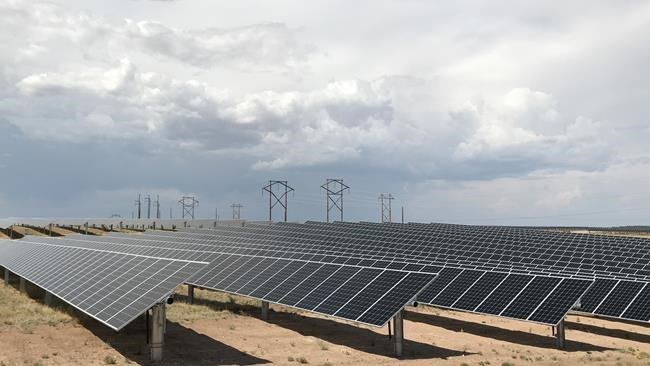
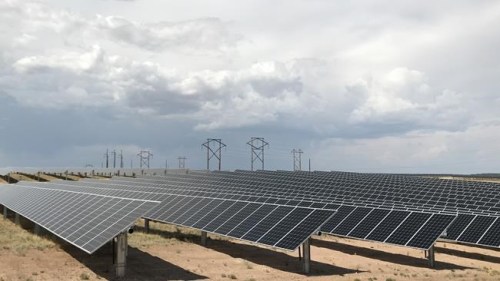
FILE - This June 15, 2021 photo shows a Public Service Co. of New Mexico solar farm west of Rio Rancho, N.M. The utility in sun-drenched New Mexico is struggling to get enough solar-generated electricity as it prepares to shut down a coal-fired power plant amid supply chain disruptions, one of the problems threatening to delay or cancel projects around the world amid pressure to reduce carbon emissions and tackle climate change. Public Service Co. of New Mexico initially proposed replacing the lost capacity with a mix of natural gas, solar and battery storage. The Public Regulation Commission instead opted for solar and storage to make up some of the difference after environmentalists pushed back on gas. (AP Photo/Susan Montoya Bryan, File)

Public Service Co. of New Mexico initially proposed replacing the lost capacity with a mix of natural gas, solar and battery storage. The Public Regulation Commission instead opted for solar and storage to make up some of the difference after environmentalists pushed back on gas.

But utility executives have acknowledged bumps in the renewable energy road, citing a perfect storm of regulatory challenges, lengthier periods of unseasonably hot weather that affect demand and the supply chain issues.

Soaring material and shipping costs are being felt across a wide range of industries. When it comes to worldwide utility-scale solar projects planned for 2022, analysts with the independent research company Rystad Energy predicted in the fall that 56% of projects risked delay or cancelation due to the factors.

In New Mexico, utility executives on Thursday submitted a plan to state regulators aimed at ensuring adequate supplies to avoid rolling blackouts during peak demands this summer. One unit of the coal-fired plant would keep running through September.

The utility says state regulators would need to sign off within weeks to have enough coal to feed the plant for an extra three months.

After that? The ability to fill the gap left by taking more around-the-clock generation offline before renewable sources are ready remains uncertain.

Even if inflation eases, the Washington, D.C.-based Solar Energy Industries Association has said longer term solutions are needed. That would include diversifying the supply chain by expanding domestic manufacturing.

The New Mexico utility also is on the hook for finding enough renewable power to replace what will be lost starting in 2023 and again in 2024 when its leases for electricity from the Palo Verde nuclear plant in Arizona expire. Regulators have approved more solar and storage in that case as well.

PNM President and CEO Pat Vincent-Collawn said in a statement to The Associated Press that the utility has a responsibility to balance reliability, cost and the environment.

“This solution may impact the timing of our plans to close the San Juan plant, but it does not change our direction and goals for delivering clean energy to New Mexicans, and it keeps our commitments to provide a financially backed just transition,” she said.

Bringing more renewable energy projects online fast is the immediate challenge in New Mexico and other states, including California, where officials who run the state’s main power grid have urged regulators to order utilities to significantly boost capacity over the next few years to ensure there’s enough electricity to meet demands.
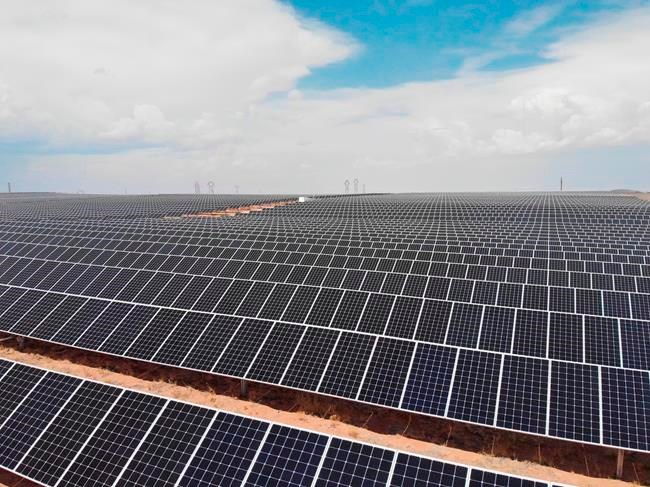
FILE - This June 15, 2021 photo shows a Public Service Co. of New Mexico solar farm west of Rio Rancho, N.M. The utility in sun-drenched New Mexico is struggling to get enough solar-generated electricity as it prepares to shut down a coal-fired power plant amid supply chain disruptions, one of the problems threatening to delay or cancel projects around the world amid pressure to reduce carbon emissions and tackle climate change. Public Service Co. of New Mexico initially proposed replacing the lost capacity with a mix of natural gas, solar and battery storage. The Public Regulation Commission instead opted for solar and storage to make up some of the difference after environmentalists pushed back on gas. (AP Photo/Susan Montoya Bryan, File)

Blackouts in August 2020 were the first in nearly 20 years because of an energy shortage, putting California’s quest to have 100% of its energy come from renewable sources under more scrutiny. The electrical grid has seen some storage and transmission upgrades since then, but officials were still forced to call for voluntary energy conservation last summer.

In New Mexico, concerns first were raised in 2021 when it became clear that developers working on the solar and battery projects meant to replace the San Juan plant were defaulting. PNM said it analyzed numerous options and spent months securing firm electricity supplies from other utilities to help meet summer demands.

The other key is the continued operation of one unit at San Juan. Utility executives say the one-time temporary extension will keep the system reliable and helps control customer costs.

Without that option, PNM would have a negative 3.4% reserve margin. The historical reserve margin is 13%.

Having a healthy reserve is more important now with demands fluctuating amid extreme weather from climate change, the utility said.

Environmentalists also are acknowledging that keeping San Juan running through September may be necessary, but they stressed that the long-term solution needs to be ending the state’s reliance on coal and gas plants and passing more legislation to address climate change.

Tom Fallgren, PNM vice president of generation, said New Mexico’s energy transition law adopted in 2019 made for good policy and provided a clear direction for the state. However, he said reliability and cost issues arise when people try to push too fast.

“That has the opportunity to derail the whole path to carbon-free,” he said. “Our caution when that bill was passed was ‘Yes, we’re all moving in the same direction, but let’s do it responsibly so we all stay moving in the same direction.’ And again, that voice has not been heard.”


Report Error Submit a Tip

More Stories

CEO, philanthropist Doug Harvey has died

Morgan Modjeski 5 minute read Preview

CEO, philanthropist Doug Harvey has died

Morgan Modjeski 5 minute read Updated: Yesterday at 6:48 PM CDT

Doug Harvey, a Winnipeg business titan and philanthropist, has died after battling cancer for more than a decade.

Harvey gave millions of dollars to Winnipeg organizations while he was CEO of DLH Group, a nationwide network of businesses that support heavy duty truck and trailer users.

Loren Remillard, CEO and president of the Winnipeg Chamber of Commerce, said the business community is mourning the loss of the influential businessman who helped shape Winnipeg.

“We are a transportation and logistics hub in Winnipeg and it was partly the result of geography, and a big part because of leaders and visionaries like Doug Harvey,” he said.

Read
Updated: Yesterday at 6:48 PM CDT

Rain causing poor harvest conditions for farmers

Connor McDowell 5 minute read Preview

Rain causing poor harvest conditions for farmers

Connor McDowell 5 minute read 2:00 AM CDT

BRANDON — Farmers are dealing with poor harvest conditions owing to the high amount of rain this month.

Brandon had received 74.7 millimetres of rain by Sept. 15, a spokesperson for Environment and Climate Change Canada said Wednesday. The amount is equal to 173 per cent of average rainfall for Brandon.

The wet conditions are causing crop loss and delays in harvesting, several Westman farmers said this week.

“At this point, it (could be) six figures of loss. And that all happens in days,” Cassandra Lepp, a Rivers-area wheat and canola farmer, said. “We have good crops out there, and they are disappearing.”

Read
2:00 AM CDT

A distant island and a European border

Editorial 4 minute read Preview

A distant island and a European border

Editorial 4 minute read 2:00 AM CDT

It’s at roughly 80°49′35″ North latitude and 66°27′30″West longitude.

Or, you might also know it as being in the Kennedy Channel of the Nares Strait in the high Arctic.

It’s Hans Island, an island that’s split between the Kingdom of Denmark and Canada.

The border was a bone of contention between the two nations for years, but not one that sired threats of annexation. Each simply claimed it as their own.

Read
2:00 AM CDT

Gas turbine peaker plants are a mistake

Don Scott 7 minute read 2:00 AM CDT

Technology respecting electricity generation, storage and grid management is rapidly advancing and displacing gas-fired peaker plants. New battery storage systems are more efficient and less costly, smooth grid flow and are non-polluting. Texas, California and Australia are replacing gas turbine peaker plants with more effective storage batteries.

Solar and wind energy generation combined with battery storage at both the grid and home/business level is the most efficient way to meet peak demand. Building expensive, outdated, polluting American gas turbines, as Manitoba Hydro is proposing, is not in Manitoba’s interest.

Premier Wab Kinew noted that a final decision to build a new turbine power plant in Brandon has not been made. I hope he’s correct, for if Manitoba Hydro already made the decision and entered binding financial obligations with GE Vernova, the PUB’s role was superfluous.

In 2025/26 Nova Scotia Power installed 3 x 50 MW Lithium-ion grid batteries with the storage capacity of over 600 MWh. Installed by Kitchener/Waterloo based Canadian Solar’s subsidiary e-Storage who have operations around the world, they accomplished this in less than two years from the approval date in June 2024. Two were operational within 18 months, the third in 24. The cost was $237 million. At Nova Scotia’s cost per MW, a 750 MW battery peaker facility would cost Hydro $1.185 billion, just 40 per cent of the proposed $3 billion gas peaker plant.

City wants short-term rental unit property owners to report all emergency-service responses

Joyanne Pursaga 5 minute read Preview

City wants short-term rental unit property owners to report all emergency-service responses

Joyanne Pursaga 5 minute read Tuesday, Sep. 15, 2026

New rules could require the owners of short-term rental units, such as Airbnbs and VRBOs, to tell the city every time an emergency responder is called to their properties.

Read
Tuesday, Sep. 15, 2026

Solar project delays create hurdles for New Mexico utility

Susan Montoya Bryan, The Associated Press 6 minute read Preview

Solar project delays create hurdles for New Mexico utility

Susan Montoya Bryan, The Associated Press 6 minute read Thursday, Feb. 17, 2022

ALBUQUERQUE, N.M. (AP) — A utility in sun-drenched New Mexico is struggling to get enough solar-generated electricity as it prepares to shut down a coal-fired power plant amid supply chain disruptions, one of the problems threatening to delay or cancel projects around the world as pressure mounts to reduce carbon emissions and tackle climate change.

New Mexico law requires publicly owned utilities and cooperatives to roll into their portfolios more renewable sources and eliminate carbon emissions over the next two decades.

As part of that push, the San Juan Generating Station — a coal-fired power plant that has produced electricity for millions of customers in the Southwest for decades — was slated to close in June.

Public Service Co. of New Mexico initially proposed replacing the lost capacity with a mix of natural gas, solar and battery storage. The Public Regulation Commission instead opted for solar and storage to make up some of the difference after environmentalists pushed back on gas.

Read
Thursday, Feb. 17, 2022