‘Nation-building’ investments in electricity grid needed to reach net-zero: Experts

Advertisement

Advertise with us

CALGARY - A price tag in the tens or hundreds of billions of dollars, and a project scope akin to that of the construction of the Canadian Pacific Railway in the 1800s.

Read this article for free:


By clicking the button above, an account will be created and you will begin to receive some of our recommended newsletters. You may opt out of any newsletter by visiting your Email and Communication Preferences page or by clicking "unsubscribe" at the bottom of any email.

or

Already have an account? Log in here »

To continue reading, please subscribe:

Digital Subscription

One year of digital access for only $1.44 a week*

  • Enjoy unlimited reading on winnipegfreepress.com
  • Read the E-Edition, our digital replica newspaper
  • Access News Break, our award-winning app
  • Play interactive puzzles

*Billed as $5.77 plus GST every four weeks. After 52 weeks, price increases to the regular rate of $19.95 plus GST every four weeks. Offer available to new and qualified returning subscribers only. Cancel any time.

To continue reading, please subscribe:

Add Free Press access to your Brandon Sun subscription for only an additional

$1 for the first 4 weeks*

  • Enjoy unlimited reading on winnipegfreepress.com
  • Read the E-Edition, our digital replica newspaper
  • Access News Break, our award-winning app
  • Play interactive puzzles
Start now

*Your next Brandon Sun subscription payment will increase by $1.00 and you will be charged $17.95 plus GST for four weeks. After four weeks, your payment will increase to $24.95 plus GST every four weeks.

Hey there, time traveller!
This article was published 05/04/2022 (1661 days ago), so information in it may no longer be current.

CALGARY – A price tag in the tens or hundreds of billions of dollars, and a project scope akin to that of the construction of the Canadian Pacific Railway in the 1800s.

That’s the scale of the massive investment in Canada’s electricity grid that experts say will be required in the near future, as the phase-out of fossil fuel-fired power generation combined with a rapid increase in demand for electricity puts never-before-seen demands on this country’s electrical grid.

“The general consensus is that we will need to double or triple the size of our electricity system between now and 2050,” said Bruce Lourie, chair of the non-profit advisory organization The Transition Accelerator.
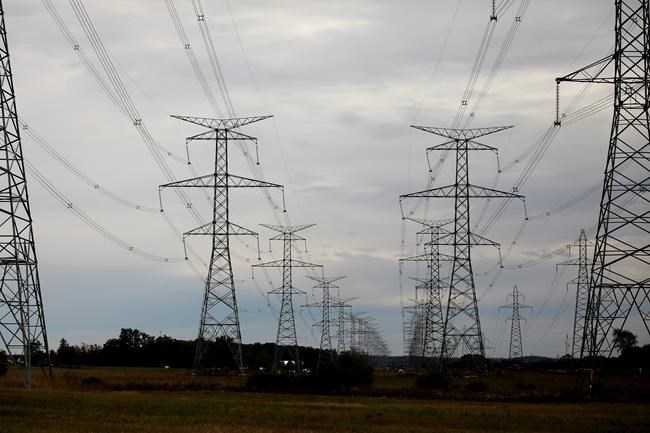
Hydro One electricity transmission lines are seen south of Chesley, Ont., on Sunday, Sept. 29, 2019. The federal government's own emissions reduction plan released last week says Canada will need to invest in
Hydro One electricity transmission lines are seen south of Chesley, Ont., on Sunday, Sept. 29, 2019. The federal government's own emissions reduction plan released last week says Canada will need to invest in "nation-building" interprovincial transmission lines if it is to have a shot at meeting its climate target of cutting emissions by 40 per cent below 2005 levels by 2030, and net-zero emissions by 2050. THE CANADIAN PRESS/Colin Perkel

“I don’t think Canadians … are recognizing or prepared for how monumental a task this is ahead of us.”

The federal government, in its emissions reduction plan released last week, describes the need for “nation building” interprovincial transmission lines if Canada is to have a shot at meeting its climate target of cutting emissions by 40 per cent below 2005 levels by 2030, and net-zero emissions by 2050.

Canada already has one of the cleanest electricity grids in the world, with over 80 per cent produced by non-emitting sources. But in order to slow the pace of climate change, electrifying more activities — everything from vehicles to heating and cooling buildings to various industrial processes — will be required. And not only will the country need more electricity, but more of it will need to come from non-emitting sources.

One way to do that would be to build new transmission lines that could move renewable power from jurisdictions like Quebec, Manitoba, and British Columbia — which have vast supplies of clean hydropower — to jurisdictions like Alberta, New Brunswick, Nova Scotia, and Saskatchewan, which are all still reliant on fossil fuels for electricity generation.

But it’s not a straightforward task. In Canada, electricity falls under provincial jurisdiction, and each province’s system has developed independently from the rest. Alberta, for example, has a fully deregulated electricity market, while electricity in neighbouring B.C. is produced and sold by a Crown corporation.

“The provinces, Crown corporations, and electric utilities would all have to agree on this,” Lourie said. “At the end of the day, politicians are going to have to sit down and sort this stuff out.”

The federal government has already pledged $25 million to help proponents begin developing regional net-zero electricity interties. Ottawa has said it wants to “lead engagement” across Atlantic Canada for the proposed Atlantic Loop initiative, which is intended to connect Nova Scotia and New Brunswick with clean hydropower from Quebec and Newfoundland.

But a great deal more work will be required to make the Atlantic Loop, or any other regional intertie project, a reality. Not only are new transmission lines expensive (Lourie estimates creating a true east-west system of regional interties across Canada could cost upwards of $100 billion), they tend to be controversial — often attracting pushback from local residents and other interest groups.

Recently, for example, voters in Maine rejected a planned $1-billion U.S. transmission line that was to carry electricity through their state from Hydro-Québec’s network to Massachusetts.

“It’s a fairly narrow group of people who don’t want a power line running through their state, but what it means is we’re going to have greater costs and more difficulty getting to our climate targets because of these campaigns,” Lourie said.

Binnu Jeyakumar, director of clean energy for the environmental think tank The Pembina Institute, said Canada’s political leaders must start working to build support for these types of projects now.

“Transmission projects, we look at them as about a decade long time frame. And we definitely don’t have that kind of time frame. We need solutions right away,” she said.

But Jeyakumar said it is possible for change to happen quickly, if governments send the right market signals. She pointed to what has happened in Alberta, which is expected to be off of coal-fired electricity entirely next year after the provincial government committed in 2015 to a phase-out of coal power by 2030.

She said the federal government’s promised Clean Electricity Standard, which aims to support a net-zero electricity grid by 2035, will send another clear signal to investors and will incentivize spending on grid upgrades and intertie projects.

“What this is going to do is put in regulatory carrots and sticks to make sure the grid decarbonizes,” Jeyakumar said. “This is how policy can be really impactful.”

While electricity infrastructure may not be as headline-grabbing as a shiny new Tesla or a cutting-edge solar farm, Jeyakumar said other efforts at decarbonization will fail if we don’t build a grid that can support them.

“It’s one of those basic building blocks that needs to be changed so we can see those types of solar projects and electric vehicles on the road,” she said.

This report by The Canadian Press was first published April 5, 2022.

Report Error Submit a Tip

More Stories

Jets out of tune against Blues

Ken Wiebe 7 minute read Preview

Jets out of tune against Blues

Ken Wiebe 7 minute read Updated: Yesterday at 8:29 AM CDT

ST. LOUIS – The issue is no longer limited to secondary scoring for the Winnipeg Jets.

Although they continue to be far too reliant on the top line for production, the Jets have suddenly been limited to not enough goals in a more general sense.

The latest example was a 2-1 loss Tuesday to the St. Louis Blues at Enterprise Center.

The Jets battled hard in this Central Division duel, but they’ve scored 24 goals in nine games (2.67 goals per game) and have one victory during the past five games after a 3-0-1 start. One of those losses did come in overtime (1-3-1).

Read
Updated: Yesterday at 8:29 AM CDT

You’re facing double trouble with infatuation

Maureen Scurfield 4 minute read Yesterday at 2:00 AM CDT

DEAR MISS LONELYHEARTS: I started enjoying the company of women in my running group so much that I ran more and more, and dropped 35 pounds over the summer and early fall. And in the summer I became attracted to a bisexual woman in the group.

At first, we claimed we were “doing OK” with the men we married. But now, feelings of all kinds are accelerating between us.

I must say I’ve suspected my husband has had another woman in recent years, but now it doesn’t bother me the same way. I finally understand wanting two people at one time. I tell myself I’m not “cheating” on anybody — because I’m not cheating on my husband with another man. But that’s not even fooling me, anymore. I’m feeling a lot more emotion for my female love interest.

So now what? I don’t want to disrupt my whole family, so should I keep it a secret for everyone’s sake? I must say the female object of my affection isn’t thinking of leaving her husband and family. I could be wrong, but I suspect she’s just having a fun time experimenting.

Limited visibility, radio communication among safety issues cited in mid-air collision

Chris Kitching 5 minute read Preview

Limited visibility, radio communication among safety issues cited in mid-air collision

Chris Kitching 5 minute read Updated: Yesterday at 5:47 PM CDT

An investigative report into a mid-air plane crash that killed two student pilots in southeastern Manitoba cited concerns about radio communication, situational awareness and visual detection methods.

Two small planes collided twice and crashed into a field after one aircraft ended up flying above the other while both approached a runway at Steinbach South Airport the morning of July 8, 2025, a Transportation Safety Board report said Wednesday. The planes belonged to the Harv’s Air Service flight school.

“Once they’re on final (approach), the ability to see each other would have been very limited,” said Eric Vermette, a TSB regional manager in Winnipeg.


Read
Updated: Yesterday at 5:47 PM CDT

Researchers: lights at Henderson crossing ‘long overdue’

Maggie Macintosh 6 minute read Preview

Researchers: lights at Henderson crossing ‘long overdue’

Maggie Macintosh 6 minute read 2:00 AM CDT

Six months after a fatal collision at a crosswalk on Henderson Highway, two traffic safety researchers question why the intersection remains an outlier that is missing key flashing lights.

The City of Winnipeg is being urged to install “backflashers” to better protect road users moving in all directions at the intersection where a 32-year-old father died in the spring.

“It’s these little, mundane, non-sexy engineering problems that can cause everything right up to fatality,” said Curt Pankratz, an associate professor at the University of Winnipeg who studies traffic engineering and policymaking.

On April 19, shortly before sunrise, Gabe Beardy was struck when he was crossing the six-lane thoroughfare at Neil Avenue.

Read
2:00 AM CDT

Winnipeg-shot biopic as daring as its subject

Randall King 4 minute read Preview

Winnipeg-shot biopic as daring as its subject

Randall King 4 minute read 2:01 AM CDT

Simultaneously huge in its biographical breadth and intimate in its scale, Patrick Wang’s film A. Rimbaud is a portrait of the 19th-century poet Arthur Rimbaud, a grand, 175-minute biopic that eschews the genre’s convention with the adventurous spirit Rimbaud applied to the written word.

For example, while we follow Rimbaud travelling the globe, the film was shot entirely on a Winnipeg soundstage.

Also, Rimbaud (portrayed by charismatic Australian actor Blake Draper) is always alone on camera. The voices of other characters are filled in by a series of musical instruments, inevitably recalling how the same technique was employed by Bill Melendez in Peanuts cartoons, wherein adult voices were portrayed by a muted trombone.

The film ended up being shot in Winnipeg thanks largely to producer Evan Johnson, a filmmaker in his own right with shared directing credits on various films with his brother Galen Johnson and Guy Maddin, including The Green Fog (2017) and Rumours (2024).

Read
2:01 AM CDT

Living a lie takes a toll on whole family

Maureen Scurfield 5 minute read 2:00 AM CDT

DEAR MISS LONELYHEARTS: My wife is no longer my life partner! To my mind, she’s just the mother of my children. She still lives with us and does the major part of the child care.

This summer she discovered I had a girlfriend, but she didn’t want to “break up our family,” as I earn a lot of money. Now she’s treating me like garbage. She’s pleasant to the kids and our cleaning help, but she doesn’t speak much to me, and is disposed to giving me lists for groceries and medication pickups via email, so I pay for almost everything.

The kids seem fine so far, because we haven’t broken up our family and we haven’t changed how we treat each other in front of them. We’re polite and we never fight.

Then just last weekend, my wife finally let me know she’d recently met someone she’s “seeing privately.” It’s a guy we both know from a sports activity the kids enjoy. That just makes me sick — and is upsetting me far more than breaking up.