Supreme Court decision may slow transition to cleaner energy

Advertisement

Advertise with us

NEW YORK (AP) — The Supreme Court ruling limiting the Environmental Protection Agency’s authority to regulate greenhouse gas emissions from power plants could have far-reaching consequences for the energy sector — and make it harder for the Biden administration to meet its goal of having the U.S. power grid run on clean energy by 2035.

Read this article for free:


or

Already have an account? Log in here »

To continue reading, please subscribe:

Subscribe and receive a limited-edition Free Press branded hat or tote.

Digital Subscription

One year of digital access for only $205*

  • Enjoy unlimited reading on winnipegfreepress.com
  • Read the E-Edition, our digital replica newspaper
  • Access News Break, our award-winning app
  • Play interactive puzzles

*First annual payment billed as $205.00 + GST for one year. This annual subscription will automatically renew at $233.00 + GST every 52 weeks (10% off the regular annual price of $259.35). Offer available to new and qualified returning subscribers only. Cancel any time.

To continue reading, please subscribe:

Add Free Press access to your Brandon Sun subscription for only an additional

$1 for the first 4 weeks*

  • Enjoy unlimited reading on winnipegfreepress.com
  • Read the E-Edition, our digital replica newspaper
  • Access News Break, our award-winning app
  • Play interactive puzzles
Start now

*Your next Brandon Sun subscription payment will increase by $1.00 and you will be charged $17.95 plus GST for four weeks. After four weeks, your payment will increase to $24.95 plus GST every four weeks.

Hey there, time traveller!
This article was published 30/06/2022 (1557 days ago), so information in it may no longer be current.

NEW YORK (AP) — The Supreme Court ruling limiting the Environmental Protection Agency’s authority to regulate greenhouse gas emissions from power plants could have far-reaching consequences for the energy sector — and make it harder for the Biden administration to meet its goal of having the U.S. power grid run on clean energy by 2035.

The nation has been gradually transitioning away from coal to cleaner sources of electricity such as natural gas, solar energy and wind, often because they are less expensive. Most experts don’t think the Supreme Court decision in West Virginia vs. EPA will immediately reverse that trajectory.

But the ruling could slow the transition to clean energy in the future because it imposes constraints on what the EPA can do without exceeding its legal authority. That is a frightening prospect, with climate experts warning of dire consequences as global temperatures and extreme weather conditions steadily rise.
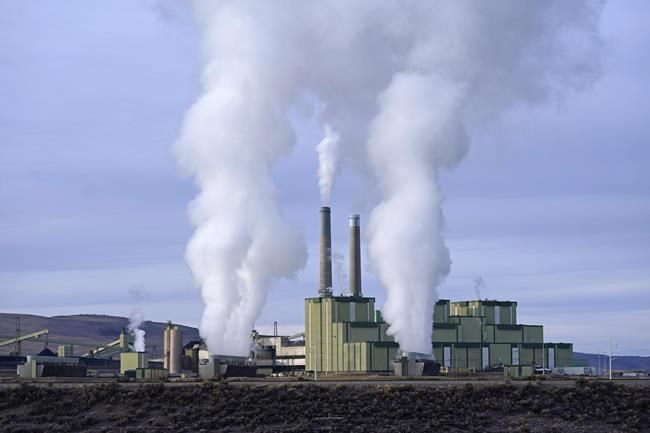
FILE - Steam billows from a coal-fired power plant Nov. 18, 2021, in Craig, Colo. The Supreme Court on Thursday, June 30, 2022, limited how the nation’s main anti-air pollution law can be used to reduce carbon dioxide emissions from power plants. By a 6-3 vote, with conservatives in the majority, the court said that the Clean Air Act does not give the Environmental Protection Agency broad authority to regulate greenhouse gas emissions from power plants that contribute to global warming. (AP Photo/Rick Bowmer, File)

Depending how Congress or the courts interpret the court’s ruling in the future, it could also change the way other agencies can regulate the power sector.

The ruling will also set a tone in policymaking chambers, making it harder to persuade state lawmakers to craft laws to boost renewables, said Sachu Constantine, executive director of Vote Solar, which advocates for laws favorable to solar energy in state legislatures.

“Without the threat of EPA or federal regulation of climate, without a recognition that carbon pollution is really, truly harmful, it becomes harder to make that argument,” Constantine said. “It makes it less likely that the risk or the cost of carbon will be directly felt by the utilities, or by other agencies who have control over how much solar we can deploy. And that loss of regulatory risk means they might be less likely to choose solar.”

The case that the Supreme Court took up, West Virginia vs. EPA, had been filed in response to former President Barack Obama’s Clean Power Plan. The Obama plan would have required states to reduce emissions from electricity generation, primarily by shifting away from coal-fired plants. That prospect upset several industries, including coal, and some state attorneys general. They challenged how far the EPA could go to influence the industry’s transition away from coal and to cleaner sources.

“It was sort of a scary prospect that EPA had the authority to close down power plants and build others,” said Jeff Holmstead, a partner at Bracewell LLP who served as an assistant EPA administrator in the George W. Bush administration. “All the major industry groups opposed that approach because of what they saw as a regulatory overreach. Power companies may still feel the same way, but in the meantime, they’ve invested a lot of resources to try to decarbonize.”

When Congress writes laws, it often leaves implementation details up to regulators such as the EPA. In this case, energy industry officials argued that the EPA had gone too far and overstepped what Congress had intended. The challenge in the West Virginia case sought to diminish that authority. It succeeded.

Thursday’s ruling means the EPA cannot force states to shift away from coal to cleaner sources such as natural gas or renewables and compel coal plants shut down. One option that’s now off the table as a result of the ruling is for the EPA to create a nationwide cap-and-trade system, said Richard Revesz, law professor at New York University. Under that system, a limit is set on how much carbon dioxide can be emitted, and companies can trade with each other to reach those goals.

“What the court is ruling out are the most effective and cheapest ways of regulating the power sector,” Revesz said.

Nothing in the ruling would stop Congress from creating a cap-and-trade system, but “under the current gridlock and given the filibuster rules in the Senate, it’s not going to happen,” he said.

Still, Revesz said, the EPA does have authority to regulate emissions from power plants in other ways.

And while the Clean Power Plan never took effect, the nation has been pivoting from coal to cleaner sources such as renewables anyway, often for economic reasons. Many states and large companies have commitments to use clean energy in the near future.

“Those commitments are driven by shareholders, by the economics of carbon reduction options,” said Sue Tierney, a senior advisor at Analysis Group and expert on power markets. “Multiple states have carbon reduction commitments, and large electricity users like very large corporations are saying we want 100% clean way earlier than 2050 … so there’s a whole lot of other forces going on besides EPA regulations at the moment that are driving things in a certain direction.”

Most major electric utilities have aggressive net-zero goals and commitments to phase out coal plants.

“Those aren’t fast enough for some advocates, but it’s not clear how much faster you can go unless you build the infrastructure to replace them,” Holmstead said.

The National Rural Electric Cooperative Association, a trade association of local electric cooperatives, applauded Thursday’s ruling.

“Coal, natural gas and nuclear plants — those are all dispatchable, always-available resources and at the same time, we’re taking those offline,” said the association’s CEO, Jim Matheson. “In terms of the overall generating capacity in this country, I think it creates greater risk for reliability.”

That doesn’t mean power companies will re-open shut-down coal plants. Doing so would be far more complicated than flipping a switch and turning power back on.

Meeting aggressive carbon reduction goals in the power sector will require work from agencies such as the Federal Energy Regulatory Commission, which plays a key role in approving the infrastructure that’s needed to transition to a power sector with fewer emissions. The Supreme Court’s ruling could affect how much authority FERC has to, for example, regulate pipeline emissions or approve locations for transmission lines or facilities, experts said.

“This is less about what’s going to happen about power plants than what’s going to happen about regulation more broadly,” Tierney said.

___

Associated Press Writers Mark Sherman and Matthew Daly in Washington contributed to this report.

Report Error Submit a Tip

More Stories

Winnipeggers witness unveiling of Japanese Canadian monument in B.C.

Morgan Modjeski 6 minute read Preview

Winnipeggers witness unveiling of Japanese Canadian monument in B.C.

Morgan Modjeski 6 minute read Yesterday at 8:39 PM CDT

As Miki Stewart gathered with her family at the Japanese Cultural Association of Manitoba on Saturday afternoon, she was thinking of her parents, Yoshimaru and Yoshi Abe.

Both Stewart, 80, and her sister Yumi Falk, 81, alongside an older brother, were born in the Tashme internment camp in British Columbia. They were among more than 2,600 Japanese Canadians who were forcefully removed and interred at the camp following the bombing of Pearl Harbour and Canada’s declaration of war on Japan in 1941.

“They didn’t talk much about how they suffered,” Stewart said of her parents. “But they did.”

She was amongst a group of more than 150 people who gathered at the association’s McPhillips headquarters on Saturday afternoon to watch the unveiling of the Japanese Canadian Monument in Victoria B.C.

Read
Yesterday at 8:39 PM CDT

Mayoral candidate Vogiatzakis criticized for living outside Winnipeg

Malak Abas 4 minute read Preview

Mayoral candidate Vogiatzakis criticized for living outside Winnipeg

Malak Abas 4 minute read Friday, Oct. 2, 2026

A mayoral hopeful took heat from other candidates Friday for living outside Winnipeg while running in the civic election.

Mike Vogiatzakis’s primary residence is in the Rural Municipality of St. Andrews, about 25 kilometres north of Winnipeg — a community with its own mayor and councillors.

But the funeral director said he owns a home in Winnipeg where he divides his time, and he would move to the city full-time if elected mayor.

“It doesn’t matter where a person lives. Why are we dividing St. Andrews and Manitoba and Winnipeg? I’ve met the criteria to run for mayor,” Vogiatzakis said Friday morning.

Read
Friday, Oct. 2, 2026

Brandonmeat packer thriving on its own

Abiola Odutola 3 minute read Preview

Brandonmeat packer thriving on its own

Abiola Odutola 3 minute read Yesterday at 2:01 AM CDT

BRANDON — Canada Packers has strengthened its business and laid the foundation for future growth during its first year as an independent company, its president says.

The Brandon-based pork producer, separated from Maple Leaf Foods in October 2025, established its own leadership, strategy, systems, culture and identity while continuing operations across its hog production farms and regional hog barns in southern and eastern Manitoba.

The company’s first year was focused on building a successful standalone business while continuing to serve customers, communities and shareholders, president Dennis Organ said.

“Market conditions over the past year have been more challenging than we anticipated when we became a separate entity,” he said in an email. “Despite that, we continued to execute against our priorities, including increasing processing volumes, maintaining disciplined operations and strengthening the business.”

Read
Yesterday at 2:01 AM CDT

Volunteer pop-up library axed from Manitoba Youth Centre

Matthew Frank 4 minute read Preview

Volunteer pop-up library axed from Manitoba Youth Centre

Matthew Frank 4 minute read Updated: Yesterday at 11:25 AM CDT

Manitoba Corrections has cancelled a pop-up library program at the Manitoba Youth Centre, leaving inmates without librarian services and fewer options to borrow certain books.

The Prison Libraries Committee, part of the non-profit Manitoba Library Association, operated and funded the volunteer program since 2024 before it was shut down by the province last month. The group previously partnered with the province to offer the service because the facility has no dedicated library of its own.

“It is concerning that community members who are incarcerated, especially youth, are losing out on meaningful programming, access to information and rehabilitation efforts, which are offered at no cost to (Manitoba) Corrections. We urge Manitoba Justice to promote more library services and programming, not less,” said a Sept. 24 letter from the non-profit addressed to the justice minister.

Ashley Huot, chair of the Prison Libraries Committee, said she was puzzled when she received an email last month from Manitoba Corrections stating that the pop-up library was no longer needed.

Read
Updated: Yesterday at 11:25 AM CDT

Morning-show veteran swaps microphone for macchiatos at new Corydon café

David Sanderson 9 minute read Preview

Morning-show veteran swaps microphone for macchiatos at new Corydon café

David Sanderson 9 minute read Yesterday at 2:00 AM CDT

Good news if you were used to having your morning coffee with Terri Gale, who earlier this summer signed off from CTV Your Morning, after 15 years on the job.

Gale, the three-hour program’s longtime weather expert, and her husband Rob Gale, the ex-head soccer coach of Valour FC and co-founder of the Northern Super League’s new Winnipeg franchise, are the owners of Golden Hour Café and Bar at 775 Corydon Ave.

Gale (formerly Apostle) nods when she is asked who would know more about caffeinated beverages than a person who, for the last decade and a half, set her alarm to go off in the wee small hours.

“I do love coffee and take mine black. Except because I hate burning my tongue — not a good thing when you speak for a living — I got into the habit of throwing a couple of ice cubes in my cup, to be on the safe side,” Gale says, seated on the second level of their attractive, 2,100-square-foot premises, which officially opened in mid-September.

Read
Yesterday at 2:00 AM CDT

May be whiff of truth to ex’s odour ardour

Maureen Scurfield 5 minute read Yesterday at 2:01 AM CDT

DEAR MISS LONELYHEARTS: I ran into an old boyfriend I used to curl on a team with, and we went for drinks. We’ve been almost eight years apart, and I couldn’t remember why we broke up, as we always had such a great time together.

It wasn’t until the second date — this time on a weekend — that it came back to me, with a jolt. Pee-yew! I remembered he doesn’t use deodorant on weekends. Why? He enjoys his own body odour. I recalled that a bit too late, and it was just as awful as ever! I went home early.

Tonight, he called and I refused him another date. I said, “Think back. You remember why we broke up?” Then he said, “Oh yeah, you hated my no-deodorant weekend policy. Well, guess what? Some women don’t mind!” I said I really doubted that, and that ended the conversation. Miss L., wouldn’t any women find stinky underarms offensive?

— Sensitive Nose, Fort Richmond