Montana site fouled by copper smelter to get final cleanup

Advertisement

Advertise with us

BILLINGS, Mont. (AP) — A subsidiary of London-based oil giant BP agreed to finish its cleanup of a 300-square mile (776-square kilometer) site in Montana that's contaminated with arsenic and other pollutants from decades of copper smelting, and to repay the U.S. government $48 million in response costs.

Read this article for free:


or

Already have an account? Log in here »

To continue reading, please subscribe:

Subscribe and receive a limited-edition Free Press branded hat or tote.

Digital Subscription

One year of digital access for only $205*

  • Enjoy unlimited reading on winnipegfreepress.com
  • Read the E-Edition, our digital replica newspaper
  • Access News Break, our award-winning app
  • Play interactive puzzles

*First annual payment billed as $205.00 + GST for one year. This annual subscription will automatically renew at $233.00 + GST every 52 weeks (10% off the regular annual price of $259.35). Offer available to new and qualified returning subscribers only. Cancel any time.

To continue reading, please subscribe:

Add Free Press access to your Brandon Sun subscription for only an additional

$1 for the first 4 weeks*

  • Enjoy unlimited reading on winnipegfreepress.com
  • Read the E-Edition, our digital replica newspaper
  • Access News Break, our award-winning app
  • Play interactive puzzles
Start now

*Your next Brandon Sun subscription payment will increase by $1.00 and you will be charged $17.95 plus GST for four weeks. After four weeks, your payment will increase to $24.95 plus GST every four weeks.

Hey there, time traveller!
This article was published 30/09/2022 (1465 days ago), so information in it may no longer be current.

BILLINGS, Mont. (AP) — A subsidiary of London-based oil giant BP agreed to finish its cleanup of a 300-square mile (776-square kilometer) site in Montana that’s contaminated with arsenic and other pollutants from decades of copper smelting, and to repay the U.S. government $48 million in response costs.

Under a legal decree filed Friday in U.S. District Court, the Atlantic Richfield Company committed to finishing cleanup work in residential yards in the towns of Anaconda and Opportunity. It also will clean up soils in the surrounding hills and address the remaining piles of contaminated waste at the site.

Arsenic and toxic metals spewed from a 585-foot-tall smokestack in Anaconda for nearly a century and the pollution settled into the ground for miles around. It’s the toxic legacy of southwestern Montana’s mining days, when copper ore processed in Anaconda was used to electrify the United States.
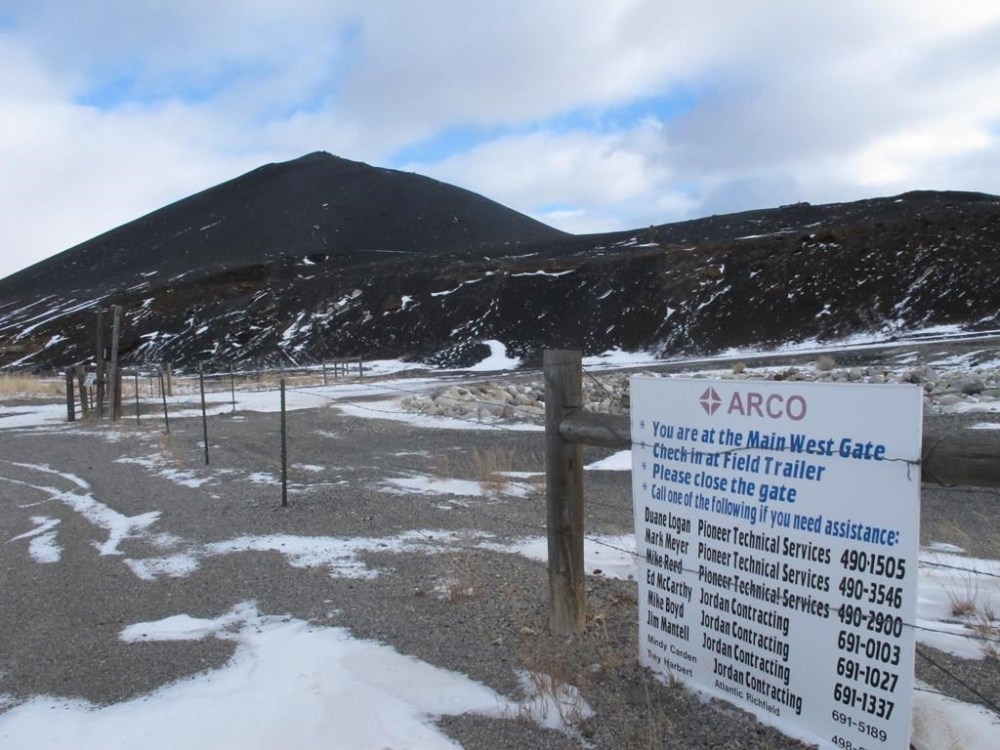
A slag pile of mining waste is seen in Anaconda, Mont., on Dec. 15, 2016. A subsidiary of London-based oil giant BP has agreed to finish its cleanup of a 300-square mile site in Montana that's contaminated with arsenic from decades of copper smelting and repay the U.S government $48 million for its work at the Anaconda Smelter Superfund Site. (AP Photo/Matt Volz, File)

Opportunity resident and former smelter worker Serge Myers, 77, said any additional cleanup work done under Friday’s agreement would be beneficial. But he remained disappointed the remediation plan being used won’t clean residential yards unless they contain more than 250 parts per million of arsenic — a level that Myers and other residents have said is arbitrary and still unsafe.

“There’s hot spots in some areas. Everybody knows that. I wish things had turned out differently where we really had more cleanup work than we had done,” said Myers, who worked at the smelter for 17 years.

The “Copper King” Marcus Daly and the Anaconda Copper Mining Co. began smelting copper ore from Butte in 1884. In 1977, ARCO purchased the Anaconda Co. and inherited vast lands polluted with arsenic, lead, copper, cadmium and zinc from ore-processing operations and stack emissions. Later, under the federal Superfund law, ARCO became retroactively liable for that contamination.

Three years after Atlantic Richfield shut down the Anaconda smelter in 1980, the U.S. Environmental Protection Agency designated it as a Superfund site because of the risk to human health and the environment. The major concern was high concentrations of arsenic in the soil and water, a contaminant that can cause cancer and a range of other diseases.

Myers and others worried about health problems from the pollution had long complained that the EPA had botched the cleanup. A tentative deal to finish the work was first announced more than four years ago.

In 2020, the U.S. Supreme Court blocked an effort by homeowners near the smelter to do cleanup work without permission from the EPA. The homeowners wanted to force Atlantic Richfield to pay for the removal of more arsenic-tainted soil beyond what the EPA had ordered.

Atlantic Richfield previously said it had spent $470 million to clean the site under multiple federal orders. The remaining work is estimated to cost $83.1 million.

Montana U.S. Attorney Jesse Laslovich, who was born in Anaconda, said the towering smokestack at the site remains a symbol both of the hard work that built the community and contamination that lingered too long.

“Our water will be cleaner, our soils will be purer, our slag will be covered, and our future will be brighter because of this historic agreement,” Laslovich said in a statement.

The smokestack is now a state park that nobody can visit because of the pollution.

In 2021, Atlantic Richfield quietly settled a civil lawsuit filed in 2008 by 98 people in Opportunity and the community of Crackerville. They wanted restoration damages to pay for a more thorough cleanup than what was planned by ARCO under the federal Superfund law. Details of that agreement were not disclosed.

Friday’s agreement must be approved by a federal judge and also is subject to a 30-day public comment period. It was signed by representatives of Atlantic Richfield, the EPA, the U.S. Justice Department and Montana Gov. Greg Gianforte.

John Davis, a lawyer who has represented ARCO, did not immediately respond to a request for comment about the agreement, nor did representatives of BP.

Report Error Submit a Tip

More Stories

J’accuse!: Kinew uses French to fry interim Tory leader over alleged caucus subterfuge

Chris Kitching and Maggie Macintosh 4 minute read Preview

J’accuse!: Kinew uses French to fry interim Tory leader over alleged caucus subterfuge

Chris Kitching and Maggie Macintosh 4 minute read Thursday, Oct. 1, 2026

NDP Premier Wab Kinew took a dig at the Progressive Conservatives’ leadership change while facing off with Obby Khan’s short-term replacement for the first time in question period Thursday.

Read
Thursday, Oct. 1, 2026

Letters, Oct. 3

7 minute read 2:01 AM CDT

A morning in the life …

My very first lesson does not start when I walk into that lecture hall, oh no — it starts long before. It begins when I walk to my car, check the estimated arrival time to the University of Manitoba and hope that Winnipeg traffic agrees with it.

A drive that appears completely manageable changes almost immediately when I’m greeted by a tsunami of orange pylons and a line of cars that appears to go on forever. Traffic moves by the inch, lanes magically disappear and the detour I took yesterday now has a detour of its own. These factors make me do a calculation that I have become all too familiar with. How late can I arrive and still find parking, run to my class across campus and get to class with enough time left to make it worth it?

I have grown used to people saying, “Why not just leave earlier?” I do. But when I’m already leaving for my 8:30 a.m. class at 7 a.m., there’s only so much I can do. This drive that some would think is relaxing is one that feels like an assignment that I didn’t know I had to complete and is due at 8:30 a.m.

Health minister warns $1.2 billion in annual federal funding set to expire in March

Scott Billeck 4 minute read Preview

Health minister warns $1.2 billion in annual federal funding set to expire in March

Scott Billeck 4 minute read Thursday, Oct. 1, 2026

Manitoba’s health minister is warning of possible cuts to health care with $1.2 billion in annual funding from Ottawa set to expire next year.

“We’re very concerned that what would be the largest cut to health care in a generation is right in front of us,” Health Minister Uzoma Asagwara said Thursday at the Manitoba legislature. “It means that services that Manitobans depend on will be in jeopardy and be at risk.

“Any reductions, any cuts from Canada, will have direct impacts on the health outcomes of Manitobans.”

Asagwara, who serves as the provincial and territorial health minister lead, chaired a virtual meeting Tuesday with provincial and territorial health ministers to discuss federal funding for health care, mental health care and substance use services, which is scheduled to expire March 31, 2027.

Read
Thursday, Oct. 1, 2026

Mayoral candidate Vogiatzakis criticized for living outside Winnipeg

Malak Abas 4 minute read Preview

Mayoral candidate Vogiatzakis criticized for living outside Winnipeg

Malak Abas 4 minute read Updated: Yesterday at 6:03 PM CDT

A mayoral hopeful took heat from other candidates Friday for living outside Winnipeg while running in the civic election.

Mike Vogiatzakis’s primary residence is in the Rural Municipality of St. Andrews, about 25 kilometres north of Winnipeg — a community with its own mayor and councillors.

But the funeral director said he owns a home in Winnipeg where he divides his time, and he would move to the city full-time if elected mayor.

“It doesn’t matter where a person lives. Why are we dividing St. Andrews and Manitoba and Winnipeg? I’ve met the criteria to run for mayor,” Vogiatzakis said Friday morning.

Read
Updated: Yesterday at 6:03 PM CDT

Creative powerhouse Perry Rosemond never lost Winnipeg roots

Ben Waldman 7 minute read Preview

Creative powerhouse Perry Rosemond never lost Winnipeg roots

Ben Waldman 7 minute read 6:00 AM CDT

He created King of Kensington, directed the troops in the Royal Canadian Air Farce, and his creative eye was behind the lens for television shows starring Johnny Cash, Tom Jones, Mr. Dress-Up and the Friendly Giant.

He also wrote and developed the Canadian version of Sesame Street during his time as the head of school and preschool programming for CBC in Toronto, and directed a televised special in 2002 for Winnipeg sketch comedy troupe Royal Liechtenstein Theatre Company.

But before his name featured in the credits of some of the most iconic and influential pieces of the Cancon canon, Perry Rosemond was an only child living in a crammed, multi-generational home in Winnipeg’s North End, racing each day to beat the morning bell next door at William Whyte School.

In memoirs that have yet to be published, the late television producer recalled his childhood. “(T)here were 14 of us in the house at 193 Andrews St., and it wasn’t that big of a house,” he writes.

Read
6:00 AM CDT

Clock ticks down on destruction of records documenting residential school abuses

Marsha McLeod 13 minute read Preview

Clock ticks down on destruction of records documenting residential school abuses

Marsha McLeod 13 minute read Yesterday at 12:49 PM CDT

In less than a year, a private company is set to destroy the largest cache of records detailing the widespread abuse of Indigenous children at residential schools in Canada.

The destruction, which was ordered by an Ontario court in 2014 and later upheld by the Supreme Court, is set to take place on Sept. 19, 2027.

This countdown is igniting emotional conversations that seek to balance the immense historical value of the records alongside the confidentiality survivors were promised as part of the process of providing detailed testimony about abuses they’d suffered.

The records were created as part of the Indian Residential Schools Settlement Agreement, a class-action settlement stemming from survivors who began suing the federal government in the late 1990s over the harm they’d been subjected to at residential schools.

Read
Yesterday at 12:49 PM CDT