Freeland’s mini-budget forecasts first surplus on the horizon, but warns of recession
Advertisement
Read this article for free:
or
Already have an account? Log in here »
To continue reading, please subscribe:

Digital Subscription
One year of digital access for only $205*
- Enjoy unlimited reading on winnipegfreepress.com
- Read the E-Edition, our digital replica newspaper
- Access News Break, our award-winning app
- Play interactive puzzles
*First annual payment billed as $205.00 + GST for one year. This annual subscription will automatically renew at $233.00 + GST every 52 weeks (10% off the regular annual price of $259.35). Offer available to new and qualified returning subscribers only. Cancel any time.
To continue reading, please subscribe:
Add Free Press access to your Brandon Sun subscription for only an additional
$1 for the first 4 weeks*
- Enjoy unlimited reading on winnipegfreepress.com
- Read the E-Edition, our digital replica newspaper
- Access News Break, our award-winning app
- Play interactive puzzles
*Your next Brandon Sun subscription payment will increase by $1.00 and you will be charged $17.95 plus GST for four weeks. After four weeks, your payment will increase to $24.95 plus GST every four weeks.
Read unlimited articles for free today:
or
Already have an account? Log in here »
Hey there, time traveller!
This article was published 03/11/2022 (1434 days ago), so information in it may no longer be current.
OTTAWA – A federal budgetary surplus is on the distant horizon for the first time since the Liberals came to power, but the rest of the fall fiscal update clouds that picture with the risk of recession and promises to spend a lot more to support Canada’s transition to a clean and green economy.
The Liberals would also need to fight another election before getting there.
The fall economic statement that Finance Minister Chrystia Freeland presented in the House of Commons on Thursday, alongside a bill to implement it, includes new measures to spur clean energy investment and help Canadians struggling to keep up with the rising cost of living.
Overall, the mini-budget proposes relatively modest new spending amid growing political pressure to demonstrate fiscal restraint after massive pandemic-era spending.
It also contains a more pessimistic alternative outlook and warnings that plans go awry.
The $30.6 billion promised over the years leading up to 2027-28 includes money set aside for three previously announced affordability measures: temporarily doubling the GST credit, topping up the housing benefit and a dental-care benefit meant as a stopgap on the way to a broader dental-care program baked into the agreement the Liberals made with the New Democrats.
The update was seized with matching clean energy investments and tax incentives made recently in the United States through its Inflation Reduction Act.
It also pledged some more affordability measures, such as permanently eliminating federal interest charges on student loans and revamping the Canada Workers Benefit so that people who qualified for it in the previous year can receive an advance instead of waiting to file their tax returns.
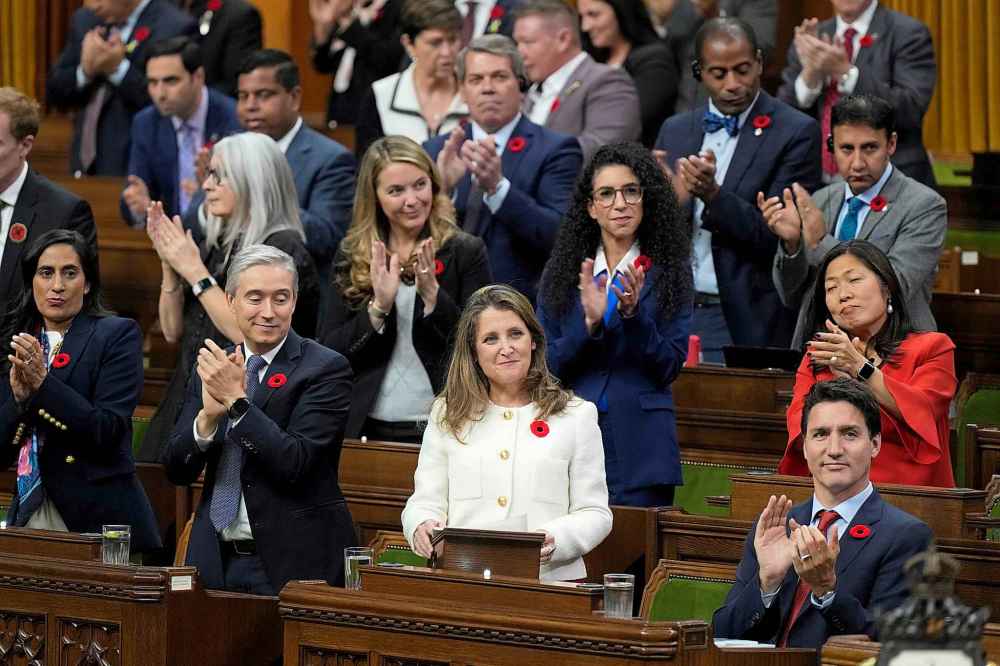
In her speech to the House of Commons on Thursday, Freeland reiterated the federal government’s commitment to stay out of the way of the central bank’s efforts to battle rapidly rising prices.
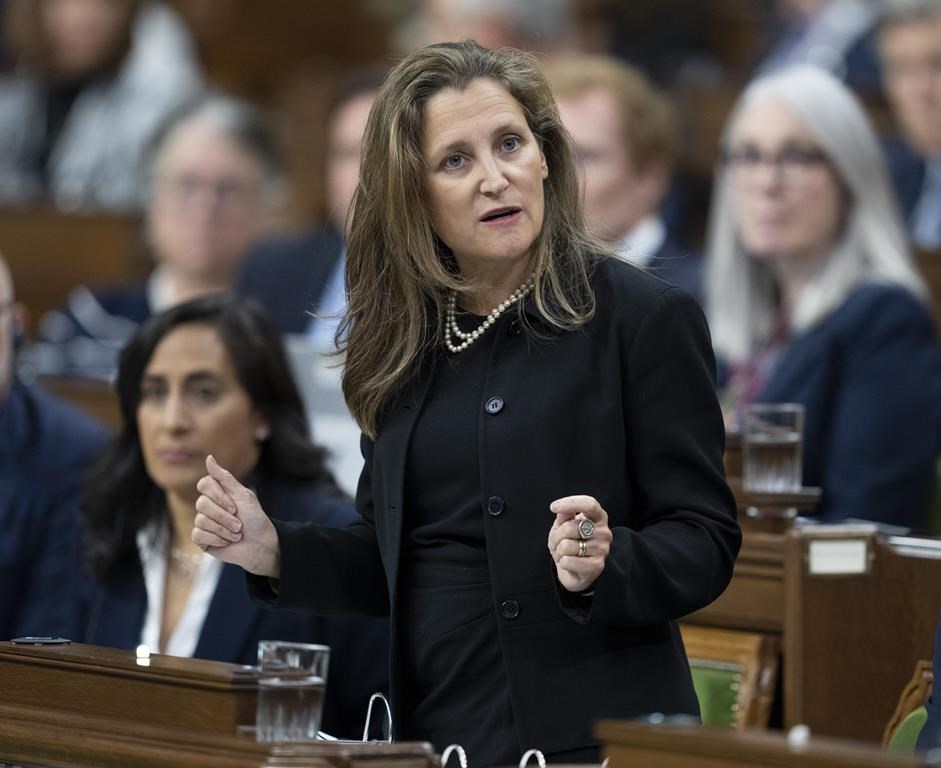
“As the Bank of Canada fights inflation, we will not make its job harder,” Freeland said in a copy of her speech provided in advance. “We are compassionate and we are also responsible.”
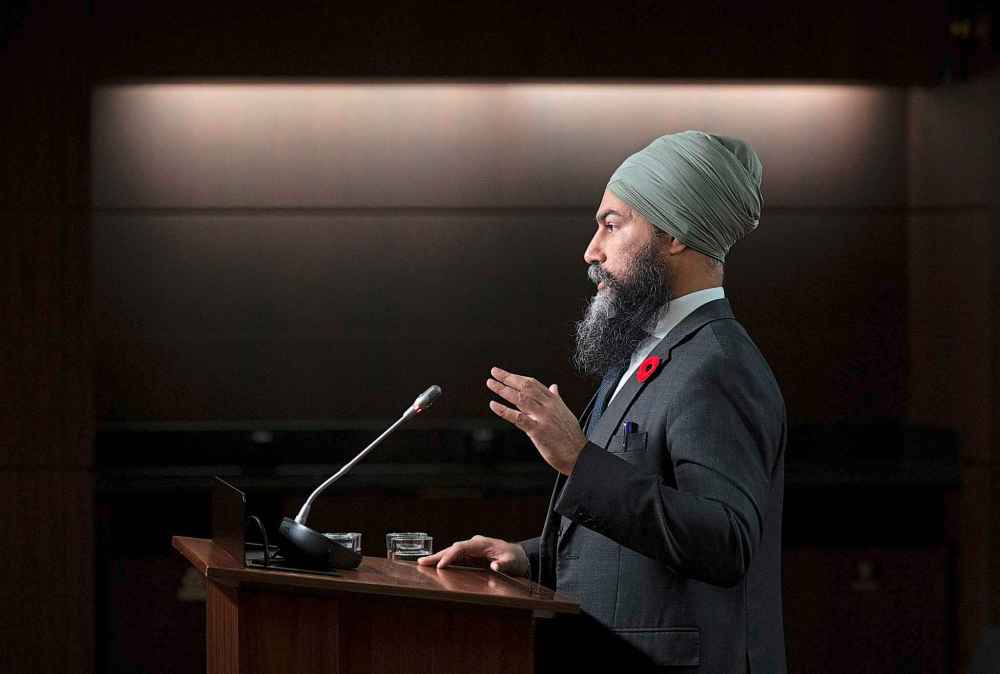
NDP Leader Jagmeet Singh said that while he believes the fiscal update falls short of the help needed by Canadians suffering under higher prices on essential goods, his caucus plans to support the Liberal minority government’s implementation bill.
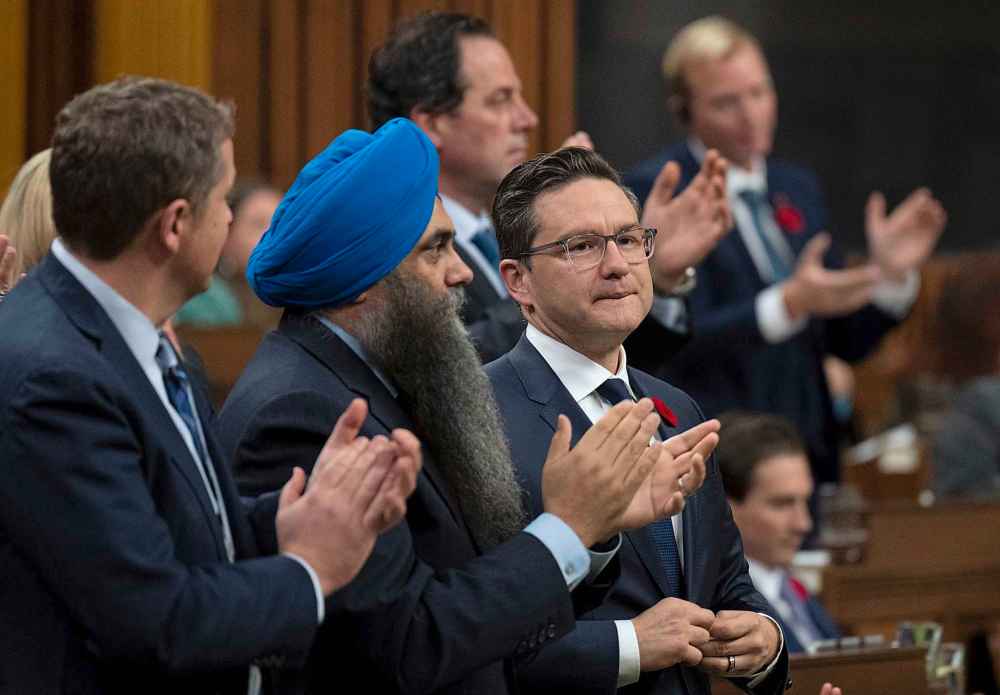
Opposition leader Pierre Poilievre panned the document, arguing it will fuel inflation.
“Conservatives will stand for the common people,” Poilievre said inside the House. “Their paycheques, their homes, their savings, and we will vote against this inflationary scheme.”
Scotiabank’s director of fiscal and provincial economics, Rebekah Young, said the new measures will not fan the flames of high inflation given much of the spending will not flow this year.
“What we see today isn’t itself going to drive inflation,” said Young.
Decades-high inflation has put pressure on the federal government to avoid fuelling inflation with additional spending as the Bank of Canada raises interest rates.
The Liberals are also proposing a two per cent tax on corporate stock buybacks in an effort to encourage companies to invest in their domestic operations and workers.
Freeland said the Liberal government felt that was the right policy to incentivize investment.
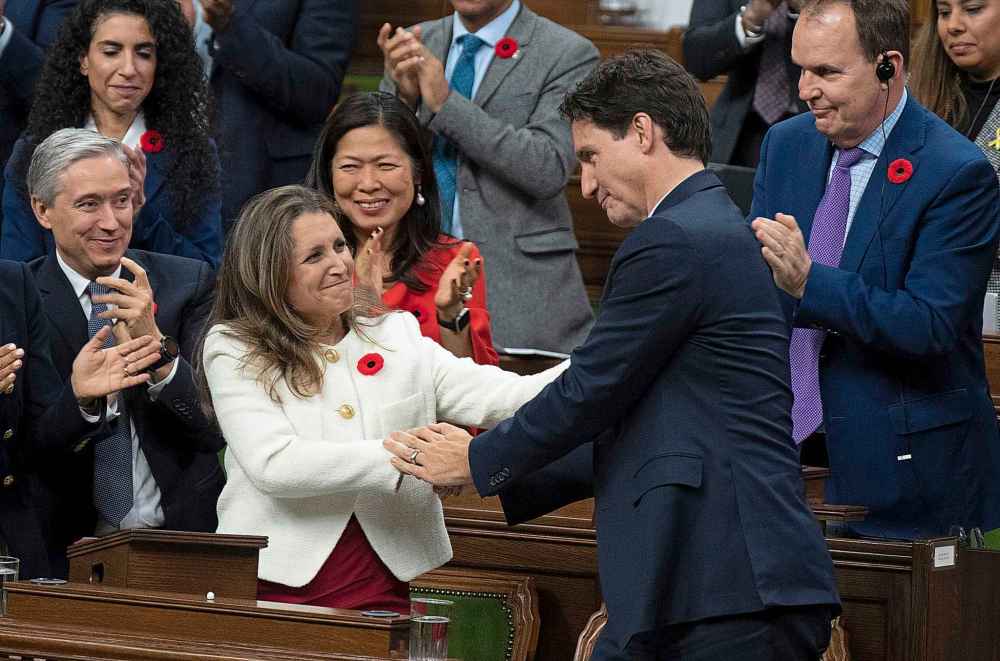
“We want to see big Canadian companies taking their profits and investing them in the productive capacity of Canada and investing them in their workers,” Freeland said during a news conference in Ottawa.
“That tax on share buybacks is designed to do precisely that.”
The fiscal update also commits another $1 billion in disaster relief this fiscal year to help with recovery efforts from the damage caused by post-tropical storm Fiona in Atlantic Canada and eastern Quebec.
As a growing number of economists forecast an impending recession, the budget update outlined multiple scenarios that may play out and based its outlook for the economy on the average of private economic forecasts.
The baseline scenariosuggests the Canadian economy will grow by 3.2 per cent in 2022, which is down from the April budget forecast of 3.9 per cent. It will be followed by significantly slower growth of 0.7 per cent in 2023, which the April budget forecast had put at 3.1 per cent.
The “downside scenario,” which considers high inflation rates sticking around for longer and prompting even tighter monetary policy, places Canada in a “mild recession” next fiscal year.
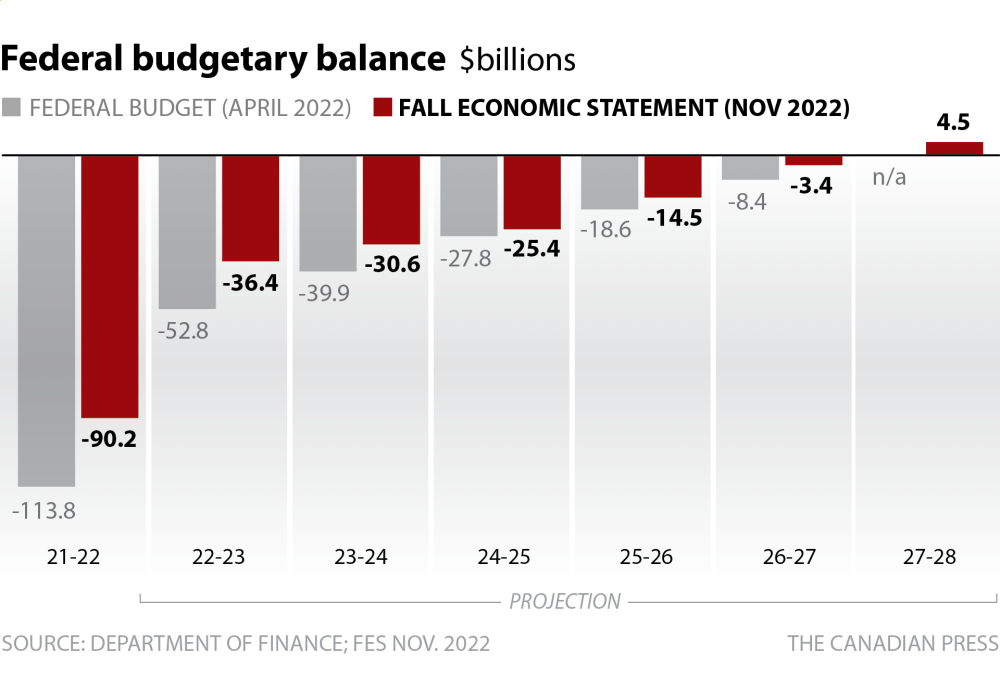
For the current fiscal year, the mid-year budget update is forecasting a $36.4-billion deficit, which is about $16 billion lower than anticipated in the spring budget thanks to high inflation and a strong economic recovery boosting government revenue.
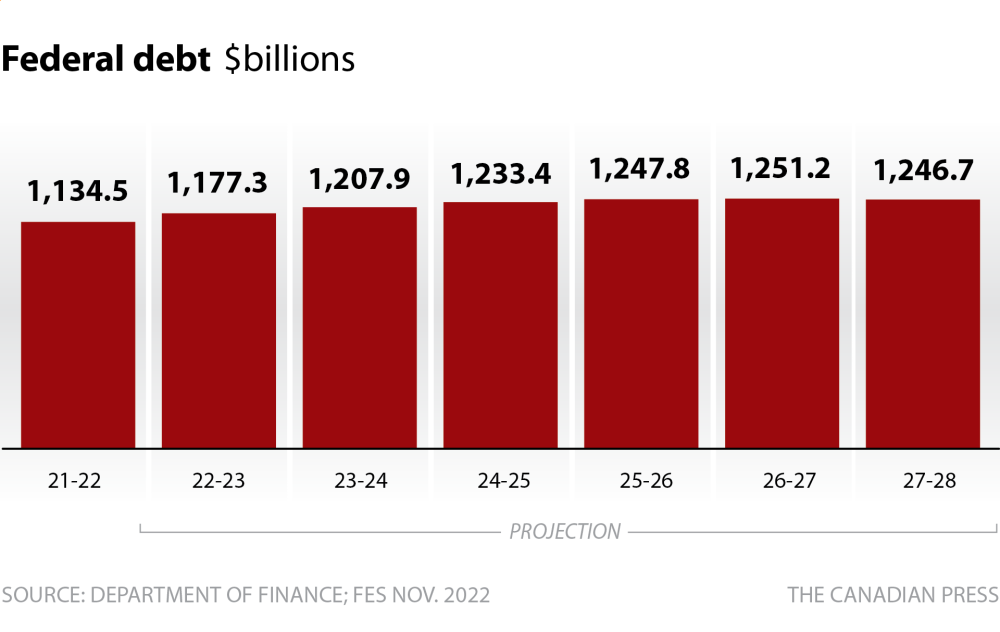
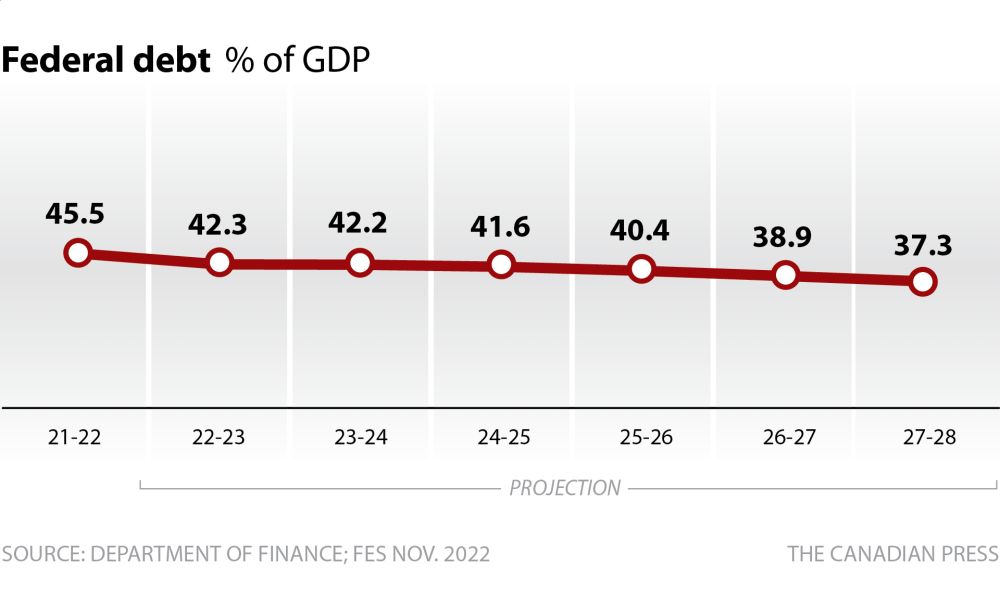
The fiscal update says the federal debt as a share of GDP is 42.3 per cent in fiscal 2022-23 and projected to steadily decline until reaching 37.3 per cent in fiscal 2027-28.
The federal government is forecasting a budget surplus of $4.5 billion during the 2027-28 fiscal year, although the more pessimistic scenario says that year will bring a deficit of $8.3 billion.
This marks the first time the Liberals have forecast a balanced budget since coming into power in 2015, preferring in previous documents to stress the declining debt-to-GDP ratio instead.
Prime Minister Justin Trudeau, when campaigning as Liberal leader that year, had promised to run just three years of “modest, short-term” deficits before balancing the budget in 2019.
Freeland acknowledged the significance of looking ahead to being back in black.
“It’s by design insofar as it is the result of our consistent and strong investments in Canadians and the Canadian economy,” Freeland told reporters. “In particular, I would say it is thanks to Canada’s remarkably strong recovery from the COVID recession.”
Getting there, however, may be challenging amid growing risks of a global recession, said Young.
The economist said the Canadian economy is heavily influenced by global economic forces, including central banks raising interest rates to clamp down on high inflation.
“These exogenous drivers could really sway how things look over the next year or two,” Young said.
The forecast also does not take into consideration future spending plans, adding another layer of risk around whether the federal government does indeed post a surplus.
The fiscal update suggests more investments in clean energy will be outlined in the coming spring budget.
This report by The Canadian Press was first published Nov. 3, 2022.
Five highlights from the Liberals’ fall economic update
Beyond the top-line debt projections and the analysis of how Canada seeks to soften the impact of a potential recession, the fiscal update offers key details that shed light on Liberal priorities. Here’s a look at five highlights.
Beyond the top-line debt projections and the analysis of how Canada seeks to soften the impact of a potential recession, the fiscal update offers key details that shed light on Liberal priorities. Here’s a look at five highlights.
Fiona relief
The Liberals are expecting to spend $1 billion in the current financial year toward provincial requests related to post-tropical storm Fiona, which savaged Atlantic Canada and eastern Quebec in late September.
That figure is on top of the $300 million over two years that the feds announced in early October in the wake of the devastating storm, and its month-long matching of donations to the Canadian Red Cross.
The new money is expected to cover requests from provinces under the Disaster Financial Assistance Arrangements, under which the federal government covers up to 90 per cent of eligible provincial expenses in the three months following a disaster.
Infrastructure funding
In last spring’s budget, the government promised $33.5 billion for public infrastructure projects across the country. The fall statement says $23 billion has been approved so far for 5,200 projects submitted by provinces and territories.
While territories have until March 2025 to allocate the money, the provincial deadline is March 2023 — otherwise the money will be reallocated.
Alberta and Manitoba only have one per cent of their funding envelopes left, representing $50.5 million and $13.6 million respectively. And though Ontario has used up all but four per cent, that still represents a significant amount of money at more than $450 million.
On the other end of the spectrum, Quebec is the biggest laggard, with 37 per cent of its envelope or $2.75 billion still available. The next-biggest amount is British Columbia’s $661 million, representing 17 per cent of its share.
Among the Atlantic provinces, Newfoundland and Labrador still has 38 per cent or $213 million; Nova Scotia has 31 per cent or $259 million; New Brunswick has 17 per cent or $113 million and Prince Edward Island has 16 per cent or $57 million.
Cryptocurrency consultations
The financial statement contains an announcement that consultations are launching right away — the same day as its release Thursday — on digital currencies “including cryptocurrencies, stablecoins and central bank digital currencies.”
Canada’s fiscal framework needs to keep pace with the rise of the currencies and how the digitization of money is “transforming financial systems in Canada and around the world,” the document says.
And the government is also seeking to understand the challenges digital currency poses to democratic institutions, with some types of crypto being used to avoid global sanctions and fund illegal activities.
The new consultations follow a legislative review announced in last spring’s budget. They also follow attacks on new Conservative Leader Pierre Poilievre for his suggestion during the Tory leadership campaign that cryptocurrencies could help Canadians “opt out” of inflation — an assertion that Liberals have ridiculed after the value of cryptocurrencies plummeted earlier this year.
In a separate process, the Bank of Canada has studied the potential for a central bank digital currency. It has said it doesn’t anticipate the need for it right now but wants to be prepared if that changes in the future.
Truckers’ rights
Individual truckers may have formed the genesis of the “Freedom Convoy” protest that descended on Ottawa last winter and prompted the Liberals’ use of emergency powers to clear protesters — a decision currently being scrutinized at a high-profile public inquiry.
But Liberals are signalling their support for the industry with their mini-budget, putting $26.3 million over five years toward orders, fines and prosecutions against non-compliant trucking industry employers.
The money seeks to address the ongoing issue of companies having truck drivers self-incorporate and operate as independent contractors instead of being classified as employees. This denies them labour rights including paid sick leave, health and safety standards and employment insurance and pension contributions, the document says.
The Canada Revenue Agency is also working to “encourage greater awareness” and “foster compliance” with tax rules that govern the use of incorporated employees, something the feds say they will elaborate on in next spring’s budget.
Immigration support
The fall statement unveils the amount of funding Liberals expect to put toward a new immigration strategy they unveiled earlier in the week.
On Tuesday, the government announced that it will seek to increase immigration to record levels, bringing in 500,000 arrivals in 2025. Liberals plan for the majority to be skilled workers who can help fill labour shortages in healthcare, manufacturing and the building trades.
Support for the processing of applications and settlement of new permanent residents will cost $1.6 billion over six years and $315 million in new, ongoing funding, the fall statement says.
With Liberals facing criticism for bottlenecks in Canada’s immigration process, another $50 million will go toward the immigration department in the current fiscal year “to address ongoing application backlogs, speed up processing and allow for skilled newcomers to fill critical labour gaps faster.”
-The Canadian Press
Related Articles
Fall budget update promises tax credits for clean electricity and hydrogen production

Advertisement Advertise With Us
Advertisement Advertise With Us